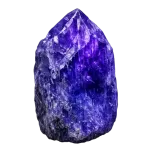
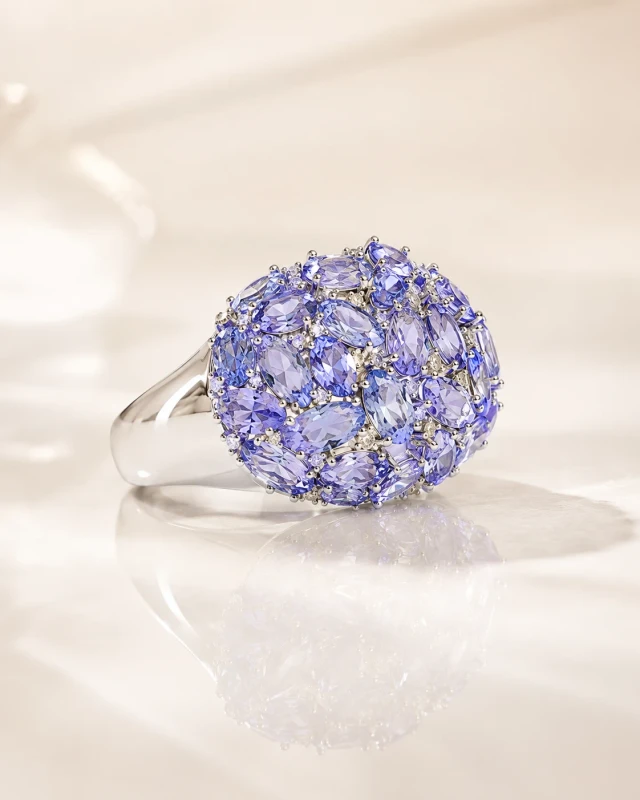
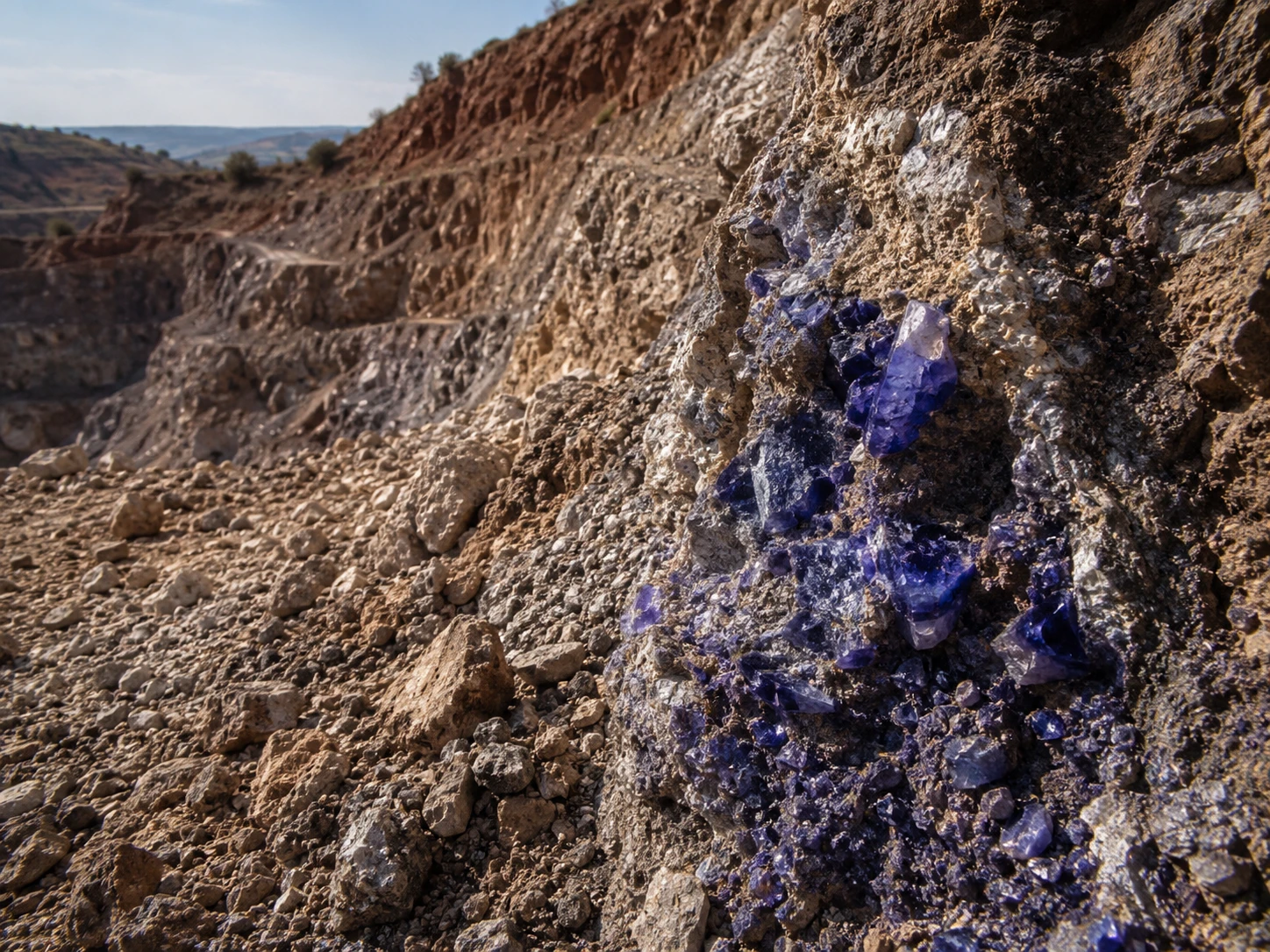



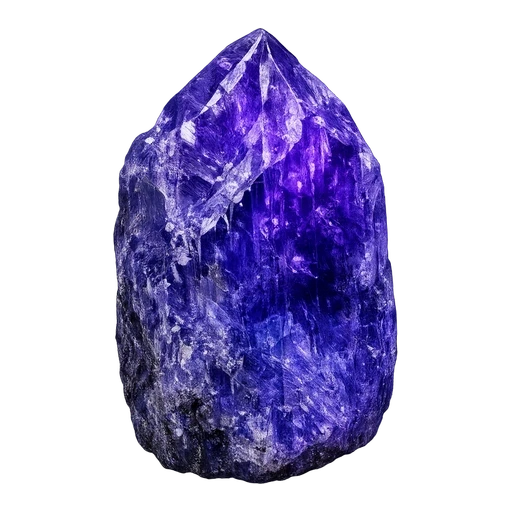
Tanzanite is the blue to violet variety of the mineral zoisite, found only in the Merelani hills of northern Tanzania and almost always heat treated to develop its colour. The words used to describe it come from three different places: mineralogy, which describes what the stone is; grading, which describes how it looks; and the trade, which describes how a seller wants it to sound. Knowing which vocabulary a word belongs to tells you how much weight to give it. For the stone itself in plain terms, start with what tanzanite is.
This glossary covers the terms that appear most often in tanzanite descriptions, grouped by where they come from.
The stone itself
Zoisite
The mineral species to which tanzanite belongs. Zoisite is a calcium aluminium silicate that occurs in many colours, and geology references list tanzanite among its varieties, alongside green, pink and other forms. The guide to tanzanite and the zoisite family covers its relatives.
Tanzanite
The trade and gem name for blue to violet zoisite. The name was chosen by Tiffany & Co, in honour of Tanzania, where it was first unearthed in 1967. It is a gem name rather than a separate mineral, which is why scientific descriptions say zoisite.
Merelani
The hills near Arusha in northern Tanzania that are tanzanite’s only known commercial source. Because there is one source, a stone’s identity as tanzanite effectively tells you its origin, a point explored in tanzanite origin determination.
Vanadium
The trace element responsible for tanzanite’s blue to violet colour. It is the same element that colours tsavorite garnet from the same region.
Optical properties
Trichroism
The property of showing three different colours along three different crystal directions. Pleochroic gems show different colours depending on the direction of viewing, and trichroic gems show three. In tanzanite these are blue, violet and a browner or yellowish tone. Trichroism is why orientation matters so much in cutting.
Pleochroism
The general term for showing different colours in different directions. Dichroic stones show two, trichroic stones three. Tanzanite is strongly trichroic, which makes it one of the most obvious examples among popular gems.
Orientation
The direction in which a cutter positions the rough crystal before cutting, deciding which of the trichroic colours faces up. Orientation largely decides whether a finished stone reads blue or violet, and it is described in how a tanzanite is cut and set.
Durability terms
Mohs hardness
A relative scale of scratch resistance, from talc at one to diamond at ten, on which each mineral scratches those below it. Tanzanite sits at 6 to 7, below quartz-rich dust at 7, which is why it scratches more easily than sapphire or diamond.
Cleavage
A tendency to split cleanly along certain planes in the crystal. Cleavage makes a stone vulnerable to splitting from a sharp blow. Zoisite has perfect cleavage in one direction, so tanzanite needs protection from hard knocks as well as from scratches.
Toughness
Resistance to breaking or chipping, as opposed to scratching. A stone can be fairly hard and still not very tough if it has cleavage, which describes tanzanite well.
Treatment terms
Heat treatment
The controlled heating of zoisite to develop or intensify its blue to violet colour. Almost all tanzanite is heat treated, typically at a few hundred degrees, and the result is stable and permanent. The guide to tanzanite heat treatment covers it in detail.
Untreated or unheated
A stone that has not been heated. Some naturally blue zoisite exists, but untreated tanzanite is uncommon, and a claim that a stone is unheated should be supported by a laboratory report.
Coated
A stone with a surface coating to improve colour. Coated tanzanite exists and is not the same as heated tanzanite; coatings can wear off, and they must be disclosed.
Size and weight terms
Carat
The unit of weight for gemstones, equal to two hundred milligrams. Carat measures weight, not size, so two stones of the same carat weight can look different in size if one is cut deeper than the other. For tanzanite, where colour deepens with size, weight and colour interact, as explained in carat versus colour.
Face-up size
How large a stone looks from above, usually given as length and width in millimetres. Face-up size is what people see when the stone is worn, which makes it more useful than carat weight when comparing stones of the same shape.
Calibrated
A stone cut to standard dimensions so that it fits ready-made settings. Calibrated stones are convenient and usually cost less to set; non-calibrated stones are cut to make the most of each crystal and may need a setting made to measure.
Melee
Very small stones, usually used as accents in clusters, halos and pavé. Tanzanite melee is sold by size and colour group rather than individually graded.
Cutting styles
Faceted
A stone cut with flat polished faces to return light, the usual form for tanzanite in jewellery. Faceting shows off brilliance and lets the cutter control orientation.
Cabochon
A stone shaped and polished into a smooth dome rather than faceted. Tanzanite cabochons are less common and usually made from material with more inclusions, which a smooth surface shows more gently than facets would.
Precision cut and native cut
A precision cut follows carefully calculated angles to maximise brightness, often at the cost of more weight lost from the rough. A native cut keeps more weight but may leave windows or dark areas. The difference shows as brightness: a precision-cut stone usually looks livelier face up.
Appearance terms
Colour shift
The way tanzanite’s colour appears to move between blue and violet under different lighting. In daylight and cool light the blue tends to dominate; under warm indoor light the violet comes forward. This is a consequence of trichroism and the light source, and it is a normal, attractive feature of the stone rather than a defect.
Bi-colour
A stone that shows two distinct colours across its face, for example blue at one end and violet or a greener tone at the other. Bi-colour tanzanite is occasionally cut deliberately as a curiosity; in a stone sold as evenly coloured, uneven colour is a grading weakness.
Cat’s-eye
A band of light that moves across the surface of a stone cut as a cabochon, caused by fine parallel inclusions. The effect is called chatoyancy. Cat’s-eye zoisite exists but is rare, and is a collector’s curiosity rather than a jewellery staple.
Inclusions
Tiny crystals, fluids or fractures inside a stone. Most commercial tanzanite is eye-clean, so inclusions visible without magnification count against a stone more than they would in a gem that is normally included.
Fracture and feather
A fracture is a break in the stone that does not follow a cleavage plane; a feather is a small fracture that looks like a fine white plume. Feathers near the girdle deserve attention in rings, since a knock can extend them.
Grading terms
| Term | What it describes | What good looks like |
|---|---|---|
| Hue | The basic colour, from blue to violet | A pleasing blue, violet or blend |
| Tone | How light or dark the colour is | Medium to medium-dark |
| Saturation | How strong or pure the colour is | Vivid, not greyish |
| Clarity | Visible inclusions | Eye-clean for most tanzanite |
| Window | A washed-out area where light passes straight through | Small or absent |
| Extinction | Dark areas in the face-up stone | Limited, not dominating |
| Brilliance | Light returned to the eye | Lively across the face |
Hue, tone and saturation
The three dimensions of colour. Hue is the colour itself, tone its lightness or darkness, saturation its strength. For tanzanite, the most prized stones usually combine a vivid saturation with a medium to medium-dark tone. The guide to how tanzanite is graded explains how these combine.
Window and extinction
A window is a pale, washed-out area in the centre of a stone where light leaks through the bottom instead of returning to the eye, usually from a shallow cut. Extinction is the opposite: dark areas that do not return light. Some extinction is normal and adds contrast; too much makes a stone look dull.
Eye-clean
A stone with no inclusions visible to the unaided eye at a normal viewing distance. Most tanzanite on the market is eye-clean, so visible inclusions weigh more heavily against a stone than they would in, for example, emerald.
Trade and marketing terms
| Trade term | Where it comes from | How to read it |
|---|---|---|
| AAA, AA, A | Seller grading scales | No universal standard; judge the stone itself |
| Block D | Trade name for a mining area | Origin within Merelani, not a quality grade on its own |
| Colour names (for example royal, velvet) | Marketing | Descriptive, not standardised |
| Investment grade | Marketing | Treat with caution; see price and value |
| Collector grade | Marketing | Often top colour, but no standard definition |
AAA and similar grades
Many sellers grade tanzanite with letters, AAA at the top. These scales are useful within one seller’s range, but there is no single standard behind them, so one seller’s AAA can be another’s AA. The letters say how a seller ranks its own stones, not how the stone compares across the market.
Matched pair
Two stones selected to agree closely in colour, tone, saturation, size and shape, for earrings or cufflinks. With a trichroic stone this is harder than it sounds, as the guide to matching a pair of tanzanites explains.
Cut and setting terms
Table, crown, pavilion and girdle
The table is the large flat facet on top; the crown is the upper part of the stone; the pavilion is the lower part; the girdle is the outer edge where crown meets pavilion. The girdle is where most chips occur, because it is the most exposed edge.
Bezel and claw (prong) settings
A bezel surrounds the stone with a rim of metal; a claw or prong setting holds it with several metal points. Bezels protect tanzanite better against knocks; claws let in more light.
Documents and paperwork
Laboratory report
A document from a gemmological laboratory identifying the stone and noting any detectable treatment. For tanzanite, a report confirms that the stone is zoisite and can describe colour. It is most worthwhile for larger or more valuable stones.
Valuation or appraisal
A document estimating a replacement value for insurance, or a market value for sale. A valuation is an opinion about price, while a laboratory report is a statement about identity, and the two answer different questions.
Disclosure
The seller’s statement of known treatments and relevant facts. For tanzanite, the minimum is that the stone is heat treated, as nearly all are; any coating or other treatment must also be stated.
Care terms
Ultrasonic and steam cleaning
Mechanical cleaning methods common in jewellery shops. Both are unsuitable for tanzanite: vibration can open cleavage and fractures, and sudden heat can crack the stone. Warm water, mild soap and a soft brush are the safe alternative, as described in the care guide.
Repolish
Polishing the surface of a cut stone again to remove scratches and restore crisp facet edges. It removes a small amount of material, so a repolished stone weighs slightly less than before, and it is the usual remedy for a tanzanite worn by years of contact.
Reset
Removing a stone from its setting and mounting it in a new one, often to replace worn claws or to move a stone into a more protective design. Because tanzanite dislikes heat, it is removed before any soldering on the mount.
Reading a description with the glossary
A good description uses the mineralogical and grading terms precisely and keeps marketing terms modest. It should state that the stone is tanzanite (zoisite), say whether it is heat treated, give its weight and dimensions, and describe colour in terms of hue, tone and saturation or with clear images in more than one light. A description that relies mainly on trade grades and colour names, with little of the rest, is giving you the seller’s opinion rather than the stone’s facts. The buying guide puts these checks in order.
When does a glossary not settle the question?
When the words are used loosely. A glossary defines terms, but it cannot make a seller use them precisely. Two sellers can both describe a stone as vivid violet-blue and mean quite different things, and no amount of vocabulary replaces seeing the stone, in daylight and in warm indoor light, beside another stone for comparison. Terms are also no substitute for identification: calling a stone tanzanite does not make it one, and a laboratory report answers that question when the price or the doubt is large enough to justify it. Use the glossary to read descriptions critically, and the stone itself to make the decision.
The short version
Tanzanite is blue to violet zoisite from Merelani, almost always heat treated, strongly trichroic, and at 6 to 7 on the Mohs scale with one direction of cleavage. Its grading vocabulary, hue, tone, saturation, clarity, window and extinction, describes how a stone looks. Trade terms such as AAA and colour names describe how a seller ranks its stones, and are worth less than the facts the other two vocabularies provide.
COMMON QUESTIONS
What is tanzanite made of?
Tanzanite is a variety of the mineral zoisite, a calcium aluminium silicate, coloured blue to violet by traces of vanadium. Its colour is almost always developed or intensified by heat treatment, which is stable and permanent.
What does AAA mean for tanzanite?
It is a trade grading term used by many sellers to signal top colour and clarity, but there is no single standard behind it, so one seller's AAA can differ from another's. Judge the stone by its actual hue, tone, saturation and clarity rather than by the letters.
What does trichroic mean?
It means the stone shows three different colours when viewed along different crystal directions. In tanzanite these are blue, violet and a browner or yellowish tone. The cutter's orientation decides which colour faces up.
What is the difference between tone and saturation?
Tone is how light or dark the colour is; saturation is how strong or pure it is. A stone can be dark but greyish, which is high tone and low saturation, or medium in tone and vivid, which is often the most attractive combination.
SOURCES
- Chatoyancy — Wikipedia The cat's-eye effect, a band of reflected light caused by parallel fibrous inclusions, shown in cabochon-cut stones.
- Carat (mass) — Wikipedia The metric carat as a unit of mass of 200 milligrams.
- Cabochon — Wikipedia A cabochon as a gemstone shaped and polished rather than faceted.
- Tanzanite — GIA Tanzanite named by Tiffany & Co, first unearthed in 1967, only source the Merelani hills, colour varying with viewing direction.
- Zoisite — Geology.com Zoisite chemistry, Mohs hardness 6.5, perfect cleavage in one direction, and the zoisite varieties including tanzanite.
- Gemstone Pleochroism — International Gem Society Pleochroism and trichroism defined.
- Tanzanite (Zoisite) Value, Price, and Jewelry Information — International Gem Society Heat treatment of almost all tanzanite, typically to around 500 to 600 degrees Celsius; Mohs 6 to 7.
- Cleavage and Parting in Gemstones — International Gem Society Cleavage defined as a tendency to split along planes.
- Mohs scale — Wikipedia The Mohs scale of mineral hardness as a relative scratch scale.