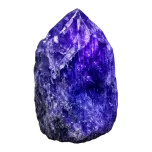
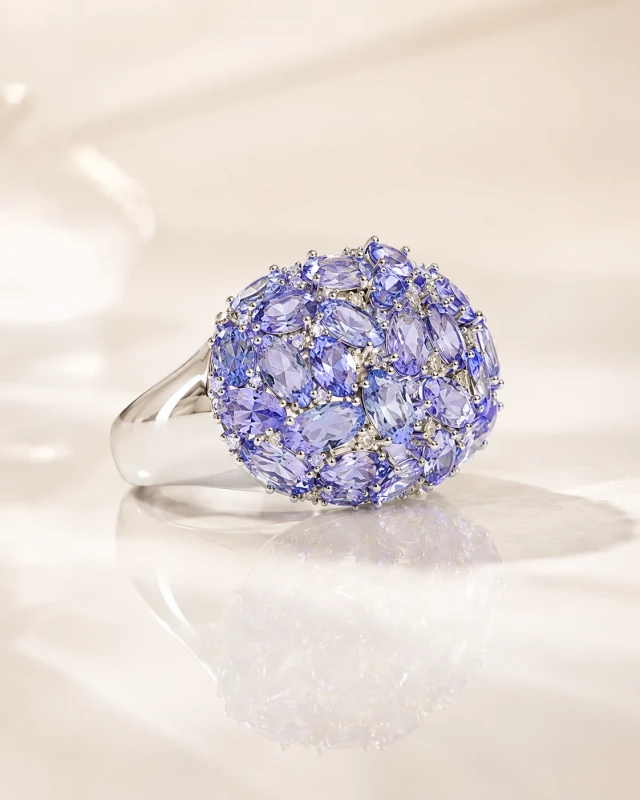
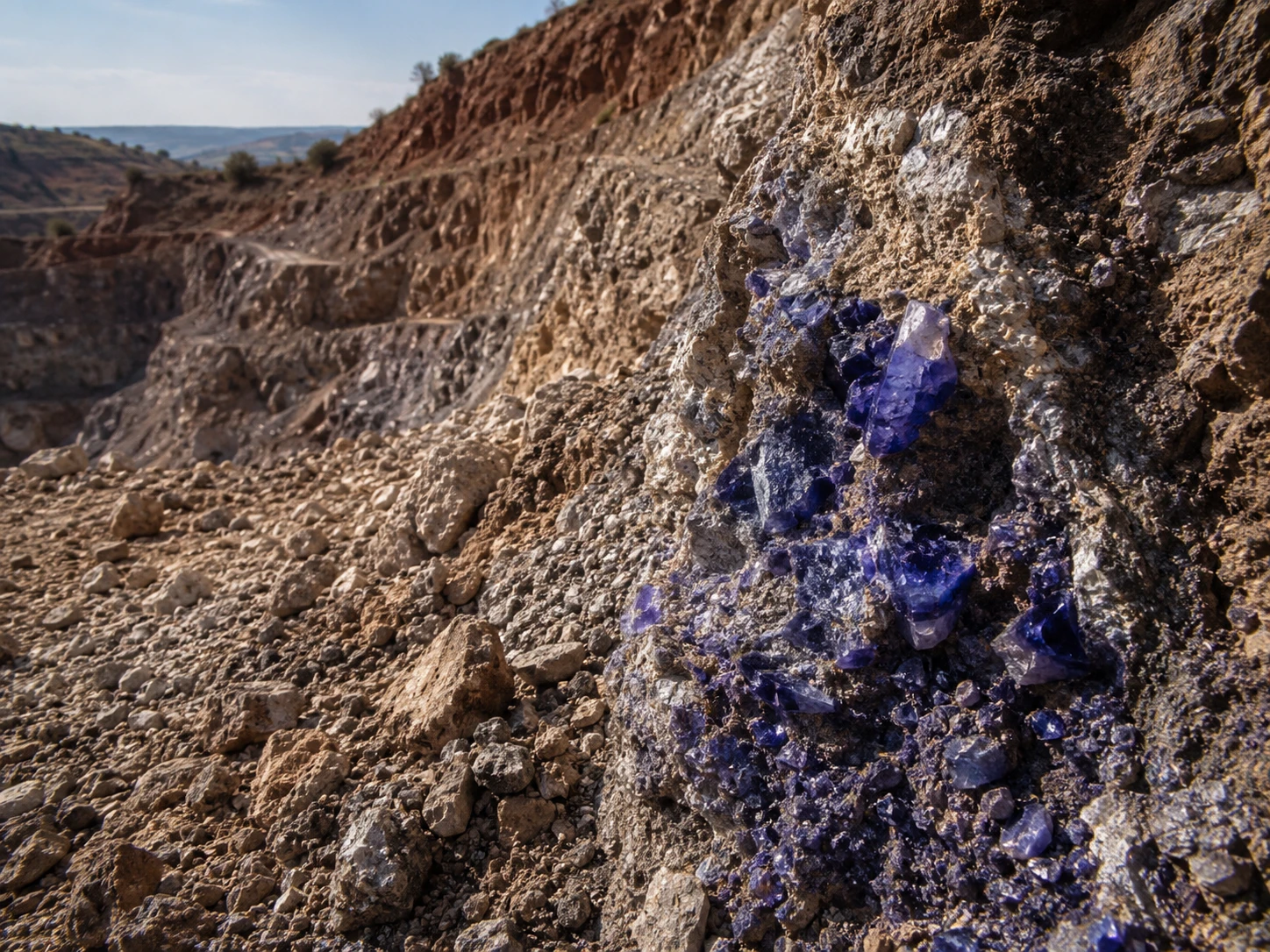

Tanzanite is geologically rarer than diamond and usually costs less. Both halves of that sentence are true, they do not contradict each other, and understanding why is worth more than any price comparison anybody can give you.
The questions people actually ask are whether tanzanite is more expensive than diamond, whether it is cheaper than sapphire, and which is rarer. The first two cannot be answered as asked. The third can, and the answer is less useful than it sounds.
The three stones, side by side
| Property | Tanzanite | Sapphire | Diamond |
|---|---|---|---|
| Mohs hardness | 6 to 7 | 9, second only to diamond among natural gems | 10 |
| Cleavage | Perfect, one direction | None | Perfect |
| Refractive index | 1.692 to 1.700 | 1.757 to 1.779 | Far higher |
| Specific gravity | 3.35 | 3.99 to 4.10 | Lower than sapphire |
| Sources | One area, northern Tanzania | Sri Lanka, Kashmir, Myanmar, Thailand, Australia, Montana | Many countries |
| Grading scale | None | No universal scale | A detailed shared one |
| Synthetics | Unknown to date | Common | Common |
Read the cleavage row against the hardness row and you have the single most useful fact in the table. Sapphire is the only one of the three with no cleavage at all, which makes it the most forgiving stone here despite diamond being harder.
Is tanzanite rarer than diamond?
Geologically, yes, and by a wide margin.
Every tanzanite on Earth comes from an area of about eight square miles in the Merelani Hills of northern Tanzania. Diamond is mined across many countries on several continents. As a statement about where the material occurs, tanzanite’s exclusivity is real and unusual, and it is one of the genuinely interesting things about the stone.
It also does not make it more expensive, and the reason is worth being precise about rather than waving at.
Rarity sets a price only when demand meets it. Diamond has a century of marketing, a universal grading language, a resale market, and a role in a near-universal social ritual. Tanzanite has sixty years, no grading scale, a thin secondary market, and no comparable ritual attached to it. Demand of that kind is what turns scarcity into price, and scarcity without it is just a fact about geology.
So the honest framing is this. Tanzanite is rarer. Diamond is more valuable. Neither statement embarrasses the other, and a seller who cites the first while implying the second is coming is selling you a prediction rather than a stone.
One more thing follows from the single source, and it cuts against tanzanite rather than for it. A gem with many deposits keeps flowing when one country closes a border or a mine floods. Tanzanite has one point of failure for its entire world supply. That is a genuine fragility in the market, and it is the same fact the marketing presents as a virtue, viewed from the other side.
Multiple sources also produce comparability. Buyers who can weigh Sri Lankan against Madagascan material develop a shared vocabulary for describing it, and shared vocabulary is what eventually hardens into a grading standard. Tanzanite never had enough diversity of material for that to happen, which is part of why it still has no scale.
Is tanzanite more expensive than diamond, or cheaper than sapphire?
Neither question can be answered as asked, and it is not evasion to say so.
A fine tanzanite costs more than a poor diamond. A fine diamond costs more than almost any tanzanite. A vivid unheated Kashmir sapphire is in a different market from both. Comparing categories tells you nothing, because the range within each category is far wider than the gap between the categories.
There is also a structural reason tanzanite resists price comparison specifically. There is no standard quality-grading scale for tanzanite, so there is no unit to compare against. Diamond prices can be quoted because a grade means the same thing in every shop that uses it. A tanzanite price is attached to a quality nobody has agreed how to describe.
This site does not publish price figures for tanzanite, for the same reason: a number without a currency, a date, a market, a stated quality and a retail-or-wholesale flag is wrong within a season. What decides the price of a tanzanite sets out the factors instead.
Tanzanite against sapphire, which is the comparison that matters
Most people asking about diamond are asking about an engagement ring. Most people asking about sapphire are asking about tanzanite’s actual rival, because both are blue and both are chosen by people who want blue.
The differences that matter are three.
Colour behaviour. Sapphire holds its colour. Tanzanite does not, by design: it is very strongly pleochroic and shows blue, red-violet and yellow-green down its three crystal axes, and it reads sapphire blue in natural light and violet under fluorescent light. If you want one colour that stays put, sapphire. If you want a stone that shifts through violet as it moves, no sapphire does that.
Durability. Sapphire at 9 with no cleavage is close to the most wearable coloured stone there is. Tanzanite at 6 to 7 with a cleavage plane is not. This is the difference that should decide a daily-wear ring, and it is not close.
Cut dependence. A sapphire’s colour is the sapphire’s. A tanzanite’s face-up colour is partly a decision the cutter made when orienting the rough, which is why how a tanzanite is cut and set matters more here than it would for corundum.
There is a fourth difference that rarely gets mentioned and matters for a gift. Sapphire carries centuries of association and a long history in royal and ceremonial jewellery. Tanzanite carries sixty years and a discovery story. Which of those is an advantage depends entirely on the recipient, and it is worth thinking about deliberately rather than defaulting to the older stone because it is older.
What tanzanite offers against all that is a colour sapphire cannot produce and a single origin sapphire cannot claim. Whether that is worth the durability trade is a real question with no general answer, and anybody who gives you one without asking what the piece is for is not answering it.
Durability, where the three genuinely separate
This is the row of the table that should drive the decision, and it is routinely misread.
Hardness measures scratch resistance, not toughness, and they are different properties. Cleavage defines how a gemstone breaks when struck, much like grain in wood. A stone can be extremely hard and still split: even diamond, with perfect cleavage, can chip or split, and diamond is described as brittle for exactly this reason.
So the ranking for daily wear is not diamond, sapphire, tanzanite in order of hardness. It is closer to sapphire first, because it combines high hardness with no cleavage plane at all; diamond second, harder but with a cleavage direction and genuine brittleness; tanzanite third, softer and cleavable both.
None of that makes tanzanite unwearable. It makes it a stone that wants a protective setting and gentler habits, which is a manageable requirement that somebody should tell you before you buy rather than after. The honest care answer covers what those habits are.
Treatment, which affects all three differently
Heating is normal in all three markets and means something different in each.
In tanzanite it is near universal and creates no additional care requirement. The trade assumes most tanzanite on the market has been heated, so there is little effect on pricing, and laboratories often find it challenging to determine whether a tanzanite has been heated at all.
In sapphire, heat treatment is common, but detection is far more reliable and unheated stones command real and well established premiums. A sapphire sold as unheated with a laboratory report is a meaningfully different object from one without.
The practical consequence is that “untreated” is a claim worth paying for in sapphire and largely not in tanzanite, because in tanzanite it is a certainty nobody can supply. Applying sapphire habits to tanzanite is how buyers pay premiums for nothing.
Telling them apart, and why one of them is easy
The three separate cleanly on measurable properties, which is what a laboratory uses and what makes confident identification a solved problem.
Refractive index does most of the work. Tanzanite sits at 1.692 to 1.700 and sapphire at 1.757 to 1.779, and diamond is far above both. Specific gravity separates them again: tanzanite at 3.35 is noticeably lighter than sapphire at 3.99 to 4.10, so two stones of equal size have visibly different weights on a scale.
Pleochroism is the one you can see without instruments. Tanzanite’s is very strong and sapphire’s is not, so a stone that swings decisively between blue and violet as you rotate it is behaving like tanzanite rather than corundum.
There is one asymmetry in the buyer’s favour, and it is unusual. To date, synthetic tanzanites are unknown, while synthetic sapphire and synthetic diamond are both produced at scale and sold legitimately. So the question “is this lab-grown?” is a live and important one for sapphire and diamond, and does not arise for tanzanite at all. What does exist for tanzanite is simulants, which are different materials pretending to be it rather than real tanzanite made in a factory, and those are separated by exactly the RI and SG measurements above.
The cost that arrives after the purchase
Durability is a running cost, not a one-off property, and it is the part of a comparison that never appears on a ticket.
A stone with no cleavage and a hardness of 9 asks very little of you over thirty years. It tolerates being worn without thought, cleaned carelessly and resized by any competent bench. A stone at 6 to 7 with a cleavage plane asks for a protective setting from the start, a jeweller who removes the stone before resizing, and habits that keep it away from impacts. None of that is expensive individually. Over decades it is not nothing, and it is a real part of what the piece costs.
The asymmetry runs the other way too. A tanzanite that is knocked and chips is a stone that needs recutting or replacing, and recutting costs weight. The same knock on a sapphire usually costs nothing at all. If a piece is going to be worn hard for a long time, that difference compounds quietly in a way the purchase price does not capture, and it belongs in the comparison alongside the number on the tag.
Where each one is the wrong choice
| Situation | Wrong choice | Better |
|---|---|---|
| A ring worn daily on a working hand | Tanzanite in fine raised prongs | Sapphire, or tanzanite bezel-set |
| You want one unchanging colour | Tanzanite | Sapphire |
| You want colour that shifts as it moves | Sapphire | Tanzanite |
| You want a resale market and a shared grade | Tanzanite | Diamond |
| You want a stone almost nobody else has | Diamond | Tanzanite |
| You are buying on “it will appreciate” | All three | Buy nothing, or buy for the object |
Suitability depends on use and maintenance rather than on which stone is objectively finer, and none of these three is better than the others in any general sense. A stone that is wrong on a builder’s hand is right on a chain, and a stone that is wrong for resale is right for somebody who was never going to sell it.
Choosing between them honestly
Ask what the piece is for before asking which stone is best, because the second question has no answer without the first.
If it is an everyday ring and the wearer is hard on their hands, the durability column decides it and tanzanite is a poor fit unless the setting compensates. If it is earrings, a pendant or an occasional ring, the durability gap largely stops mattering, because nothing on a chain gets knocked against a doorframe.
If you want blue that stays blue, sapphire. If you want a stone that reads blue in daylight and violet indoors and comes from one hillside on Earth, nothing else does that, and no amount of sapphire will scratch the itch.
One practical tactic helps more than any table. Look at candidates from two of the three categories on the same day, in the same light, before deciding. Comparing a tanzanite seen last month under shop lighting against a sapphire seen today by a window is not a comparison, and it is the way most of these decisions actually get made.
And if the argument being made to you is about appreciation, scarcity countdowns or investment grade, that is the moment to stop listening to the comparison and look at the stone. Every stone in this article is worth owning for what it looks like. None of them is worth owning for what somebody predicts about it.
Where to start
For the material itself and the trichroism behind the colour shift, what tanzanite is. For why one hillside holds the world’s only deposit, why tanzanite is found in only one place. For the factors that move a quote, what decides the price, and for judging stones in order, how to buy tanzanite.
When you want to look at pieces, ours are here. We sell one stone, so this comparison is not a sales pitch: if the durability column says sapphire for your piece, buy the sapphire.
COMMON QUESTIONS
Is tanzanite rarer than diamond?
Geologically yes, and by a wide margin. Every tanzanite comes from an area of about eight square miles in northern Tanzania, while diamond is mined across many countries on several continents. But rarity only becomes price where demand meets it, and diamond has a century of marketing, a universal grading language, a resale market and a social ritual attached to it. Tanzanite is rarer; diamond is more valuable. Neither statement contradicts the other.
Is tanzanite more expensive than diamond?
The question cannot be answered as asked. A fine tanzanite costs more than a poor diamond, and a fine diamond costs more than almost any tanzanite. The range within each category is far wider than the gap between categories. Tanzanite also has no standard grading scale, so there is no shared unit to compare prices against in the way diamond grades allow.
Should I choose tanzanite or sapphire for an engagement ring?
For a ring worn daily on a working hand, sapphire, and it is not close. Sapphire is hardness 9 with no cleavage planes at all; tanzanite is 6 to 7 with one direction of perfect cleavage. Tanzanite becomes reasonable in a protective bezel setting, or in earrings and pendants where impacts are not a factor. Suitability depends on use and maintenance rather than on which stone is finer.
What is the difference between tanzanite and sapphire?
Three things. Sapphire holds one colour; tanzanite is very strongly pleochroic, showing blue, red-violet and yellow-green down its axes, and reading sapphire blue in daylight but violet under fluorescent light. Sapphire is far more durable. And a tanzanite's face-up colour is partly a decision the cutter made when orienting the rough, which is not true of sapphire in the same way.
Is there such a thing as lab-grown tanzanite?
No. To date, synthetic tanzanites are unknown, while synthetic sapphire and synthetic diamond are both produced at scale and sold legitimately. What does exist for tanzanite is simulants: different materials such as synthetic forsterite, YAG, synthetic sapphire or glass, imitating it. Those are separated straightforwardly by refractive index and specific gravity.
SOURCES
- Tanzanite Value, Price, and Jewelry Information — International Gem Society Hardness 6 to 7, perfect cleavage, refractive index 1.692 to 1.700, specific gravity 3.35, very strong pleochroism with blue, red-violet and yellow-green; sapphire blue in daylight and violet under fluorescent light; synthetic tanzanites unknown to date.
- Sapphire Value, Price, and Jewelry Information — International Gem Society Sapphire at Mohs 9, second only to diamond among natural gems, with no cleavage planes; refractive index 1.757 to 1.779; specific gravity 3.99 to 4.10; the six principal sources; heat treatment described as common.
- Gemstone Hardness and Wearability — International Gem Society Hardness measures scratch resistance rather than toughness; cleavage defines how a gem breaks when struck, much like grain in wood; even diamond with perfect cleavage can chip or split; diamond at Mohs 10 described as brittle.
- Tanzanite Buyer's Guide — GIA The absence of any standard quality-grading scale for tanzanite, and that GIA evaluates without grading it.
- Tanzanite Quality Factors — GIA The trade assuming most tanzanite has been heated so there is little pricing effect, and laboratories finding heat detection challenging.
- Tanzanite: A blue gemstone found in only one place on Earth — Geology.com The roughly eight square mile mining area in the Merelani Hills, and one direction of perfect cleavage.