
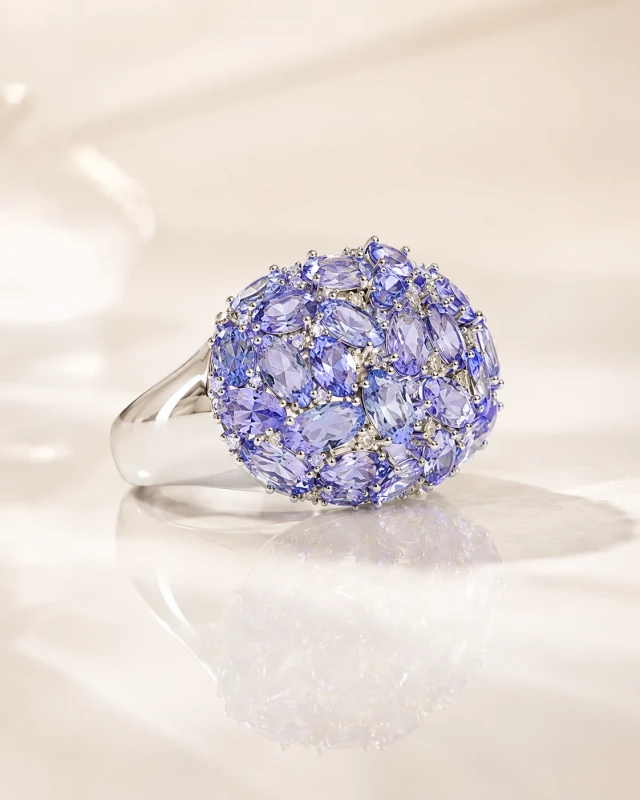
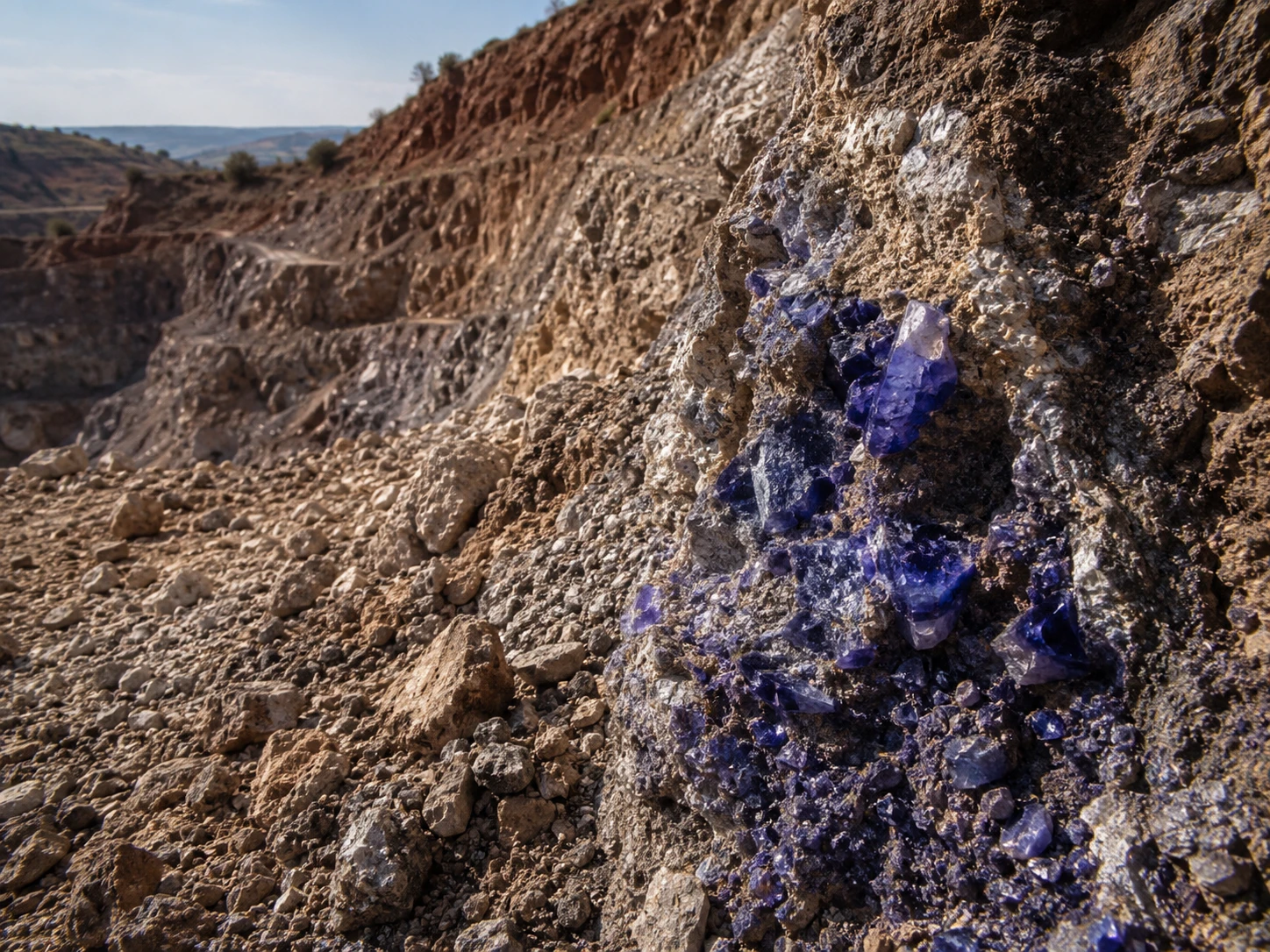




Yes, with two habits. Take it off for the short list of things that produce sharp knocks, and never let anyone put it in an ultrasonic cleaner. Tanzanite is 6 to 7 on the Mohs scale, with fair to poor toughness and cleavage, which is a specific weakness rather than a general fragility, and specific weaknesses can be worked around.
What follows is the whole of it: what the three durability numbers actually mean, what will damage the stone, how to clean it, and when to hand it to somebody with a bench.
Hardness, toughness and cleavage are three different things
People use them interchangeably and they measure three unrelated properties. Tanzanite scores differently on each, and only one of them decides whether a piece survives being worn.
| Property | What it measures | Tanzanite | What it means for you |
|---|---|---|---|
| Hardness | Resistance to scratching | 6 to 7 on Mohs, about 6.5 | Ordinary dust contains quartz at 7, so polish dulls slowly over years of nothing in particular |
| Toughness | Resistance to breaking or chipping | Fair to poor | A knock is absorbed badly. This is the number that matters |
| Cleavage | A plane the crystal parts along | Perfect, in one direction | When it fails it does not chip at the edge, it splits |
Hardness is the one everybody quotes and the least important of the three for a piece of jewellery. Losing polish is slow, visible long before it is serious, and fixable at a bench. Nobody has ever lost a stone to being scratched.
Toughness and cleavage are the pair that decide outcomes. A tough stone spreads the energy of an impact through the crystal. A stone with perfect cleavage has a built-in plane for that energy to travel along, and once it starts moving along that plane it does not stop at a chip. This is why the setting matters more here than the hardness figure does, and why a stone that has survived ten years can fail on an ordinary Tuesday.
What actually damages tanzanite
Four things, and they are not the four people expect.
A sharp knock. The plane of cleavage is the vulnerability, and a single hard contact in the wrong direction is worth more damage than a decade of wear. Door frames, gym equipment, the underside of a table, a car door. Almost every coloured stone that fails in ordinary life fails to one moment somebody remembers afterwards.
Sudden temperature change. Tanzanite tolerates heat poorly and tolerates a jump in temperature worse. Moving a piece from hot water to cold, or a jeweller’s steam jet to room air, is thermal shock, and thermal shock is how a stone that survived cutting finally fractures.
Vibration. Ultrasonic cleaning drives vibration through a liquid bath and into whatever is sitting in it. On a diamond that is harmless. On a stone with a cleavage plane it is an invitation.
Acid. GIA is specific about this one: keep it clear of strong acids, because hydrochloric and hydrofluoric acid will attack the stone. That is a workshop problem more than a household one, but drain cleaners and some descalers are the domestic version.
What does not damage it is worth saying too. The heat treatment nearly every tanzanite has had is permanent, and creates no additional care requirement. The colour does not fade in sunlight. Water is fine. Soap is fine. Wearing it is fine.
How to clean it
Warm water, a mild detergent and a soft brush, and nothing else.
The method takes two minutes. Fill a bowl with lukewarm water and add one drop of washing-up liquid. Let the piece sit for a few minutes so the film around the setting softens rather than needing to be scrubbed off. Work around the stone and under the setting with a soft brush, using no pressure at all: you are lifting a film, not polishing. Rinse in water of the same temperature, never colder. Dry with a lint-free cloth and leave the piece out until the underside of the setting is dry.
This is the International Gem Society’s method as well, and there is no gentler one worth knowing. A piece that looks tired is almost always dirty rather than damaged, and the film is hand cream, hairspray and skin rather than anything dramatic.
How often depends on wear rather than a schedule. A piece worn daily benefits from a rinse every few weeks. A piece worn occasionally wants cleaning when it looks like it needs it, and no more. Cleaning is not free: every session is another chance to knock the stone against a tap.
What to avoid, and why each one matters
Five things, in the order they are likely to happen to you.
The ultrasonic bath. Never an ultrasonic or steam cleaner. This one deserves emphasis because the machine is standard equipment behind almost every jewellery counter in the world. A ring handed over for a routine clean can come back damaged by a device nobody thought to ask about. Say the word tanzanite before you hand it over, every time, including to people who should already know.
The steam jet. Same answer, different mechanism: thermal shock rather than vibration.
The hot tap. Rinsing under water noticeably hotter or colder than the wash is the domestic version of the same problem.
Household cleaners. Bleach, oven cleaner, descaler. These attack the metal as fast as they attack the stone, and a loosened setting is a lost stone.
Wearing it to do things. Not a chemical problem, a mechanical one. The list is short and specific: lifting, gripping, climbing, gardening, sport, moving furniture, anything with a tool in the other hand.
Does tanzanite scratch easily?
More easily than sapphire, less easily than people fear, and the answer is about dust rather than about knives.
The Mohs scale is a ranking of what scratches what. Tanzanite sits at 6 to 7 and ordinary household dust contains quartz, which is 7. That single fact explains almost everything about how a tanzanite ages: it is not being attacked by anything dramatic, it is being very slowly abraded by the same grit that is on every surface in every room.
What that looks like in practice is a stone that keeps its colour and loses a little of its snap. The facet edges soften, the polish goes slightly matte, and the piece reads as tired rather than damaged. Somebody who has worn the same ring daily for five years will usually not notice, because it happened at the speed of hair growing.
It also means the fix is boring and cheap. Repolishing removes a few microns and the stone comes back. A jeweller who tells you a slightly dulled tanzanite needs replacing is selling you something.
Two things make it happen faster. Storing the piece loose with harder stones, which turns years into months. And wearing it while doing anything that puts grit on your hands, which is gardening, most sport, and any kind of building work.
What to tell a jeweller before they take it
One sentence, and it is worth being the person who says it every time.
“This is tanzanite, so please no ultrasonic and no steam.”
That is the whole handover. It sounds excessive to repeat to a jeweller who has been doing this for thirty years, and it is the single most useful thing in this article. The ultrasonic bath is where jewellery goes by default while somebody looks at something else, and the person who puts it in is often not the person you spoke to. The damage is done in ninety seconds and it is not reversible.
The same sentence applies when a piece goes in for something unrelated. A ring being resized, a clasp being replaced, a chain being soldered: all of those involve heat, and all of them end with a clean. Ask what the process involves and say the sentence.
If you are travelling with it, the rules are the ones you already know for anything fragile. Hand luggage rather than hold, a pouch rather than loose in a bag, and off the hand for the parts of a journey that involve lifting.
Settings that protect, and settings that do not
The setting does more for a tanzanite’s survival than any habit you can adopt.
| Setting | What it does for a tanzanite |
|---|---|
| Bezel | A metal rim around the whole girdle. The most protective, and the girdle is where a cleavage failure usually starts |
| Half bezel or channel | Protects the two edges most likely to be struck while leaving light in from the sides |
| Low profile | Sits close to the finger, so it catches on less. Height is a bigger risk factor than most people expect |
| Halo | Small stones around the centre take contact first, and they are usually harder than the tanzanite |
| High four-claw solitaire | The least protective arrangement available. Maximum light, maximum exposure, and the claws are the thing that catches |
The International Gem Society’s guidance is blunter than most sellers will be: reserve these gems for occasional pieces or use protective settings. Read that as two routes rather than a prohibition. Occasional wear needs no special setting. Daily wear needs one, and it is not a compromise so much as a decision made once.
Earrings and pendants are a category of their own, and it is the easy one. Nothing on a chain gets knocked against a door frame, and an earring is never used to open anything. If the stone is what you want and the hand is the problem, the stone was never the problem.
Storing it
Separately, and that is the whole rule.
Tanzanite at 6.5 will be scratched by anything harder sharing a box with it, which is most things: sapphire, ruby, topaz, garnet, and every diamond. A soft pouch or a lined compartment is enough. What is not enough is a jewellery box with one large tray, where a bracelet slides across a ring every time the lid moves.
Keep it out of a car glovebox and off a sunny windowsill, not because the colour will fade, but because both are places where temperature swings are large and quick.
When it needs a bench rather than a bowl
Three signals, and the first one is urgent.
A stone that moves. Push gently with a fingernail. If the stone shifts or ticks, stop wearing the piece. A loose stone in a bowl of water is a stone going down a drain, and a loose stone in a setting is one knock from being lost entirely.
Claws that catch. A claw that snags on fabric has worn thin or lifted. That is a twenty-minute job now and a lost stone later.
Dullness that survives a clean. If a piece comes out of the bowl looking the same as it went in, the surface is scratched rather than dirty, and it wants repolishing. This is bench work, not a home job, and it is worth budgeting for the way you would budget for a watch service.
Every Maison Tanzanite piece can come back for cleaning and inspection: talk to client relations rather than handing it to whoever is nearest.
A year of ownership, in order
What actually happens, and when.
Week one. Nothing, except forming the habit of taking it off. Decide now which activities the piece comes off for and put a dish where you will actually use it: beside the kitchen sink, not in a drawer upstairs. The habit is the whole of the protection and it is built in the first fortnight or not at all.
Month three. The first clean. Warm water, a drop of detergent, a soft brush. This is also the first inspection: push the stone gently with a fingernail and check whether anything moves.
Month six. The film comes back faster than people expect on a piece worn daily, because hand cream and soap build up under a setting rather than on it. Same two minutes.
Year one. Worth a look from somebody with a loupe, whether or not anything seems wrong. Claws wear from the inside and a thinning claw looks fine from above until the day it does not. This is the appointment that prevents the expensive one.
None of that is onerous and none of it is unique to tanzanite. What is unique is that the consequences of skipping it are worse here than they would be on a sapphire, because the cleavage plane means a failure is a split rather than a chip.
Where this advice stops being enough
Two situations it does not cover.
The first is a piece that has already been damaged. Nothing here repairs a fracture, and a stone with a visible break reaching the surface is structurally different from one without: it will fail again at the same place, and cleaning it carelessly is more likely to finish the job. That is a conversation with a bench about recutting or replacement, not a care routine.
The second is a stone whose treatment nobody has confirmed. Everything above assumes ordinary heat-treated tanzanite, which is nearly all of it. A stone that has been fracture-filled or coated behaves differently under heat and solvents, and neither of those treatments is common in tanzanite but neither is impossible. If a stone came without paperwork and you are about to do anything more aggressive than soapy water, get it identified first.
Heating is the one treatment nearly every tanzanite has had, and it changes none of the above: is all tanzanite heat treated explains why, and why coating is the treatment that would change your cleaning routine.
If something has already happened to a stone, prevention is the wrong article: what can be repaired sets out which damage polishes out, which costs weight, and which ends the stone.
If you want the background on why the stone behaves this way at all, the trichroism and the single origin are in what tanzanite is, and how it is judged before you buy is in why AAA means nothing.
COMMON QUESTIONS
Can you wear tanzanite every day?
Yes, with two precautions. Take the piece off for activities that produce sharp knocks, which is lifting, gripping, sport, gardening and anything involving tools. And never let it near an ultrasonic or steam cleaner. A protective setting, particularly a bezel or a low profile, does more for daily survival than any habit.
Does tanzanite scratch easily?
More easily than sapphire and less easily than people fear. It sits at 6 to 7 on the Mohs scale and ordinary household dust contains quartz at 7, so a daily-worn piece slowly loses polish rather than being visibly damaged. Repolishing at a bench restores it.
Can a tanzanite ring go in an ultrasonic cleaner?
No, and it is worth saying out loud every time the piece changes hands. Ultrasonic cleaning drives vibration through the stone and tanzanite has a plane of perfect cleavage for that vibration to find. Steam adds thermal shock to the same problem. Warm water, mild detergent and a soft brush are the whole method.
What is the safest setting for a tanzanite worn daily?
A bezel, because it puts metal around the entire girdle, which is where a cleavage failure usually begins. A low profile matters almost as much: height is what catches on things. The least protective arrangement is a high four-claw solitaire.
SOURCES
- Tanzanite Care and Cleaning — GIA Mohs 6 to 7, fair to poor toughness, cleavage, no ultrasonic or steam, and the warning about hydrochloric and hydrofluoric acid.
- Tanzanite Description — GIA Heat treatment is permanent and creates no additional care requirement.
- Tanzanite Buyer's Guide — GIA
- Tanzanite Value, Price, and Jewelry Information — International Gem Society Mohs hardness, the cleaning method, and the recommendation to reserve tanzanite for occasional pieces or protective settings.
- Tanzanite: the blue gemstone from a single source — Geology.com Hardness of about 6.5 and the single direction of perfect cleavage.