

Tanzanite is a more fragile engagement stone than sapphire or diamond, and anyone who tells you otherwise is selling. It ranks 6 to 7 on the Mohs scale, with fair to poor toughness and a tendency to break when struck. Corundum, the family sapphire and ruby belong to, is 9 on the Mohs scale with excellent toughness and no cleavage at all.
That is the whole of the bad news, and it is real. It is also not the end of the question, because an engagement ring is worn by a particular person doing particular things, and the stone is only one of the three things that decide whether it survives.
Is tanzanite actually strong enough?
Strong enough for what, and on whose hand.
Gemmologists separate two properties the word “hard” runs together. Hardness is resistance to scratching. Toughness is resistance to breaking. A stone can be excellent at one and poor at the other, and tanzanite is middling at the first and weak at the second.
The scale itself misleads people. The steps on the Mohs scale are not evenly spaced: diamond sits one number above corundum and is many times harder. So the gap between tanzanite at 6 to 7 and sapphire at 9 is far wider than the two-point difference suggests.
The property that matters most for a ring is the one with no number attached. Cleavage is a plane along which a crystal parts cleanly, and a stone with cleavage can be split by a single knock at the wrong angle rather than merely chipped. Sapphire has none. Tanzanite has it.
GIA’s own position, in their care guidance, is not that tanzanite is unsuitable. It is that with proper care to avoid hard blows, tanzanite can be worn in all styles of jewellery. The phrase carrying the weight there is proper care, and whether that is a reasonable thing to ask of a ring somebody intends never to take off is a question about the person, not the mineral.
Who should not buy one
We would rather say this plainly than have somebody find out in a year.
Do not choose tanzanite for an engagement ring if the wearer works with their hands in a way that involves impact or grit: climbing, gardening, joinery, nursing, anything with heavy lifting or scrubbing. Do not choose it for somebody who will not take a ring off, ever, for anything. And if the ring has to survive being knocked against a doorframe with no consequence, choose something else, because sooner or later it will be, and the consequence with tanzanite is not always a scratch you can polish out.
In those cases the answer is a harder stone, and it is not a failure of taste to want one. Sapphire comes in a violet-blue close enough to tanzanite that most people cannot tell them apart at conversational distance, and it is a great choice for rings subject to daily wear.
The numbers behind the durability question
Three properties decide this, and only one of them is hardness.
Durability in a gemstone is not one measurement. It is three, they are independent, and tanzanite scores differently on each. Confusing them is why people talk past each other about whether this stone belongs on a hand.
| Property | What it means | Tanzanite | Sapphire |
|---|---|---|---|
| Hardness | Resistance to scratching | 6 to 7 on Mohs, about 6.5 | 9 |
| Toughness | Resistance to breaking or chipping | Fair to poor | Excellent |
| Cleavage | A plane the crystal parts along when struck | Perfect, in one direction | None |
Hardness is the one everybody quotes and the least important of the three for a ring. Ordinary household dust contains quartz at 7 on the Mohs scale, which is why a stone below 7 slowly loses its polish on a hand: not from one dramatic event but from years of nothing in particular. That is a maintenance question, and it is answerable by repolishing.
Toughness and cleavage are the pair that decide whether a ring survives. A tough stone absorbs a knock. A stone with perfect cleavage has a built-in plane for that knock to travel along, and when it goes it does not chip at the edge, it parts. That is the failure mode worth planning around, and it is the reason the setting matters more here than the stone’s hardness does.
None of that makes tanzanite unsuitable. It makes it a stone with a specific weakness in a specific direction, which is a solvable problem rather than a disqualifying one.
Which setting protects a tanzanite
The setting does more for the stone’s survival than the stone’s own hardness does.
GIA’s buying guidance is explicit about it: with a hardness of 6 to 7, a setting that surrounds the tanzanite with metal or gems will help protect it. In practice that means the metal, not the stone, takes the knock.
| Setting | What it does for a tanzanite |
|---|---|
| Bezel | Metal wraps the girdle completely. The most protective, and the one we recommend for a ring worn daily |
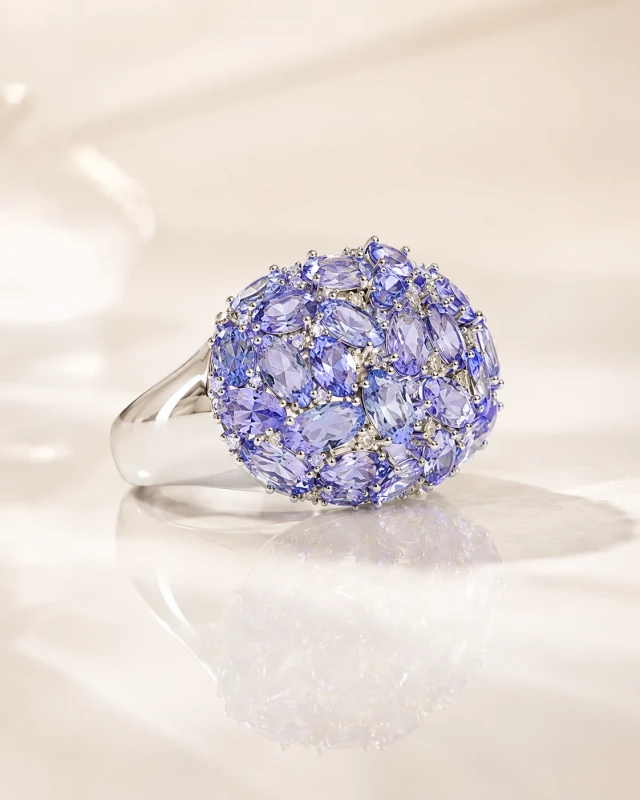
| Halo | Surrounding stones absorb glancing blows to the edge, where cleavage damage starts |
| Low profile | The stone sits close to the finger and catches on less |
| High solitaire, claws only | The girdle is exposed on every side. Beautiful, and the least protective thing you can do with this stone |
A high four-claw solitaire is the classic engagement silhouette and the worst choice available for a stone that cleaves. If that shape is the point, it is a good reason to choose a different stone rather than a good reason to accept the risk.
What tanzanite gives you that sapphire does not
Colour behaviour, and rarity of a specific kind.
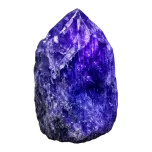
Tanzanite is trichroic: it shows three different colours along three directions of the crystal, so the cutter’s decision about orientation determines what the finished stone looks like. Two tanzanites cut from the same rough can differ in colour purely because of how they were oriented on the wheel. That trade-off, colour against size, is most of what decides a tanzanite’s price, and it is worth understanding before shopping: what tanzanite is, and what decides its colour.
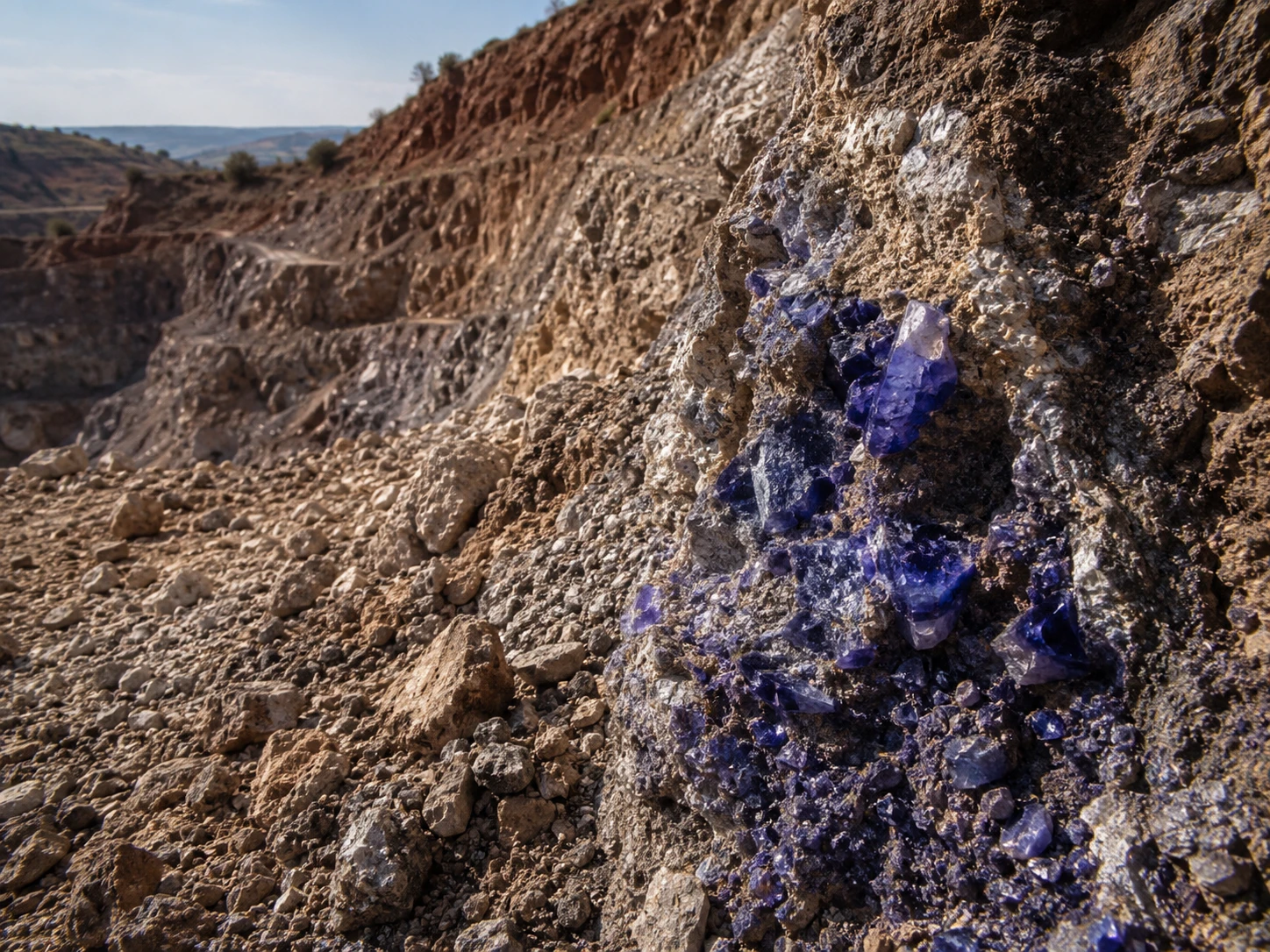
And there is one deposit. Tanzanite comes from the Merelani hills of northern Tanzania and nowhere else on Earth; it was found there in 1967 and named by Tiffany & Co., who introduced it in 1968. Sapphire is mined on several continents. Whether single-source origin matters to you is a matter of taste rather than a fact about quality, but it is a real difference and not a marketing line.
What daily wear actually costs you
Two habits, and they are not onerous.
The first is taking it off. Not for everything, but for the short list of things that produce the sharp, concentrated impacts this stone is worst at: gym equipment, gardening, moving furniture, anything involving a doorframe and a hurry. Most damage to coloured stones in rings happens in a moment somebody remembers afterwards.
The second is how it gets cleaned. Warm water, a mild detergent and a soft brush, and never an ultrasonic or steam cleaner. This one matters more than it sounds, because the ultrasonic bath is standard equipment behind almost every jewellery counter. A ring handed over for a routine clean can come back damaged by a machine nobody thought to ask about. Say the word tanzanite before you hand it over, every time, including to people who should already know.
The International Gem Society’s own guidance is blunter than most jewellers will be with you: reserve these gems for occasional pieces or use protective settings. Read that as the two routes it describes rather than as a prohibition. Occasional wear needs no special setting. Daily wear needs one.
There is a third cost that is worth naming because it is rarely mentioned at the point of sale: repolishing. A stone worn daily on a hand will want attention at some point in its life, and that is bench work rather than something to be done at home. Budget for it the way you would budget for a watch service, and it is a small number. Ignore it for fifteen years and you will be told the stone needs recutting, which is a larger one.
Living with one
The rules are short, and they are the same rules that make any coloured stone last.
Take it off before the gym, the garden, the washing-up and the beach. Wash it in warm water with a little soap and a soft brush. Keep it away from strong acids. And never put it in an ultrasonic or a steam cleaner: neither is recommended for tanzanite, because the vibration can open an existing fracture and the heat can shock the stone.
One more thing, which is not about durability. Almost all tanzanite on the market has been heat treated; it begins as brownish zoisite and heat brings out the blue and violet. The colour is permanent and creates no extra care requirement. Any jeweller who implies their tanzanite is uniquely untreated, without a laboratory report saying so, is telling you something they cannot support.
What to ask before you commit to one
Four questions, and they are about the hands rather than the stone.
How is this hand used? Not “is this person careful”, which everybody says yes to, but specifically: does it lift, grip, climb, garden, cook at volume, work with tools. A stone with perfect cleavage in one direction does not care how careful somebody is in general. It cares about one impact.
Will the ring come off? A ring that is removed for the gym and the garden is in a different durability category from one that never leaves the finger. If the honest answer is that it will never come off, the setting has to do all the work, and the setting choice stops being a preference.
What size is the stone going to be? This is the question people ask last and it interacts with everything. Deep colour generally needs above five carats, and a five carat stone on a hand is a large object with more surface exposed to the world. Wanting both the saturation and daily wear is wanting two things that pull against each other, and it is better to know that before choosing than after.
Who will service it? Find out now whether the jeweller who sells it will also repolish and retip it in ten years, and whether they will remember not to put it in the ultrasonic. A stone like this benefits from a relationship rather than a transaction, and that is worth asking about at the point where you still have leverage.
If you would rather talk it through than read about it, that is what we are for: request a private viewing, or look at what we carry first.
If the answer is no, what instead
Sapphire, and it is not a consolation prize.
If the honest reading of the hands in question is that a tanzanite will be knocked, the stone to look at is sapphire, and the reason is the middle row of the table above rather than the top one. Corundum is 9 on the Mohs scale with excellent toughness and no cleavage plane, so it fails in none of the three ways tanzanite can.
What you give up is real and specific. You lose the trichroism, which is the thing tanzanite does that no other blue stone does: the violet that appears and retreats as the hand turns is a property of the crystal having three colours in it, not an effect of the cut. You also lose the single origin, if that matters to you.
What you gain is a ring nobody has to think about. That is worth more than it sounds over twenty years.
There is a middle route worth considering. A tanzanite in a pendant or a pair of earrings sits in the two positions where none of this applies: nothing on a chain gets knocked against a doorframe, and an earring is never used to open anything. If the stone is what you want and the hand is the problem, the stone was never the problem.
So: yes or no
Yes, if the ring will be looked after and set protectively. No, if it will not.
That is a less satisfying answer than either of the ones usually given, and it is the accurate one. The stone is not fragile in the sense of being unwearable; it is fragile in the sense of being unforgiving of one specific kind of accident. Somebody who knows that before choosing is choosing well. Somebody who has been told only that it is rare and beautiful has not been given enough to choose with. Nor does a grade help: there is no standard scale for this stone, and what AAA means depends entirely on who wrote it. One practical thing decides more than the setting does, and almost no bridal advice mentions it: the wedding band beside it. Wearing a tanzanite ring with a wedding band explains why a diamond eternity band is the specific hazard. And if part of the appeal is what the stone is said to signify, it is worth knowing which of those meanings are documented and which are recent: the birthstone and the symbolism.
COMMON QUESTIONS
Can tanzanite be worn every day?
Yes, with precautions. GIA's guidance is that with proper care to avoid hard blows, tanzanite can be worn in all styles of jewellery. Daily wear is realistic in a protective setting for someone who takes the ring off for manual work, and unrealistic for someone who will not.
How does tanzanite compare with sapphire for an engagement ring?
Sapphire is markedly more durable. Corundum is 9 on the Mohs scale with excellent toughness and no cleavage; tanzanite is 6 to 7 with fair to poor toughness and does have cleavage. Tanzanite's advantages are its trichroism and its single source, not its resilience.
What setting is best for a tanzanite engagement ring?
A bezel, or a halo. GIA recommends a setting that surrounds the stone with metal or gems, because the metal then takes the impact instead of the stone. A high solitaire on claws leaves the girdle exposed and is the least protective option.
Will a tanzanite ring scratch?
It can. At 6 to 7 on the Mohs scale tanzanite is softer than many gemstones, so it abrades over years of contact with harder material. Chips and breaks are the more serious risk, because tanzanite has cleavage and can part when struck rather than simply scratching.
Is heat-treated tanzanite worth less?
Heating is normal for tanzanite rather than a defect, and the resulting colour is permanent with no additional care requirements. What matters is disclosure: the treatment should be stated, and a report from an independent laboratory should name any detectable treatment.
Can a damaged tanzanite be repaired?
Abrasion on the surface can often be polished out by recutting, which makes the stone slightly smaller. A break along a cleavage plane usually cannot be repaired, only recut into a smaller stone or replaced, which is why prevention through the setting matters more than any repair.
Can a jeweller clean a tanzanite ring in an ultrasonic machine?
No, and this is worth saying out loud every time the ring changes hands. Ultrasonic cleaning drives vibration through the stone, and tanzanite has a plane of perfect cleavage for that vibration to find. Steam adds thermal shock to the same problem. Warm water, mild detergent and a soft brush are the whole method.
Is a tanzanite pendant safer than a tanzanite ring?
Considerably. Almost every impact a gemstone suffers in ordinary life happens to a ring, because a hand is what people open doors and lift things with. A pendant or a pair of earrings puts the same stone somewhere it is very unlikely to be struck, which removes most of the durability argument entirely.
SOURCES
- Tanzanite Care and Cleaning Guide — Gemological Institute of America Mohs 6 to 7, fair to poor toughness, cleavage as a tendency to break when struck, the uneven spacing of the Mohs scale, the position that with proper care tanzanite can be worn in all styles of jewellery, and that ultrasonic and steam cleaning are not recommended.
- Sapphire Care and Cleaning Guide — Gemological Institute of America Corundum is 9 on the Mohs scale with excellent toughness and no cleavage, making it a great choice for rings subject to daily wear. Supports every comparison drawn with sapphire.
- Tanzanite Buyer's Guide — Gemological Institute of America That tanzanite at 6 to 7 is softer than many gems, and the recommendation of a setting that surrounds the stone with metal or gems to protect it. Supports the settings section.
- Tanzanite Description — Gemological Institute of America Tanzanite as the violet-blue variety of zoisite, its trichroism, and that most tanzanite is heat treated from brownish zoisite with a permanent resulting colour.
- Tanzanite History and Lore — Gemological Institute of America The single source in the Merelani hills of northern Tanzania, the 1967 discovery, and Tiffany & Co. naming and introducing the stone in 1968.
- Tanzanite Value, Price, and Jewelry Information — International Gem Society Mohs hardness, the recommendation to reserve tanzanite for occasional pieces or protective settings, and the cleaning method.
- Tanzanite: the blue gemstone from a single source — Geology.com Hardness of about 6.5 and the single direction of perfect cleavage.