
No classical astrological tradition assigns tanzanite anything, because tanzanite was unknown until 1967 and those traditions are far older. It is a December birthstone, added to the list in 2002, and it carries the symbolism people have given it since. Everything else you will read about its powers is modern belief, and this page labels it as such throughout.
That is not a dismissal. A stone can mean a great deal without any of the meaning being measurable, and most jewellery worth owning works exactly that way. What follows separates what is documented from what is believed, so you can choose on either basis knowingly rather than be sold one as the other.
A note before the first claim. Nothing on this page is a medical, psychological, financial or spiritual promise. Where a tradition holds something, it is written as a tradition holding it. No gemstone has been shown to affect health, fortune or relationships, and any seller telling you otherwise is making a claim they cannot support.
Direct answer: is tanzanite good for astrology?
In classical Vedic gem astrology, tanzanite has no assigned role at all.
The system usually meant by the question is the navaratna, the nine gems. It maps nine specific stones to nine celestial bodies: ruby to the Sun, pearl to the Moon, emerald to Mercury, coral to Mars, yellow sapphire to Jupiter, diamond to Venus, blue sapphire to Saturn, hessonite to the ascending lunar node and cat’s eye to the descending node. The list is fixed, it is old, and it was one of the most powerful talismans in Hindu tradition.
Tanzanite is not on it and could not be. The gem was identified in 1967. The tradition was complete centuries before that. So when a seller tells you which Rashi should wear tanzanite, they are not quoting a text, because no text mentions it. They are extending a system by analogy, usually on the basis that the stone is blue and blue is associated with Saturn.
That extension may be meaningful to you. It is simply not classical, and knowing the difference is the whole point of asking the question.
Documented history: what actually happened
Short, recent and unusually well recorded, which is rare for a gemstone.
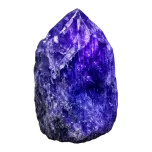
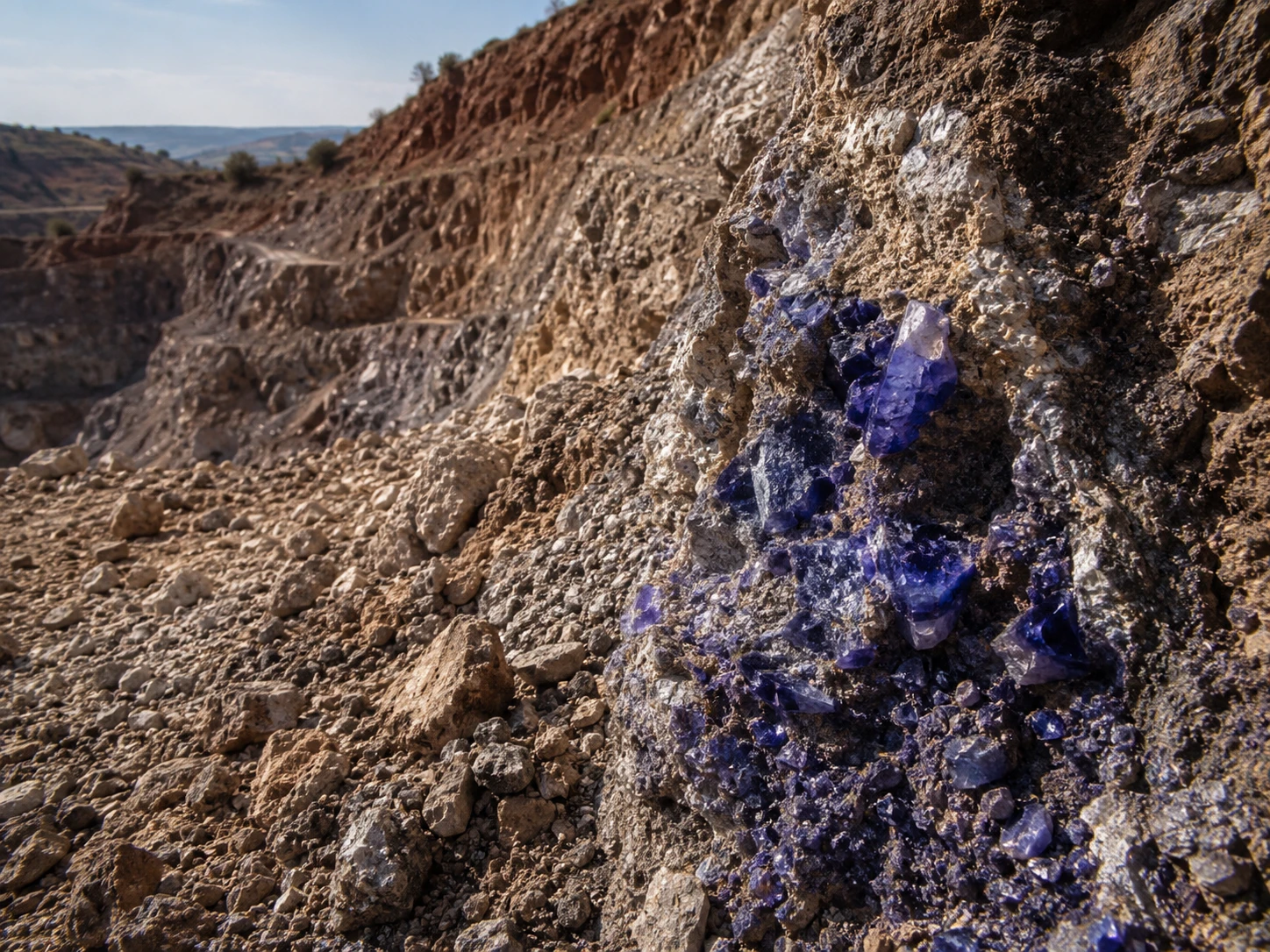
Maasai herders found blue crystals in the Merelani Hills near Arusha in 1967 while tending livestock, and a prospector named Manuel d’Souza registered claims with the government. D’Souza initially believed he was mining sapphire; the material turned out to be a blue variety of zoisite, a mineral that had been known since the early 1800s without anybody caring much about it.
The name came from a shop. Tiffany recognised the gem’s potential, became its primary distributor, and renamed it tanzanite in 1968 rather than sell something called blue zoisite, launching a promotional campaign the same year.
That is the entire documented history: sixty years, one hillside, and a marketing decision that gave the stone its name. Anything presenting tanzanite as an ancient stone of the Maasai, or as a gem used by any historical civilisation, is inventing a past for something that does not have one. The stone is genuinely remarkable. Its history is genuinely short. Both are true and neither needs embellishing.
The December birthstone, and how that list is made
Tanzanite is a December birthstone. It is also one of four, and the list itself is younger and more commercial than most people assume.
| Stone | Standing |
|---|---|
| Turquoise | The traditional December birthstone |
| Blue zircon | Added by the Jewelry Industry Council of America in 1952 |
| Blue topaz | A modern December stone |
| Tanzanite | Officially joined the December lineup in 2002 |
Birthstone lists have a real history and it is a trade history. Their ancestor is the breastplate described in Exodus, set with twelve stones each representing one of the twelve tribes of Israel. The modern American list is much later: in 1912 the National Association of Jewelers met to officially standardise the list of American birthstones, a list that combined various customs while ensuring the stones chosen would be practical for American jewelers to sell and promote in large quantities. The Jewelry Industry Council of America modified it again in 1952, adding alexandrite, citrine, pink tourmaline and zircon.
Read that 1912 phrasing again, because it is unusually candid. The stones were chosen partly for whether jewellers could sell them in quantity. That does not make birthstones meaningless. It makes them a shared convention rather than a discovery, which is a perfectly good thing for a gift to be, as long as nobody claims otherwise.
Tanzanite’s 2002 addition is the same kind of event: a trade body recognising a stone that had become popular. If you were born in December, tanzanite is genuinely your birthstone under the modern list. It has been for a little over twenty years.
Symbolism, and where it comes from
The associations attached to tanzanite are consistent, appealing and entirely modern.
Transformation is the common one, usually tied to the fact that most of the material is heated to bring out its colour. Spirituality and intuition come from the violet-blue itself, drawing on colour symbolism that long predates the stone. Dignity and calm follow from the same place. In colour-based systems the stone is often linked to the upper chakras, again by hue rather than by any tradition specific to tanzanite.
The honest framing is the one the International Gem Society uses: tanzanite lacks the extensive historical lore of other birthstones, and the meanings it carries are presented as symbolic associations rather than verified properties. A stone found in 1967 has had sixty years to accumulate meaning, and what it has accumulated came from the people wearing it and the people selling it.
There is a version of this that is completely legitimate. A stone given to mark something becomes about that thing. A ring worn through a hard year is about the year. That meaning is real, it is yours, and it does not require the mineral to be doing anything.
Astrology and Rashi traditions, described plainly
The question deserves more than a yes or no, so here is the full position.
Traditional Jyotish gem prescription works from a birth chart. A qualified practitioner reads the chart, identifies which planetary influence wants strengthening, and prescribes the corresponding stone from the fixed nine, with rules about metal, weight, finger and timing. It is a specific system with internal logic, and the stone is chosen by the chart rather than by preference.
Tanzanite cannot enter that system through the front door, because the door was built before the stone existed. What happens instead is substitution by colour: blue stones are associated with Saturn, so tanzanite is sometimes offered as an alternative to blue sapphire, which is expensive and which the tradition itself treats as powerful and to be prescribed carefully.
Two things are worth saying about that. First, it is a modern commercial extension and should be described as one. Second, practitioners within the tradition are frequently the ones who object to it most strongly, because substituting stones by colour is not how the system works. If you want to follow Jyotish, the honest advice is to consult a practitioner and follow what they prescribe, which will very likely not be tanzanite.
There is also a question of who is answering. A prescription that arrives from somebody with stock to move is not the same object as one that arrives from a practitioner with no interest in which stone you end up with. That distinction holds across every tradition and it is usually the most reliable signal available to a person who cannot evaluate the tradition itself.
If you like tanzanite and were hoping for astrological permission to buy it, the permission you actually need is your own. That is a better position than it sounds, because it is the only one that survives contact with a seller who has read the same articles you have.
What the beliefs cannot do
This is the limit, stated once and clearly.
No gemstone has been shown to affect physical health, mental health, fertility, wealth, luck or the course of a relationship. There is no mechanism and no evidence, and the absence is not a gap waiting to be filled by a study. Any seller who attaches those outcomes to a stone is making a claim that in much of the world is also a regulatory problem for them.
| Claim about tanzanite | What kind of claim it is |
|---|---|
| Found in 1967, named by Tiffany in 1968 | Documented history |
| A December birthstone since 2002 | Documented trade convention |
| Blue variety of the mineral zoisite | Established gemmology |
| Symbolises transformation and calm | Modern cultural association |
| Assigned to a Rashi or planet | Modern extension, absent from classical texts |
| Improves health, luck, wealth or focus | Unsupported, and not a claim this maison makes |
The line worth holding is between the first three rows and the last one. The middle rows are where most meaning actually lives, and they are perfectly good ground to stand on. A stone that means transformation to you because you decided it does is not a weaker object than one with a certificate of mystical efficacy, because no such certificate exists.
Choosing among December’s four stones
Being spoilt for choice is itself a fact about December, and the four are not interchangeable.
Turquoise is the one with the deep history, and it is the traditional December stone precisely because people have worn it for millennia. If what you want from a birthstone is continuity with something old, turquoise is the honest answer and tanzanite is not. Blue zircon has real fire and an older place on the list than tanzanite, having been added in 1952. Blue topaz is the most affordable of the four and the most widely available, which is both its advantage and the reason it carries the least distinction.
Tanzanite’s case against the other three is not history and not price. It is that the stone does something the others do not. It comes from one small area in northern Tanzania and nowhere else, and it shows different colours down different crystal axes, so the gem in front of you is partly a decision somebody made when they oriented it. Neither of those is a belief. They are the two most interesting true things about the stone, and they are why it earned a place on a list it had no history to justify.
The four also differ considerably in how much daily wear they tolerate, and that difference matters more than any of the symbolism when the piece is a ring. Turquoise and tanzanite both want more care than a birthstone shopper usually expects, for different reasons. If the gift is going onto a hand that never comes off, let the practical question decide between the four and treat the meaning as a tie-breaker rather than the other way round.
Gift occasions where tanzanite fits
The stone works best where its actual story is the point.
A December birthday is the obvious one and the most defensible: it is the modern birthstone and the recipient can look that up. A twenty-fourth wedding anniversary is a common modern association, following the same kind of trade convention as the birthstone lists. Beyond that, the arguments that work are the true ones. It comes from a single small area in northern Tanzania and nowhere else on Earth. It shows different colours down different axes. It was unknown within living memory.
For a gift, that last fact is unexpectedly useful. Most gemstones come with a history the recipient has heard. This one comes with a discovery date more recent than the moon landings, which makes it a stone you can actually tell someone about.
Choosing a piece, once meaning is settled
Meaning decides whether you want tanzanite. It decides nothing about which one to buy.
Two practical things carry over from the sections above. The heating that symbolism reads as transformation is real and near universal, and it should be disclosed to you as a matter of course rather than presented as either a flaw or a mystery. And the colour that the symbolism depends on is the thing you should judge hardest, in daylight, before anything else.
The durability question also belongs in a gift decision. Tanzanite asks for gentler habits than the stones most people are used to, and a piece given to somebody who will never take it off deserves that conversation up front rather than a year later: the honest care answer covers what the stone can and cannot take.
For the material itself, the trichroism and the single origin that most of the symbolism is built on, start with what tanzanite is. If you are choosing a piece, how to buy tanzanite gives the order to judge things in, and what decides the price explains why two stones that look similar are not priced alike.
If you are buying it for somebody else, giving tanzanite as a gift covers which format to choose and, more usefully, which claims to leave out of the card. December has three other birthstones and all four are treated, which is not the argument most gift guides make: December’s four birthstones, honestly compared.
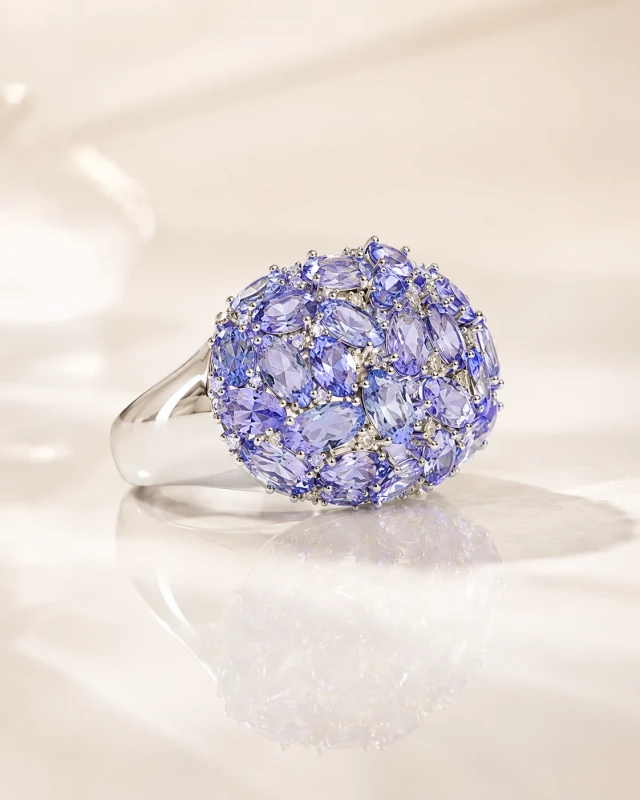
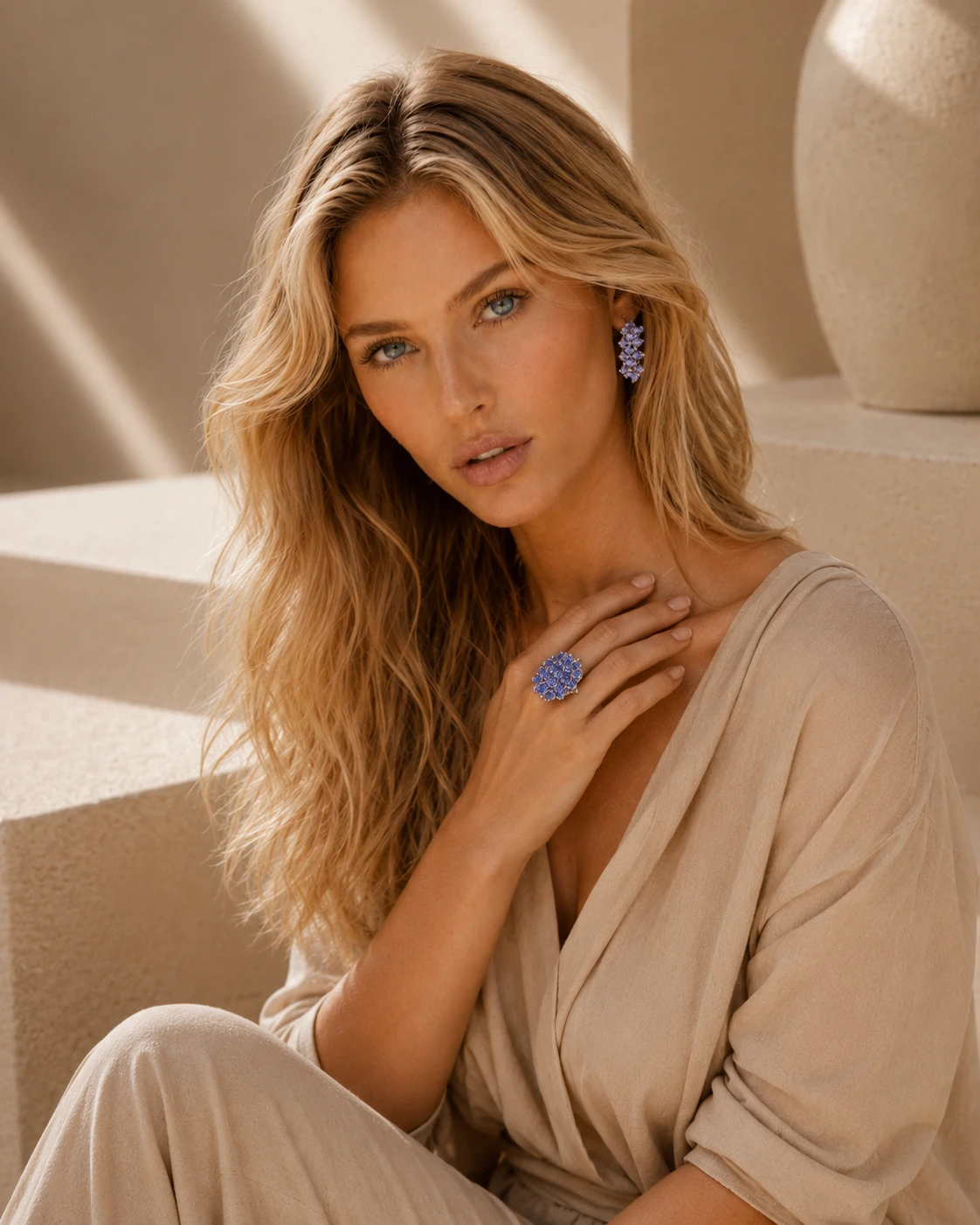
When you want to look at pieces rather than at meanings, ours are here. Each states its metal and the treatment of its stones, which is the only kind of claim we think a piece of jewellery should make for itself.
COMMON QUESTIONS
Which Rashi can wear tanzanite?
No classical text assigns tanzanite to any Rashi, because tanzanite was not identified until 1967 and the tradition is far older. The navaratna maps nine fixed stones to nine celestial bodies: ruby to the Sun, pearl to the Moon, emerald to Mercury, coral to Mars, yellow sapphire to Jupiter, diamond to Venus, blue sapphire to Saturn, hessonite and cat's eye to the lunar nodes. Any Rashi assignment for tanzanite is a modern extension made by analogy with blue sapphire, not a prescription from the tradition.
Is tanzanite a December birthstone?
Yes. Tanzanite officially joined the December birthstone lineup in 2002, alongside turquoise, blue zircon and blue topaz. Turquoise is the traditional December stone; tanzanite is the most recent addition, recognised after the gem became widely popular.
What are the benefits of wearing tanzanite?
The honest answer is aesthetic and personal rather than physical. No gemstone has been shown to affect health, mental health, fertility, wealth or luck, and we make no such claim. Tanzanite is commonly associated with transformation, calm and intuition, and those associations are modern cultural symbolism rather than demonstrated properties. A stone that marks an occasion carries the meaning you give it, which is a real thing and does not require the mineral to be doing anything.
Is tanzanite an ancient or lucky stone?
It is not ancient. Maasai herders found blue crystals in the Merelani Hills near Arusha in 1967, a prospector named Manuel d'Souza registered the claims believing he had found sapphire, and Tiffany renamed the material tanzanite in 1968. Anything presenting it as a historic stone of any civilisation is inventing a past for a gem discovered within living memory. Claims that it brings luck are beliefs, not findings.
Why is tanzanite on the birthstone list if it has no history?
Because birthstone lists are trade conventions rather than ancient inheritances. The modern American list was standardised in 1912 by the National Association of Jewelers, combining various customs while ensuring the chosen stones could be sold and promoted in quantity, and it was modified again in 1952. Tanzanite's 2002 addition follows the same pattern: a trade body recognising a stone that had become popular.
SOURCES
- Centuries of Opulence: Jewels of India — GIA The navaratna and its nine fixed stone-to-planet assignments, and its standing as a talisman in Hindu tradition.
- History of Tanzanite — American Gem Society The 1967 discovery by Maasai herders in the Merelani Hills, Manuel d'Souza's sapphire assumption, identification as blue zoisite, and Tiffany's 1968 renaming and campaign.
- December Birthstones — International Gem Society Tanzanite officially joined the December lineup in 2002; turquoise as the traditional stone; tanzanite lacking the extensive historical lore of other birthstones.
- History of Birthstones — International Gem Society The breastplate of twelve stones for the twelve tribes; the 1912 National Association of Jewelers standardisation and its commercial framing; the 1952 Jewelry Industry Council modifications.
- Tanzanite Description — GIA Tanzanite as a blue variety of zoisite and the near-universal heat treatment referenced in the symbolism section.