
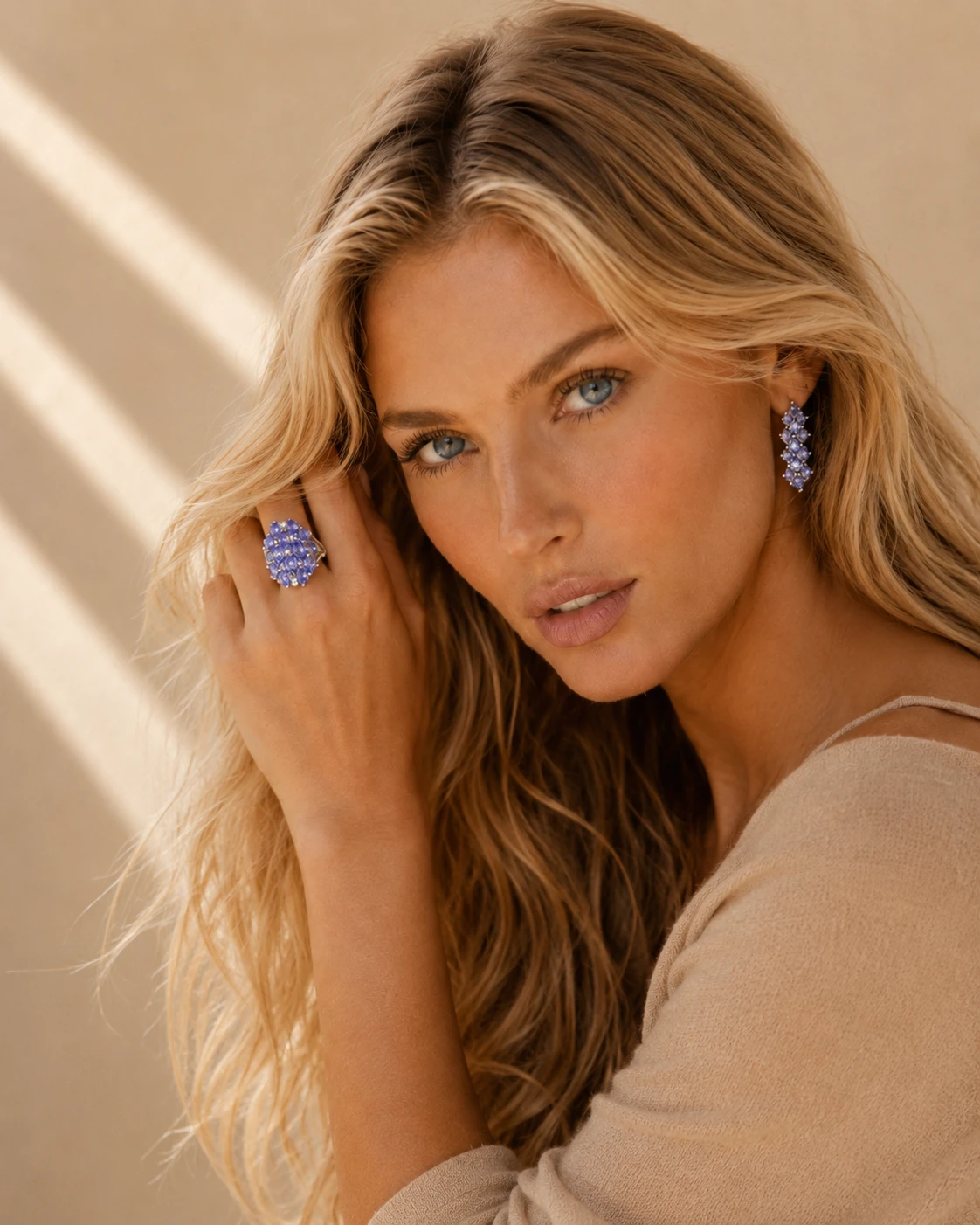
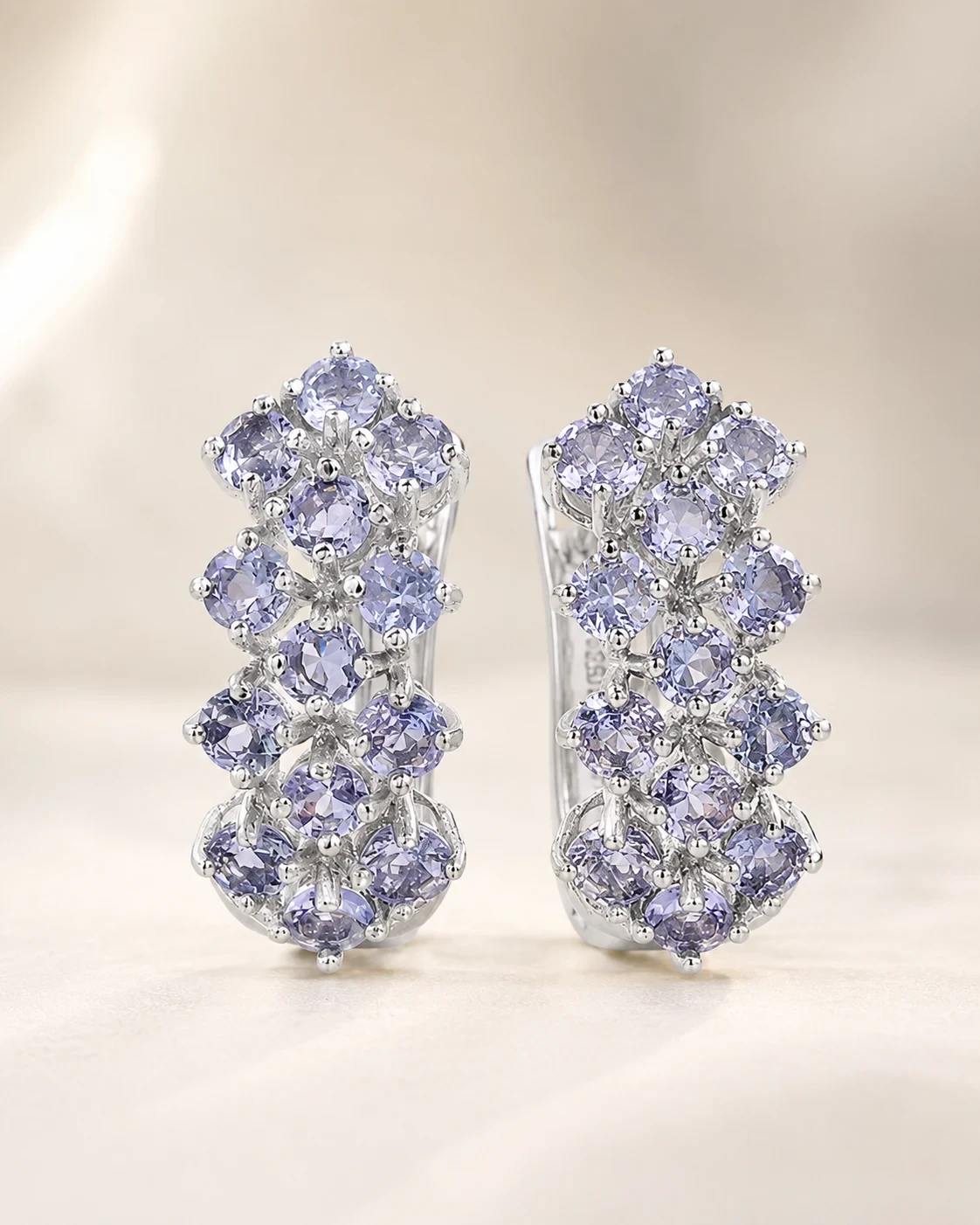
The easiest tanzanite gift is a pendant or a pair of earrings, because they sidestep both problems a ring creates: you do not need a size, and you do not need the durability conversation. That single decision solves most of what makes gemstone gifting difficult.
The harder part is what you say about it. Tanzanite attracts more unsupported claims than almost any other stone, and repeating one in a card is how a good present acquires a false statement attached to it permanently.
Start with the format, not the stone
Rings need a size and they put a gem where hands meet doorframes. Everything else is easier.
A pendant hangs clear of contact, which matters for a stone at 6 to 7 on the Mohs scale with perfect cleavage. It also sits at a distance where the colour shift is most visible, since tanzanite reads sapphire blue in natural light and violet under fluorescent light.
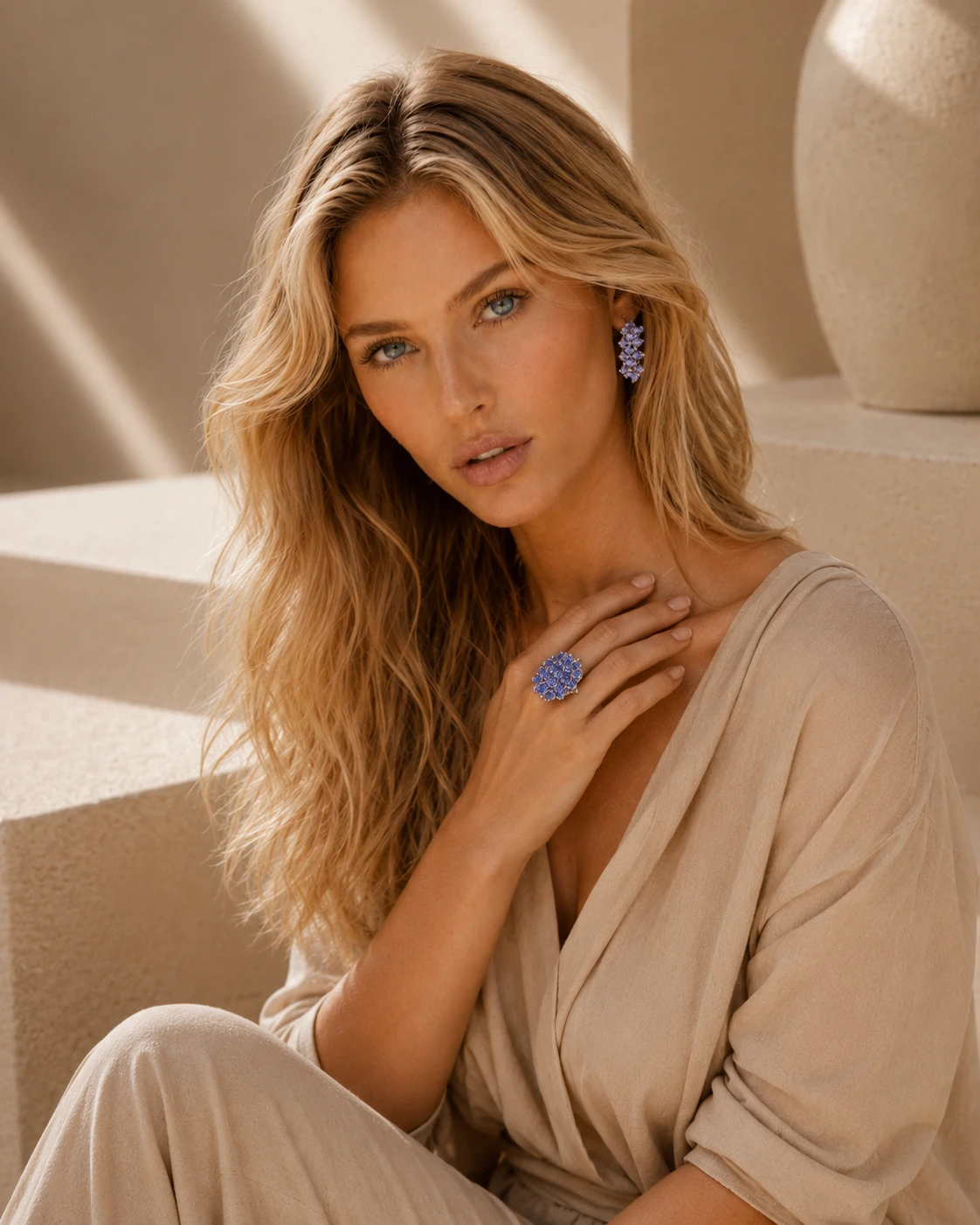
Earrings are the other easy answer, and they do something specific: the stones move constantly and catch different angles, which is where strong pleochroism shows best. Small stones do more here than their size suggests.
Bracelets sit between the two. They take more contact than a pendant and less than a ring, and a bezel or a protected setting is worth asking for.
If it has to be a ring and the size is unknown, that is its own problem with its own answers: proposing with a tanzanite covers sizing without asking, and applies equally to a gift that is not a proposal.
What you can honestly say about it
| Do not say | Say instead |
|---|---|
| “It’s running out, so it will appreciate” | “It comes from one small area in northern Tanzania and nowhere else” |
| “Untreated, so it’s rarer” | “It’s been heated, like almost all tanzanite. That’s normal and permanent” |
| “AAA grade, the highest quality” | “Here’s what I liked about the colour” |
| “It brings calm and clarity” | “People associate it with those things, which is a nice idea” |
| “It’s rarer than diamond, so it’s worth more” | “It is rarer than diamond. Diamond is worth more. Both are true” |
The left column is what you will be told in a shop and what you will read online. The right column is what survives somebody looking it up afterwards, which they will, because a gift is exactly the thing people research.
The row about grades is worth expanding. AAA and similar letters are descriptions individual companies create for their own goods, and there is no standard quality-grading scale for tanzanite at all. Repeating a grade as though it were an objective rating passes on a claim you cannot support.
The facts that are actually impressive
You do not need the invented ones. The true ones are better.
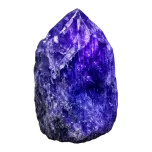
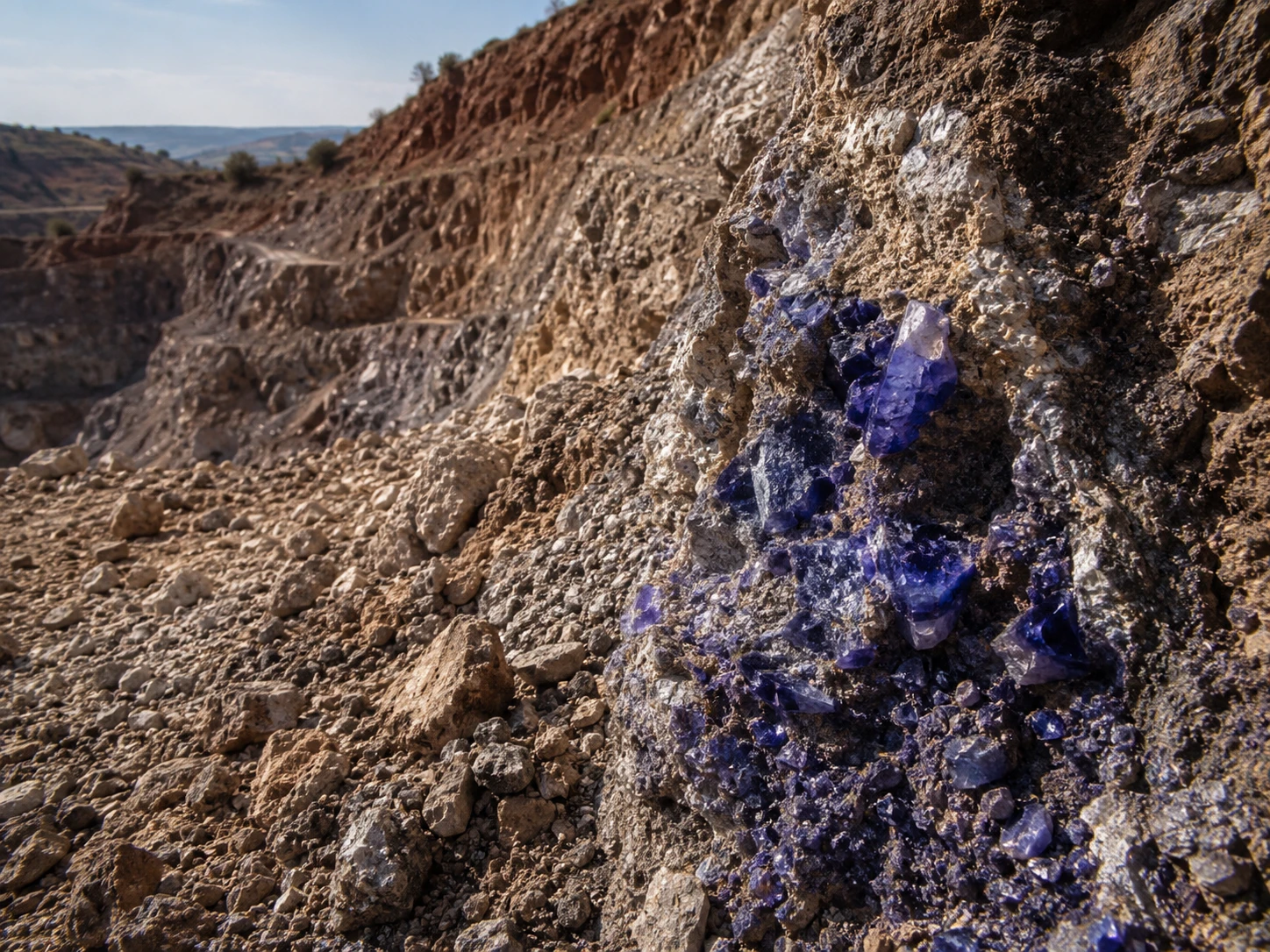
Tanzanite was unknown to anybody before 1967. It comes from one hillside and has never been found anywhere else on Earth. It shows different colours down different crystal axes, so it is genuinely a different colour depending on how it is turned and what light it is under. And most of what is mined is light to medium, so vivid stones are the exception rather than the rule.
Those four facts are checkable, interesting, and more unusual than anything in the sales patter. A stone discovered more recently than the moon landings is a better story than a fabricated ancient one.
Formats compared, for a gift
| Format | Size problem | Durability problem | Best for |
|---|---|---|---|
| Pendant | Chain length only, and replaceable | Almost none. It hangs clear | Most people, most occasions |
| Earrings | None, beyond pierced or not | Almost none | Showing the colour shift at its best |
| Bracelet | Wrist size, hard to guess | Moderate. Wrists meet desks | Someone whose size you know |
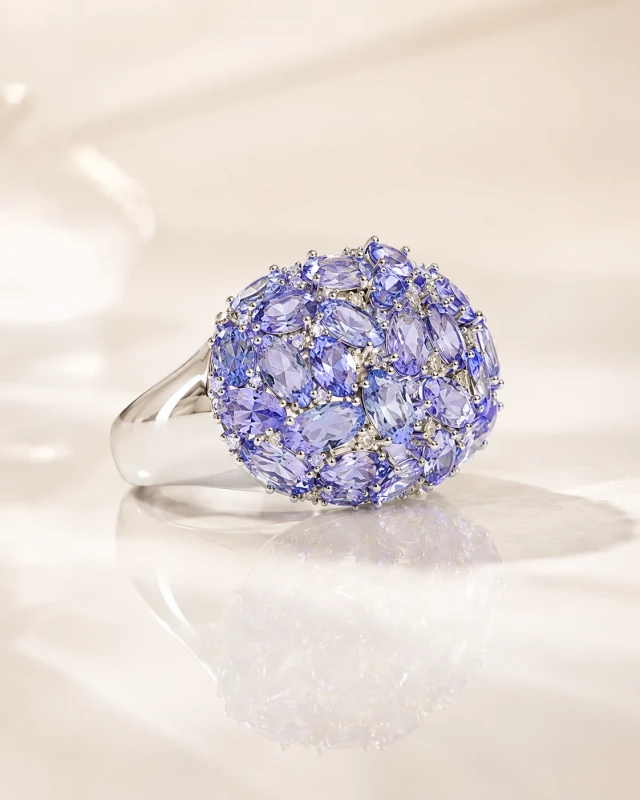
| Ring | Significant, and resizing is awkward here | Highest | Someone you can size properly |
| Loose stone | None | None until it is set | Letting them choose the setting |
The last row is an underused answer. A loose stone in a box, with the setting chosen together afterwards, removes every problem in the table and gives the recipient a decision rather than a fait accompli. It suits somebody with particular taste, and it means the stone gets set once rather than set and then altered.
The first row is the default for a reason. If you take one thing from this article, a pendant is the format that is hardest to get wrong.
Buying it online, sight unseen
Most gifts are now bought this way, and it removes the one check that matters most.
You cannot judge a trichroic stone from a photograph. The image shows one of three colours, under one light, at one angle, after whatever the camera and the editor did. A listing that states the lighting is being straight with you; one that does not is showing a face and calling it the stone.
So the checks shift to the seller. Does the listing give millimetre dimensions as well as carat weight? Does it name the treatment? Does it say what the accent stones actually are rather than calling them “accent stones”? Does it use a company grade as though it were a standard?
Then read the return terms before the description, and check specifically whether the window survives the recipient seeing it. A gift bought in November for December needs a window that reaches past the giving date, and that is a question to ask rather than assume.
Choosing colour for somebody else
The judgement you are making on their behalf is which way the stone leans, and it is a real one.
A blue-leaning tanzanite is cool and behaves like a sapphire in a wardrobe. A violet-leaning one has red in it and reads warmer. Neither is better, and people usually have a clear preference once they see both.
Two shortcuts help. Look at what they already wear: somebody whose jewellery is all cool white metal has told you something, and somebody in warm gold has told you something else. And look at the stone in daylight rather than under the shop’s lighting, because the shop’s lighting is chosen to flatter its stock and pushes tanzanite toward violet.
If the stone you can afford is a pale one, that is not a compromise to apologise for. Pastel hues are more plentiful, more affordable, and have a subtle appeal of their own, and a pale stone honestly described is a better gift than a vivid one described dishonestly.
Sizes that are not ring sizes
Non-ring gifts still have a fit question, and it is easier but not absent.
Chain length is the one people get wrong. A pendant on a chain that is too short sits awkwardly against a collarbone and one too long disappears under a neckline, and both are fixable only by replacing the chain. If you can see a necklace they wear often, match its length, and if you cannot, choose a mid-length that most necklines tolerate and keep the receipt.
Earrings have a simpler variable: whether they have pierced ears, and whether they wear studs or drops. Both are observable without asking.
For bracelets, wrist size is genuinely hard to estimate and adjustable designs exist for exactly this reason. If in doubt, that is the format to avoid.
Occasions where tanzanite fits
A December birthday is the most defensible occasion, because tanzanite officially joined the December birthstone lineup in 2002 and the recipient can verify it.
It is worth knowing what a birthstone list actually is before leaning on it too heavily. The modern list was standardised in 1912 by the National Association of Jewelers, combining various customs while ensuring the stones they chose would be practical for American jewelers to sell and promote in large quantities. That does not make birthstones meaningless. It makes them a shared convention, which is a perfectly good thing for a gift to run on, as long as nobody presents it as ancient.
Beyond December, tanzanite is commonly associated with a twenty-fourth wedding anniversary, again by modern convention. And for any occasion at all, the single-origin story does the work without needing an assigned meaning.
What not to promise
Three claims to keep out of the card, and out of the conversation.
Health, luck, wealth or protection. No gemstone has been shown to affect any of them, and attaching those outcomes to a present puts a claim on it that cannot be met. If the recipient likes the symbolism, they can hold it as symbolism, which is a different and perfectly good thing.
Appreciation. Tanzanite is not an investment. There is no grading scale to hold value against, retail and resale are different markets, and a one-of-a-kind coloured stone sells when a specific buyer appears rather than when you want it to.
A depletion date. The figures usually quoted are from 2018 and describe reserves in the ground rather than gem-quality material reaching a market. There is no credible countdown, and repeating one attaches a falsehood to something you meant kindly.
The general rule: say what is true about the object and let the meaning be theirs to assign.
Receipts, returns and the unromantic part
The paperwork is the part that makes a gift recoverable if it turns out to be wrong, and almost nobody asks about it before buying.
Ask three things at the counter. How long the return or exchange window is, whether it starts at purchase or can be extended for a gift, and whether engraving or resizing voids it. That last one matters: personalised goods are commonly excluded from return rights, so engraving before the recipient has seen the piece closes the exchange door.
Keep the receipt with a description of the actual stone rather than “pendant”, and keep any identification report. Both are useful to them later, for insurance and for the day somebody asks what it is. Insuring and valuing a tanzanite covers what the documents do.
Giving the paperwork with the gift is not unromantic. It is the difference between a nice object and a nice object they can look after.
One practical detail on timing. If you buy well ahead of the occasion, the return window may expire before the gift is opened, which is the most common way a recoverable mistake becomes an unrecoverable one. Ask whether the window can be extended for a gift, and get the answer in writing rather than as a friendly assurance.
If they already own tanzanite
Matching is harder than it looks and worth thinking about before buying a companion piece.
Two tanzanites of different sizes will not match in tone, because saturation depends on the depth of stone light travels through: accent stones under two carats are commonly a lighter colour while deep colour generally requires a stone above five carats. A pendant chosen to match a large ring will read paler beside it, and that is physics rather than a defect.
The better approach is to match the metal and let the stones differ, or to choose a piece that will be worn separately. If you do want a true set, the piece has to be chosen against the existing one in person and in daylight, which usually means giving up the surprise.
Gifts for someone who will wear it hard
Worth a separate thought, because the honest answer is sometimes a different stone.
If the recipient is a nurse, a chef, a climber or simply somebody who never takes jewellery off, a tanzanite ring is the wrong present however much they like the colour. The stone is soft enough to abrade and has a plane it can split along, and a gift that needs to be treated carefully by somebody who will not treat it carefully is a slow disappointment.
There are three good answers. Give a pendant or earrings instead, where the problem does not arise. Give a ring with a bezel setting, which puts a metal wall between the stone and the world. Or give a different stone, and there is no shame in that: December’s four birthstones, honestly compared sets out which of the four survives daily wear best, and it is not this one.
Choosing the format around the person rather than around the stone is the single decision that separates a gift that lasts thirty years from one that spends twenty-nine of them in a drawer.
Presentation, and the moment itself
Two small things that improve a gemstone gift and cost nothing.
Show it in daylight if you possibly can. A stone unwrapped under a warm evening bulb is showing its violet face at its least brilliant, and the same stone by a window the next morning looks like a different and better object. If the moment has to be in the evening, say that there is more to see tomorrow, and mean it.
And let them turn it. Tanzanite is the rare gem where handling it is the point rather than a risk to the presentation, because the colour genuinely changes as it moves. Handing somebody a stone and telling them to tilt it is a better introduction than any description.
Beyond that, resist the temptation to build the moment around a claim. The stone does not need a legend attached, and a present that arrives with an accurate sentence about where it came from ages better than one that arrives with a story that unravels.
Where to start
Choose a pendant or earrings, look at the stone in daylight, keep the receipt, and say only the true things, which are more interesting anyway.
For which of December’s four stones suits the person, December’s four birthstones, honestly compared. For what the stone is taken to mean and which of it is documented, the birthstone, the symbolism and the astrology. For the care conversation that follows a gift, the honest care answer.
When you want to look at pieces, ours are here.
COMMON QUESTIONS
What is the safest tanzanite gift to buy for someone?
A pendant. It needs no ring size, only a chain length that is replaceable, and it hangs clear of the contact that threatens a stone at 6 to 7 on the Mohs scale with a cleavage plane. Earrings are nearly as safe and show the colour shift best, since the stones move constantly. Bracelets are harder to size and take more contact, and rings are hardest on both counts.
What should I say about tanzanite when I give it?
The true things, which are more interesting than the sales patter. It comes from one small area in northern Tanzania and nowhere else. It was unknown to anybody before 1967. It shows different colours down different crystal axes, so it reads blue in daylight and violet under indoor light. Avoid claims about appreciation, scarcity countdowns, grades like AAA, or any health or luck outcome.
Should I mention that the stone was heated?
If it comes up, yes, and without embarrassment. Heating is near universal in tanzanite, permanent, and creates no additional care requirement, so it is the ordinary condition of the species rather than a defect. Saying it first is much better than the recipient discovering it later and wondering what else was left out. Do not claim a stone is unheated unless a report supports it.
How do I choose the colour for somebody else?
Decide whether they lean cool or warm. A blue-leaning tanzanite is cool and behaves like a sapphire in a wardrobe; a violet-leaning one has red in it and reads warmer. Look at what they already wear, since all-white metal and warm gold each tell you something. Judge the stone in daylight rather than shop lighting, which pushes tanzanite toward violet.
Can I buy a piece that matches tanzanite they already own?
Only with the existing piece in hand, and even then imperfectly. Stones of different sizes will not match in tone, because saturation depends on the depth of stone light travels through: accent stones under two carats are commonly lighter and deep colour generally needs above five carats. A pendant chosen to match a large ring will read paler beside it. Matching the metal and letting the stones differ works better.
SOURCES
- Tanzanite Value, Price, and Jewelry Information — International Gem Society Hardness 6 to 7 with perfect cleavage; very strong pleochroism; sapphire blue in natural light and violet under fluorescent light.
- Tanzanite Buyer's Guide — GIA AAA as a description individual companies create for their own goods; no standard grading scale; most tanzanite mined being light to medium; accent stones under two carats commonly lighter and deep colour generally requiring above five carats.
- Tanzanite Description — GIA Pastel hues being more plentiful, more affordable and having a subtle appeal of their own; heat treatment being permanent.
- December Birthstones — International Gem Society Tanzanite officially joining the December birthstone lineup in 2002.
- History of Birthstones — International Gem Society The 1912 National Association of Jewelers standardisation and its explicitly commercial framing.
- Tanzanite: A blue gemstone found in only one place on Earth — Geology.com The single deposit in northern Tanzania and the 2018 reserve figures referenced in the section on what not to promise.