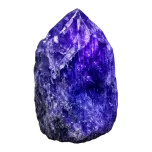

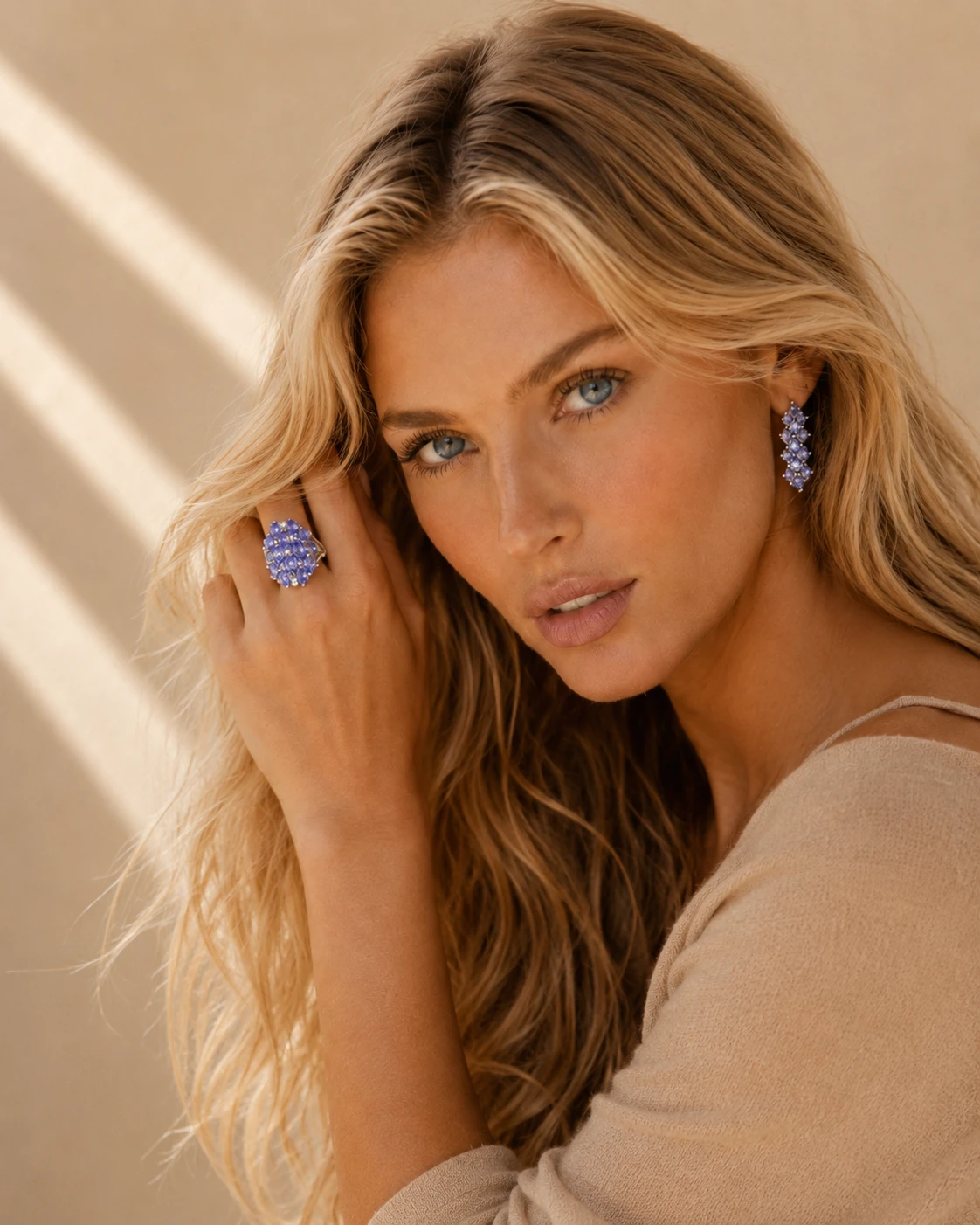
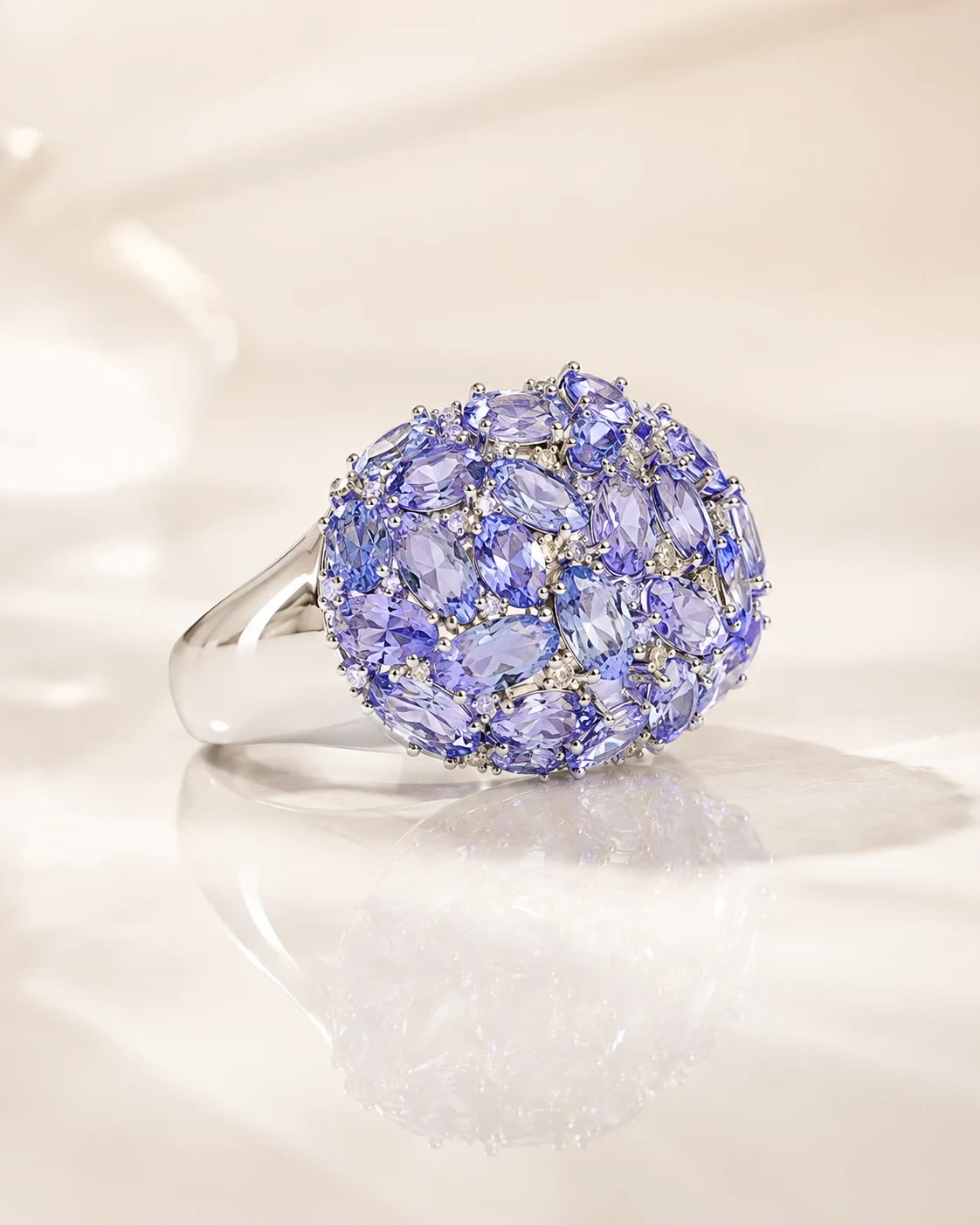
Tanzanite is worth buying if you want the colour. It is not an investment, nobody honest will promise you it appreciates, and this article contains no financial advice and no price figures, for reasons that become obvious below.
What it does contain is the anatomy of a tanzanite price: which factors move it, how far, in what order, and how to tell whether the number in front of you is built on the stone or on the story attached to it. That is a more useful thing to own than a figure, because a figure goes stale in a season and the anatomy does not.
Why there is no price list
Because there is nothing to list against.
Diamond has published price guides because the material is close to uniform and graded on a scale the whole trade shares. Two stones of the same grade are genuinely comparable, so a number can be attached to a grade and the number means something in every shop that uses it.
Tanzanite has no standard quality-grading scale at all, and GIA evaluates tanzanite but does not grade it. There is no agreed unit to price. Any list you find is one company’s opinion of its own stock, which is useful to that company and meaningless as a benchmark, because the grades in the left column were written by the people in the right column.
This is why a quoted price per carat carries less information here than it would elsewhere. It is a real number attached to an unstated quality, and without the quality it is a statement about weight. Two stones at the same price per carat can be entirely different objects, and usually are.
What actually moves the price
Six things, and they are nothing like equally weighted.
| Factor | How far it moves the price | Why |
|---|---|---|
| Colour saturation | Most of it | Vivid stones are the sought-after ones and most of what is mined is not vivid |
| Size | A great deal, and tangled with colour | Deep colour generally needs above five carats, so a large vivid stone is scarce twice over |
| Hue direction | Meaningfully | Blue face-up is cut from more rough than violet, so it costs more at the same size |
| Cut quality | More than buyers expect | Cut makes a large difference to brilliance, and orientation fixes the face-up colour permanently |
| Clarity | Least, and close to pass or fail | Eye-visible inclusions cause a drop in value; eye-clean is the expectation |
| Treatment | Almost none | The trade assumes most tanzanite has been heated, so there is little effect on pricing |
The last row surprises people who have been told untreated stones command a premium. In tanzanite they largely do not, and the reason sits in the row above it. Heating is close to universal, and laboratories often find it challenging to determine whether a tanzanite has been heated at all. A premium for a certainty nobody can supply is a premium for a story.
The two factors that are really one
Colour and size cannot be priced separately, and treating them as separate is the most common way to overpay.
Saturation depends on the depth of stone light travels through. Identical material looks weaker in a smaller gem, which is why accent stones under two carats are commonly a lighter colour and why the deep colours start appearing above five. A large vivid stone is therefore expensive twice: once for being large, and once for being the size at which that colour becomes possible at all.
Run that backwards and you have the check that saves you money. When you are shown a vivid stone, ask whether the vividness belongs to the stone or to its size. A vivid three carat stone is doing something genuinely unusual. A vivid eight carat stone is doing roughly what eight carat stones do. Those are not the same achievement, and they should not carry the same premium for each carat.
The reverse case is worth naming too, because it is where the value tends to sit. The majority of tanzanite mined is light to medium, and pastel hues are more plentiful, more affordable, and have a subtle appeal of their own. A pale stone honestly described and honestly priced is not a compromise. It is the ordinary case of the material, sold as what it is.
Cut is priced least and shows most
Cut is where the gap between what a factor costs and what it does is widest.
Two decisions happen before a facet is placed. The first is orientation: which of three pleochroic directions faces up, in a stone that shows blue, red-violet and yellow-green depending on the axis. That decision fixes the colour of the finished gem permanently. The second is proportion, which decides how much light comes back to the eye.
Neither shows on a ticket. Both show in the stone. A cutter chasing weight rather than colour keeps more carats and produces something flatter, and the market pays for the carats. That is the arbitrage available to a buyer who looks: tilt the stone, watch for a dark patch under the table that follows it as it moves, and you are seeing weight that was kept at the expense of light. It cost the buyer more and it looks worse.
What treatment does to a price, which is very little
Ask, expect yes, and do not pay extra for no.
Most gems are heat treated, which removes or reduces the brownish colour and maximises the blue and violet. The change is permanent and it creates no additional care requirement. Heating is the normal state of the material rather than a defect concealed in it, which is why the trade prices it as background rather than as a discount.
That has an unintuitive consequence for the buyer. In most gem species, untreated commands a premium because untreated is rare and detectable. Here it is neither reliably one nor dependably the other, and a seller charging for guaranteed-unheated tanzanite is charging for a certainty the laboratories themselves decline to claim. The question worth paying for is disclosure, not absence.
Is tanzanite a good investment?
No, and anybody telling you otherwise is selling something. This is not financial advice and nothing here should be read as a prediction about any market.
Three reasons, none of which is about the stone being bad.
There is no grade to hold value against. An asset needs a unit. Without a shared scale, a resale conversation in fifteen years starts from scratch with somebody else’s eye, and their eye may not agree with the one that sold it to you. The absence of a grading standard is not a small technicality here. It is the thing that makes a stable secondary price impossible.
Retail and resale are different markets. What a shop charges includes the shop: the premises, the staff, the stock sitting unsold, the returns policy, the guarantee. All of that is legitimate and none of it is recoverable when the piece changes hands privately. Any coloured stone bought at retail and sold privately loses that layer, and it is a thick layer.
Liquidity is the quiet problem. An investment is something you can convert when you choose to. A one-of-a-kind coloured stone converts when a specific person who wants that specific stone happens to be looking, which may not coincide with the month you need the money. Assets that only sell on the buyer’s timetable are not really assets in the sense the word is being used when somebody says “investment grade”.
Buy tanzanite because a trichroic stone from one hill on Earth does something no other blue stone does. Buy it at a price you are content to have simply spent.
The depletion story, examined
You will read constantly that tanzanite is running out and that this makes it an appreciating asset. The claim deserves a closer look than it usually gets.
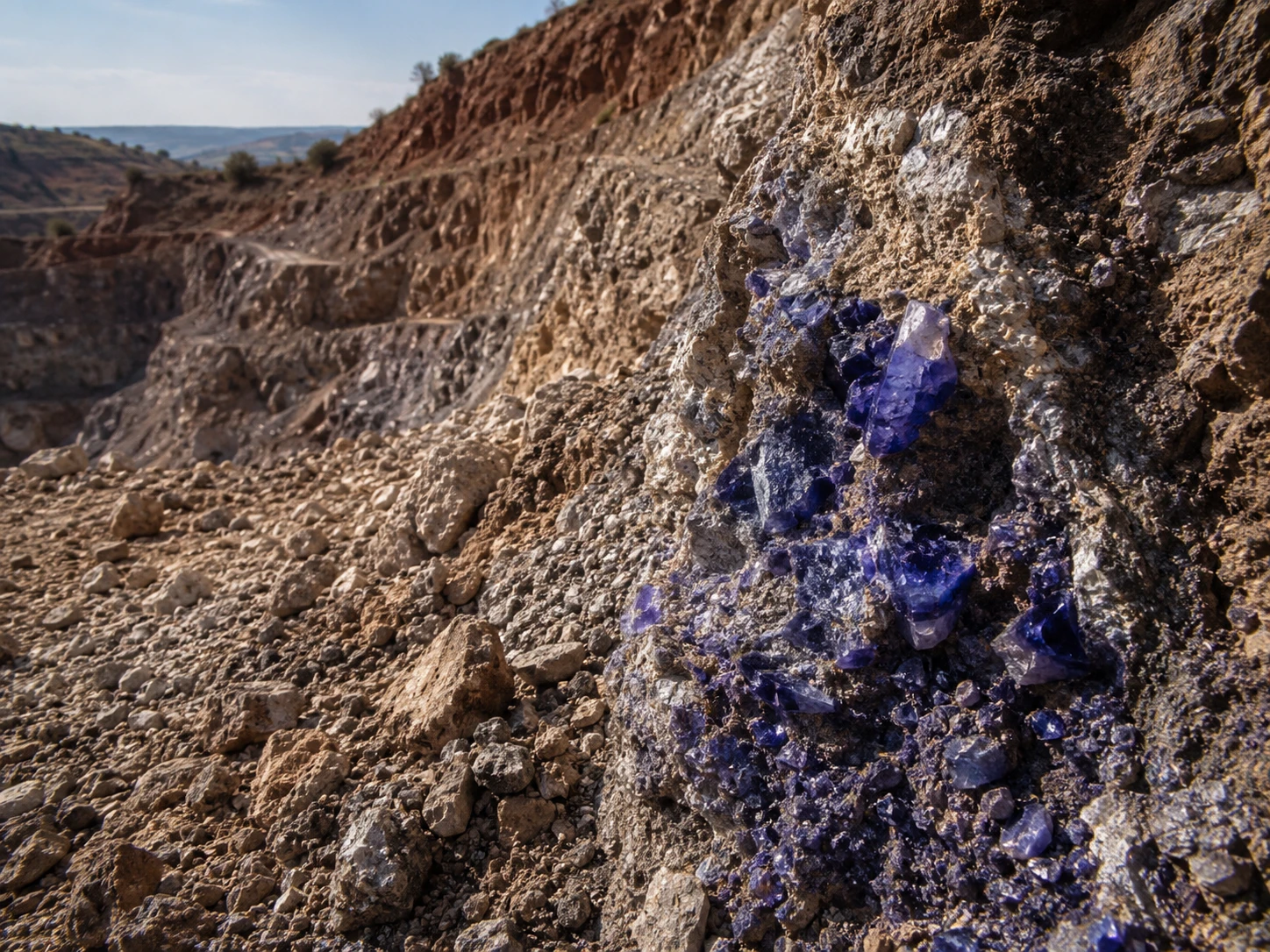
A 2018 study by Tanzania’s National Bureau of Statistics put total reserves at 109 million carats, with Block C alone estimated at about 87.1 million carats. The deposit is genuinely small in area, about eight square miles in northern Tanzania, and that single origin is a real and unusual fact about the stone.
But reserves in the ground and gem-quality material reaching a market are different numbers, and the gap between them is large and unpublished. A reserve estimate says how much zoisite is down there. It does not say how much of it will be facetable, what colour it will be, how much survives cutting, or at what cost it comes out. Using the first number to predict the price of the second is not analysis.
We have not found a gemmological source that supports the depletion timeline as it is usually told, so this site does not repeat it. The single origin is worth knowing about because it is true and because it explains the stone’s character. It is not evidence of a countdown, and a sales argument built on one should be heard as a sales argument.
Where the price goes in a finished piece
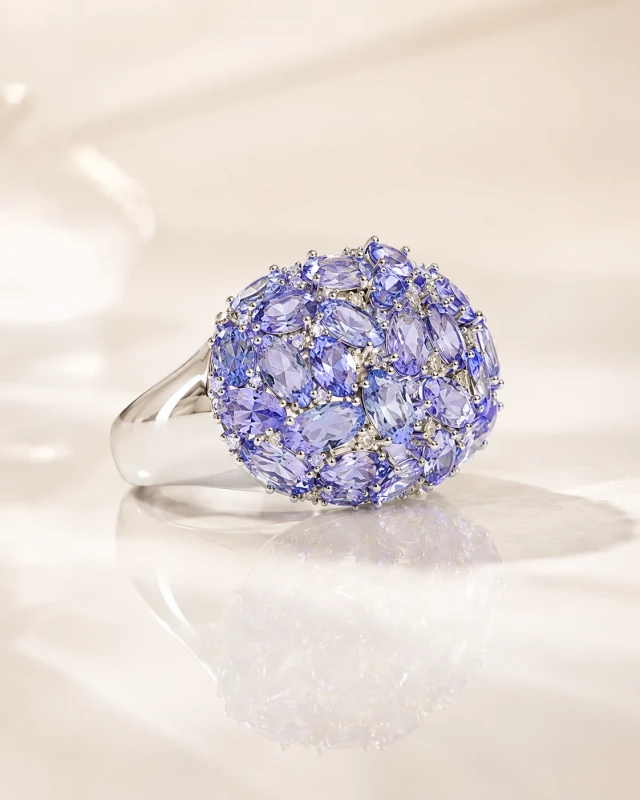
Most people do not buy a stone. They buy a ring, and the ring’s price covers four things that are never itemised: the stone, the metal, the setting work, and the house selling it.
That matters because value can be moved between them without the ticket changing. An ordinary stone in an elaborate mount and a very good stone in a plain one can cost the same, and both are legitimately priced. Only one of them is mostly gemstone. Which one you want is a real preference and not a mistake either way, but you should know which you are buying, and the only way to know is to ask what the stone alone would be.
The setting also hides evidence. A closed back or a deep bezel conceals the pavilion, which is exactly where a window, a fracture or a repair would show. That is not an argument against protective settings, which are what a stone with one direction of perfect cleavage actually wants. It is an argument for asking for the laboratory report when the mount denies your eye half the object, and for treating a seller who resists that request as having answered a different question.
The metal is the one component with a public price, and it is usually the smallest share of the four. If a quotation spends most of its explanation on the gold, look again at what it says about the stone.
What a fair price is built on
Not a number. A chain of decisions somebody can attribute.
Ask what the stone alone would cost, separately from the setting. Ask what the same stone one step lower in saturation would cost. Ask what a comparable stone sold for recently. A seller who can answer all three is pricing from knowledge of their own stock. A seller who cannot is pricing from hope, and their number carries no information you can use.
Then check that the comparison you are being offered is a comparison at all. A loose stone against a mounted one is not, because the mount hides the pavilion and absorbs an unstated share of the price. A stone seen in a display case against one seen in daylight is not either, because tanzanite reads sapphire blue in natural light and violet under fluorescent light. Two stones judged in two rooms on two days have not been compared, whatever the tickets say.
Where a price should make you walk
| Signal | What it usually means |
|---|---|
| Far below the market | A simulant. No synthetic tanzanite is known, but many simulants exist |
| A premium for AAA | A letter one company invented for its own stock, priced as though it were a standard |
| A premium for untreated | A certainty laboratories are careful not to claim |
| A premium for investment grade | A term with no definition behind it in this material |
| Any price with no dimensions | Carats without millimetres hides how the weight is distributed |
| A discount that expires today | A decision being rushed on the one purchase that rewards slowness |
Only the first suggests fraud. The rest are ordinary sales language, and a buyer who has read this far can simply decline to pay for them. Declining is usually enough. A seller who cannot explain a premium will often stop charging it.
What this article cannot tell you
A number.
That is deliberate rather than evasive. A price figure means nothing without a currency, a date, a market, a stated quality, and a statement of whether it is retail or wholesale. Any figure published without those five becomes wrong within a season and is misleading immediately. The trade prices coloured stones by negotiation against a specific object, and no article substitutes for the object.
It also cannot tell you whether a particular stone is worth it to you, because most of that answer is not financial. A stone bought for its colour and worn for thirty years has returned something no spreadsheet records. A stone bought because somebody said the supply was ending has not, whatever it eventually sells for.
What you can take with you is the ability to say which factor is doing the work in the price in front of you, and to notice when the answer is none of them.
Where to start
If you want the ordering of those factors as a shopping method rather than a price anatomy, that is how to buy tanzanite. If you want to understand why no grade exists to price against, that is why AAA means nothing. If the piece is going onto a hand every day, durability belongs in the price too, and that is the honest care answer. For the material itself, the trichroism and the single origin, start with what tanzanite is.
When you are ready to look at pieces rather than at prices, ours are here. Each one states its metal, the treatment of its stones and what its smaller stones actually are, which is the least a price should come with.
COMMON QUESTIONS
Is tanzanite a good investment?
No, and this is not financial advice. Three things work against it: there is no standard grading scale, so no shared unit to hold value against; retail prices include the cost of the shop, which is not recoverable in a private sale; and a one-of-a-kind coloured stone only sells when a specific buyer is looking, which may not be when you want to sell. Buy tanzanite for the colour, at a price you are content to have spent.
Why is there no price list for tanzanite?
Because there is nothing to list against. Diamond has published guides because the material is close to uniform and graded on a scale the whole trade shares. Tanzanite has no standard quality-grading scale at all, and GIA evaluates it without grading it. Any price list you find is one company's opinion of its own stock, with grades written by the same people setting the prices.
Does untreated tanzanite cost more?
Generally not, and paying a premium for it is questionable. The trade assumes most tanzanite on the market has been heated, so treatment has little effect on pricing, and laboratories often find it challenging to determine whether a particular stone was heated at all. What is worth paying for is disclosure, not a guarantee of absence that nobody can reliably give.
Is tanzanite really running out?
The claim is repeated far more confidently than the evidence supports. A 2018 study by Tanzania's National Bureau of Statistics put total reserves at 109 million carats, with Block C alone at about 87.1 million. Reserves in the ground are not the same as gem-quality material reaching a market, and we have found no gemmological source supporting the depletion timeline as it is usually told.
Why does a bigger tanzanite cost so much more per carat?
Because saturation depends on the depth of stone light travels through, so size and colour are one judgement rather than two. Deep colour generally needs a stone above five carats, and accent stones under two carats are commonly pale. A large vivid stone is scarce twice over, once for its size and once for being the size at which that colour becomes possible.
SOURCES
- Tanzanite Buyer's Guide — GIA No standard grading scale and GIA does not grade tanzanite; the five carat saturation threshold; accent stones under two carats; cut and brilliance; AAA as a company-created description.
- Tanzanite Quality Factors — GIA Vivid stones are the sought-after ones; eye-visible inclusions cause a drop in value; the trade assumes heating so there is little pricing effect; laboratories find heat detection challenging.
- Tanzanite Description — GIA Heat treatment removes brownish colour and is permanent; pastel hues are more plentiful and affordable.
- Tanzanite Value, Price, and Jewelry Information — International Gem Society Trichroism across blue, red-violet and yellow-green; sapphire blue in daylight and violet under fluorescent light; no known synthetic but many simulants.
- Tanzanite: A blue gemstone found in only one place on Earth — Geology.com The 2018 National Bureau of Statistics reserve figures of 109 million carats total and about 87.1 million in Block C; the roughly eight square mile working area; one direction of perfect cleavage.