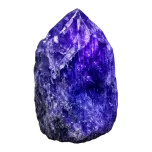
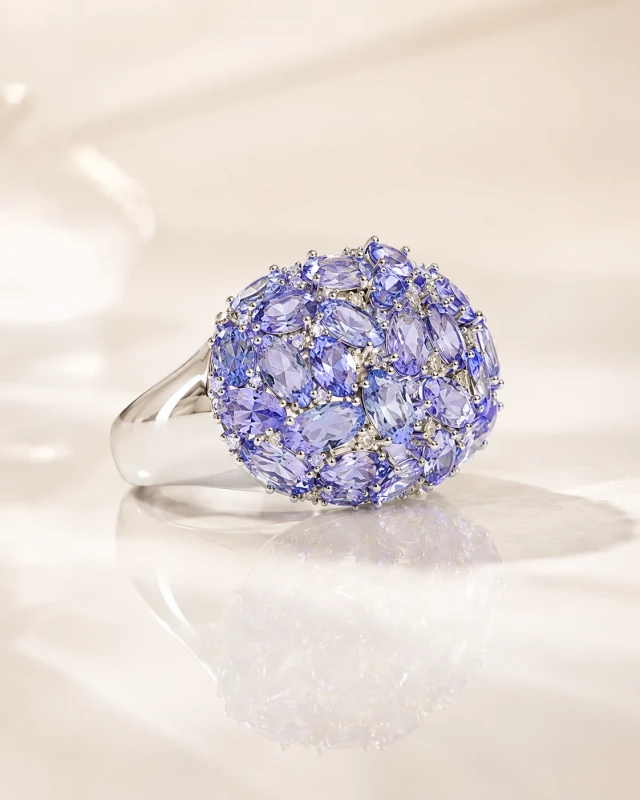
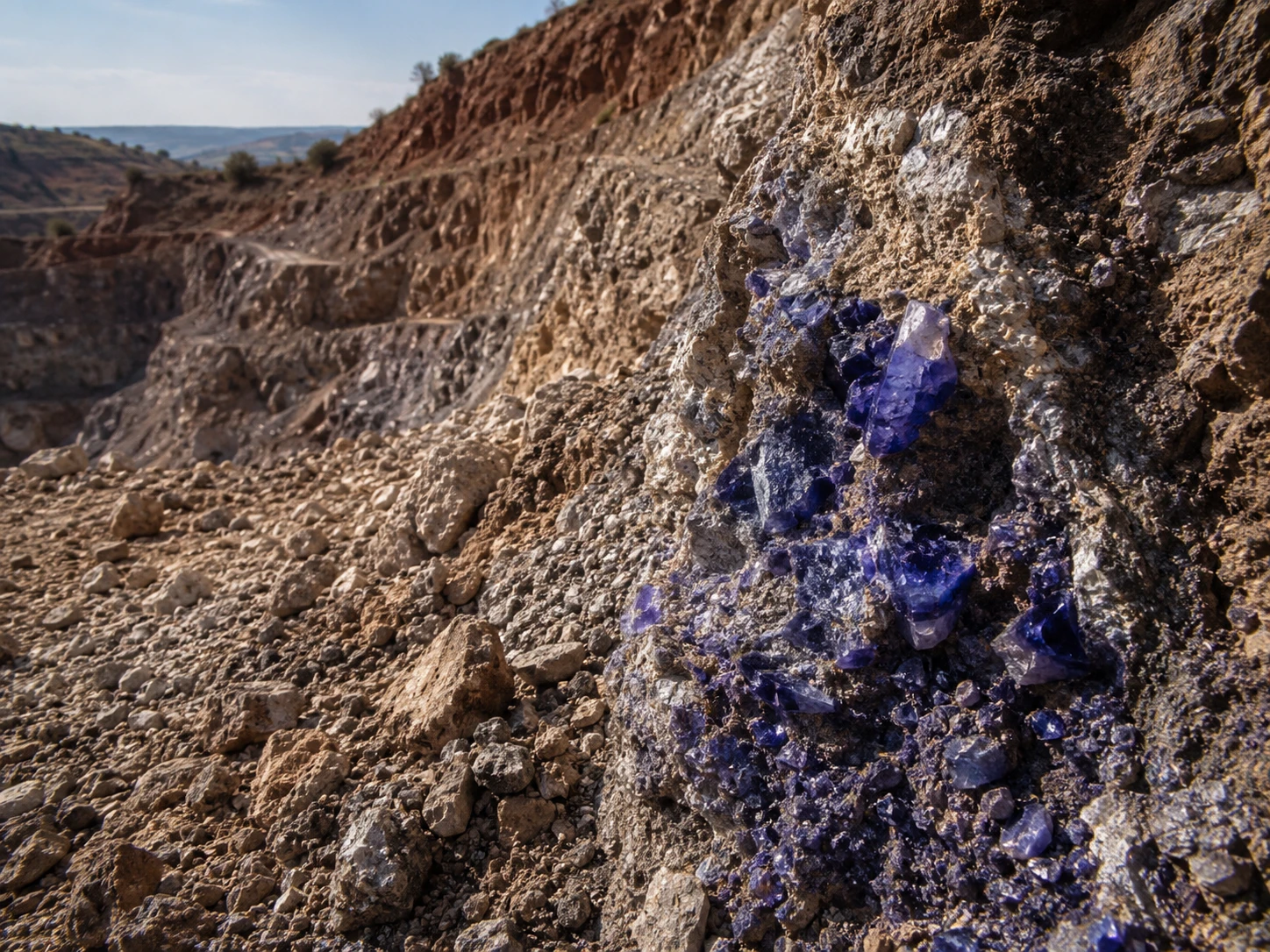



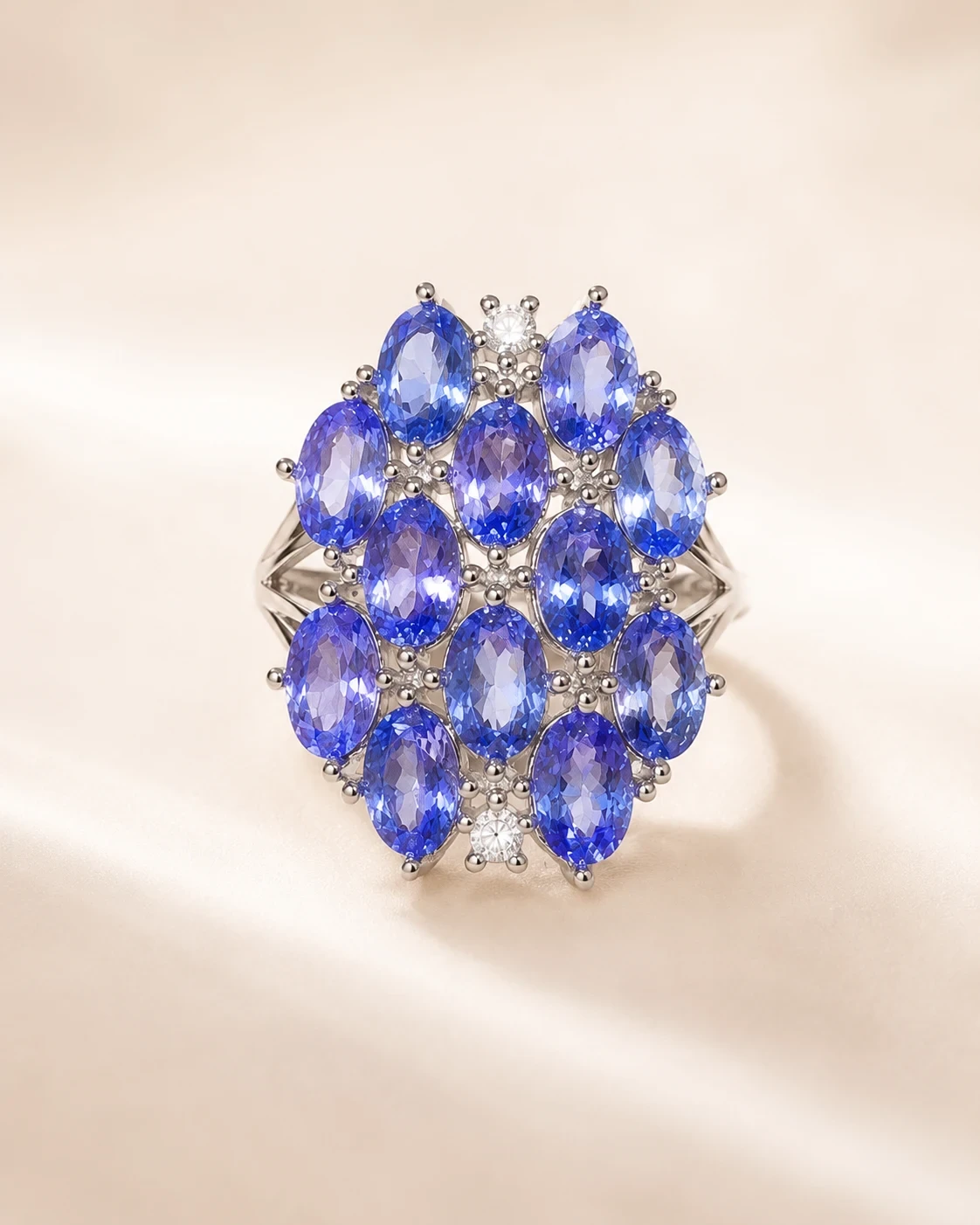
A tanzanite ring and a wedding band can share a finger, and the thing most likely to damage the tanzanite is the other ring. Not doorframes, not worktops. The band sitting against it for sixteen hours a day.
This gets almost no attention because most bridal advice is written about diamond centre stones, where it barely matters. At 6 to 7 on the Mohs scale it matters a great deal, and it is entirely manageable once you know what is rubbing against what.
The hazard, stated plainly
Hardness measures scratch resistance, not toughness, and scratch resistance is a comparison rather than a property. Anything harder than your stone will mark it, given contact and time.
Two rings on one finger are in contact constantly, with small movements, under the pressure of a hand that grips things. That is not an occasional knock. It is a low-grade abrasive process running all day, and the wear appears at the girdle and the lower crown facets where the rings meet.
For a diamond centre at 10 this is close to irrelevant. For tanzanite it is the single most predictable source of damage the stone will ever face, and it is the one nobody warns you about at the counter.
Diamond bands are the specific problem
An eternity or half-eternity band set with diamonds puts stones at 10 on the Mohs scale directly against a stone at 6 to 7, at the exact point where the two rings touch.
| Band type | Risk to a tanzanite beside it |
|---|---|
| Diamond eternity or half-eternity | Highest. Hard stones in permanent contact with a much softer one |
| Sapphire or ruby set band | High. Corundum sits at 9, still far above tanzanite |
| Plain metal band | Low. Metal is softer than the stone and marks itself instead |
| Milgrain or textured metal band | Low to moderate. Texture concentrates contact but is still only metal |
| Tanzanite or soft-stone band | Moderate, and mutual. Both stones lose |
The pattern in that table is simple: stones beside stones is the problem, and metal beside stone is not. A plain band takes the damage itself and shows it as ordinary wear on the metal, which is exactly where you want damage to land.
This does not mean a diamond band is forbidden. It means that if you want one, the design has to keep the two rings from touching, and that is a solvable problem addressed further down.
The fixes, compared
| Solution | How it works | What you give up |
|---|---|---|
| Contoured or shadow band | Shaped to sit close without bearing on the stone | The band is made for one specific ring |
| Plain metal spacer | Puts a soft buffer between the two rings | A little height on the finger |
| Bezel the tanzanite | A metal wall between the gem and everything | The pavilion is hidden from view |
| Wear on separate hands | Removes the contact entirely | The look of a matched stack |
| Plain band instead of set | Metal takes the wear instead of the stone | A row of brilliance beside the centre |
There is no row in that table that costs the stone anything, which is the point. Every one of these is cheap next to a recut, and a recut is what the alternative eventually buys you.
If you are choosing between them, the bezel is the one that solves the most problems at once, because it protects against knocks and worktops as well as against the band. The spacer is the one that requires no decision at the time of purchase and can be added later, which makes it the sensible retrofit for a ring you already own.
What daily wear actually does
Not dramatic breakage, in most cases. A slow loss of the thing you bought the stone for.
The quality of the cut makes a large difference to brilliance, and brilliance depends on facets meeting cleanly and returning light. Abrasion softens exactly those junctions. A stone worn against a harder band for years does not usually crack; it gradually stops sparkling, and the owner concludes the stone was never very good.
That is worth naming because it changes what you are protecting against. The catastrophic failure is rare and memorable. The slow one is common, invisible week to week, and entirely preventable by keeping a hard band off a soft stone.
Heat treatment, incidentally, has nothing to do with any of this. It is permanent and creates no additional care requirement, so a heated stone wears exactly like an unheated one. The variable is what it is touching.
Metal against metal, which is a smaller and different issue
The bands also wear each other, and this one is cosmetic rather than structural.
Two different metals in contact wear at different rates, with the softer one losing. Gold is alloyed precisely because pure gold has one significant drawback, softness, which means it wears out easily, and different alloys land in different places on that scale. Platinum is more resistant to scratching than gold, so a platinum band beside a gold one will quietly consume the gold over years.
There is a specific consequence for white gold. Its brightness usually comes from rhodium plating, and that plating can rub off over time, resulting in minor discoloration and a reduction of shine. Two rings rubbing accelerate exactly that, and the wear shows first on the touching edges. It is fixable, since polishing and reapplying the rhodium is relatively straightforward and affordable, but it becomes a recurring job rather than a rare one.
None of this endangers the stone. It is worth knowing so that uneven wear between two rings reads as normal physics rather than as a fault in one of them.
Keeping the rings from touching
Three approaches, in ascending order of how much they change the look.
A contoured or shadow band. Cut to follow the outline of the engagement ring and sit close without bearing against the stone or its setting. This is the standard solution and it is a good one, because it looks like a matched pair while keeping a gap where it counts.
A spacer. A thin plain band worn between the two rings. It costs a little height on the finger and it completely removes stone-on-stone contact, and a plain metal spacer is doing the job the table above describes: absorbing wear into metal.
Separation. Wear the band on the other hand, or on a different finger, or wear the rings on different days. Unromantic and completely effective, and more common than people admit.
Each of these has a version that fails. A contoured band ordered from a photograph rather than fitted to the actual ring often ends up bearing on the setting after all. A spacer thin enough to be invisible is sometimes too thin to keep the rings apart under grip pressure. And separation only works if it is a habit rather than an intention.
A fourth option is structural rather than additive: a bezel or half-bezel around the tanzanite raises a metal wall between the gem and anything beside it. That helps against the band and against everything else, which is why it keeps appearing as the answer to tanzanite questions.
Wearing order, and why the tanzanite goes outside
Convention puts the wedding band closest to the heart, meaning below the engagement ring on the finger. For tanzanite there is a practical reason to prefer that order too.
The ring nearer the fingertip takes more contact with the outside world, but the ring nearer the knuckle takes more of the flexing and gripping load. A stone set high on the outer ring, with a plain band inboard of it, keeps the gem away from the hardest-working part of the joint and away from the band’s own stones if it has any.
If your band is set with diamonds all the way round, the order matters less than the gap does, because an eternity band contacts the ring above it regardless of which way up the stack sits.
Sizing two rings that live together
Two rings on one finger behave like one wider ring, and that changes the fit.
Worn as a pair, they distribute pressure differently, and many people find the combined stack sits tighter than either ring alone. Size the pair together rather than separately, on the same day and at the same time of day, because fingers change size with heat, salt and activity more than people expect.
The consequence for tanzanite is worth being explicit about. Resizing a tanzanite ring is not a casual job: it puts heat and mechanical stress into a mount holding a stone with a cleavage plane, and the stone should be removed first. So getting the fit right at the outset is worth more here than it would be with a sapphire, and it is a good argument for buying the band after the engagement ring rather than the other way round.
When they should not be worn together
Four situations where the stack comes off, and the first two are not about the stone at all.
Anything physical. Gym work, lifting, gardening, climbing, DIY. Two rings grinding under grip pressure is the abrasive process described above, running at speed.
Swimming and cold water. Fingers shrink, and a stack is easier to lose than a single ring because it moves as a unit.
When the band is set with diamonds and there is no gap. If the design has stones touching stones and neither a contour nor a spacer, wearing them together permanently is choosing to abrade the tanzanite. Wear them separately until the design is changed.
When either ring is loose. A ring that spins puts contact where it was never designed to be, and a loose stone in either ring turns an ordinary day into a lost gem.
None of these is a reason to keep the rings in a box. A stack that comes off for the gym and goes back on afterwards will outlast one that never comes off at all, and the habit takes a week to form.
Anniversary bands, and adding one later
Adding a band years after the engagement ring is common, and it is easier when the tanzanite is already in the picture.
The rule that matters is the same one: choose a band whose stones cannot reach the tanzanite, or whose shape holds it clear. A plain metal anniversary band is not a lesser choice here; against a soft centre stone it is the technically better one, and it lets the tanzanite carry the piece visually rather than compete with a row of brilliance.
If you want a stone-set band, the safe versions are those where the stones sit inboard, flush, or on the outer edge away from the contact face. Ask the bench to show you where the two rings meet, physically, with both in hand. Thirty seconds of that answers more than any catalogue photograph.
For metal, matching the engagement ring is the usual instinct and it is sound, mostly to avoid the differential wear described earlier. Tanzanite goes with warm and cool metals in different ways, so the aesthetic question has more freedom than the practical one.
Stacking more than two
Three or more rings on a finger multiplies every problem in this article, and one detail changes.
With two rings there is a single contact face to think about. With three, the tanzanite may sit between two others and take contact on both sides, including from a ring that was never chosen with it in mind. Stacks also rotate more, so the contact points move rather than staying where you inspected them.
If you wear a stack, the tanzanite belongs at one end of it rather than in the middle, and preferably at the fingertip end where it meets fewer neighbours. Bezel-setting matters more here than anywhere else, because a bezel is the only fix that works regardless of what ends up sitting next to it next year.
The other stack-specific point is loss. Several rings move as a unit and slip off together, which is how people lose three rings at once in a swimming pool. That is not a gemmological risk, and it is the one most likely to actually happen.
Buying the pair: an order of operations
If both rings are still ahead of you, a little sequencing avoids most of this article.
Choose the tanzanite ring first, including its setting, because the setting decides what a band has to work around. A bezel-set stone accepts almost any band; a high raised solitaire constrains the choice considerably.
Take the engagement ring with you when choosing the band, physically, and put both on the hand. Look at the contact point in daylight. This is a two-minute check that no photograph or description substitutes for, and it is the single most useful thing in this article.
Size them together, on the same day, and ask whether the band can be ordered slightly differently to clear the setting. Many can, and the request is routine.
Then ask one question that people forget: what happens if the ring needs resizing in ten years. With a tanzanite the answer involves removing the stone, so a band that can be resized independently of the engagement ring is quietly worth having.
Where to start
Look at where the two rings actually touch, with both on your hand, before buying the second one. If stones meet stones, change the design or add a spacer. If metal meets metal, you have almost nothing to worry about.
For whether tanzanite belongs in an engagement ring at all, tanzanite engagement rings, and when the answer is no. For the habits that keep any tanzanite intact, the honest care answer, and if something has already gone wrong, what can be repaired.
When you want to look at pieces, ours are here.
COMMON QUESTIONS
Can I wear a wedding band next to a tanzanite engagement ring?
Yes, and the band is the main thing to get right. Two rings on one finger are in contact all day under grip pressure, which abrades a stone at 6 to 7 on the Mohs scale. A plain metal band is safe, because metal is softer than the stone and takes the wear itself. A stone-set band needs a contoured shape, a spacer, or a bezel around the tanzanite to keep the two from touching.
Will a diamond eternity band damage my tanzanite?
It can, and it is the highest-risk combination. Diamonds sit at 10 on the Mohs scale and tanzanite at 6 to 7, and an eternity band places hard stones in permanent contact with a much softer one at exactly the point where the rings meet. Hardness is scratch resistance, meaning a comparison rather than a property, so anything harder will mark the stone given contact and time. Keep a gap, or choose a plain band.
Which ring goes on first?
Convention puts the wedding band closest to the heart, below the engagement ring, and for tanzanite there is a practical reason to prefer that too. It keeps the raised stone away from the hardest-working part of the knuckle and away from the band's own stones. If the band is set with diamonds all the way round, the order matters less than the gap does, because it contacts the ring above it either way.
Should I size the two rings together?
Yes. Worn as a pair they behave like one wider ring and often sit tighter than either alone, so size them together on the same day and at the same time of day. Getting it right at the outset matters more with tanzanite than with a harder stone, because resizing puts heat and mechanical stress into a mount holding a gem with a cleavage plane, and the stone should be removed first.
My rings have worn each other unevenly. Is something wrong?
Probably not. Two metals in contact wear at different rates and the softer one loses: platinum is more resistant to scratching than gold, so a platinum band will slowly consume a gold one. White gold shows it soonest because its brightness comes from rhodium plating, which rubs off with contact. Replating is straightforward and affordable, just recurring. None of this endangers the stone.
SOURCES
- Gemstone Hardness and Wearability — International Gem Society Hardness measuring scratch resistance rather than toughness; diamond at Mohs 10 and corundum at 9, used for the band comparison.
- Tanzanite Value, Price, and Jewelry Information — International Gem Society Hardness 6 to 7 with perfect cleavage.
- Platinum vs. White Gold: How to Choose — International Gem Society Platinum being more resistant to scratching than gold; rhodium plating rubbing off with minor discoloration and reduced shine; replating being straightforward and affordable.
- Jewelry Metals 101: Gold, Silver, and Platinum — International Gem Society Gold's softness as the reason it is alloyed, underlying the differential-wear section.
- Tanzanite Buyer's Guide — GIA Cut quality making a large difference to brilliance, used to explain what slow abrasion actually costs.
- Tanzanite Description — GIA Heat treatment being permanent and creating no additional care requirement.