
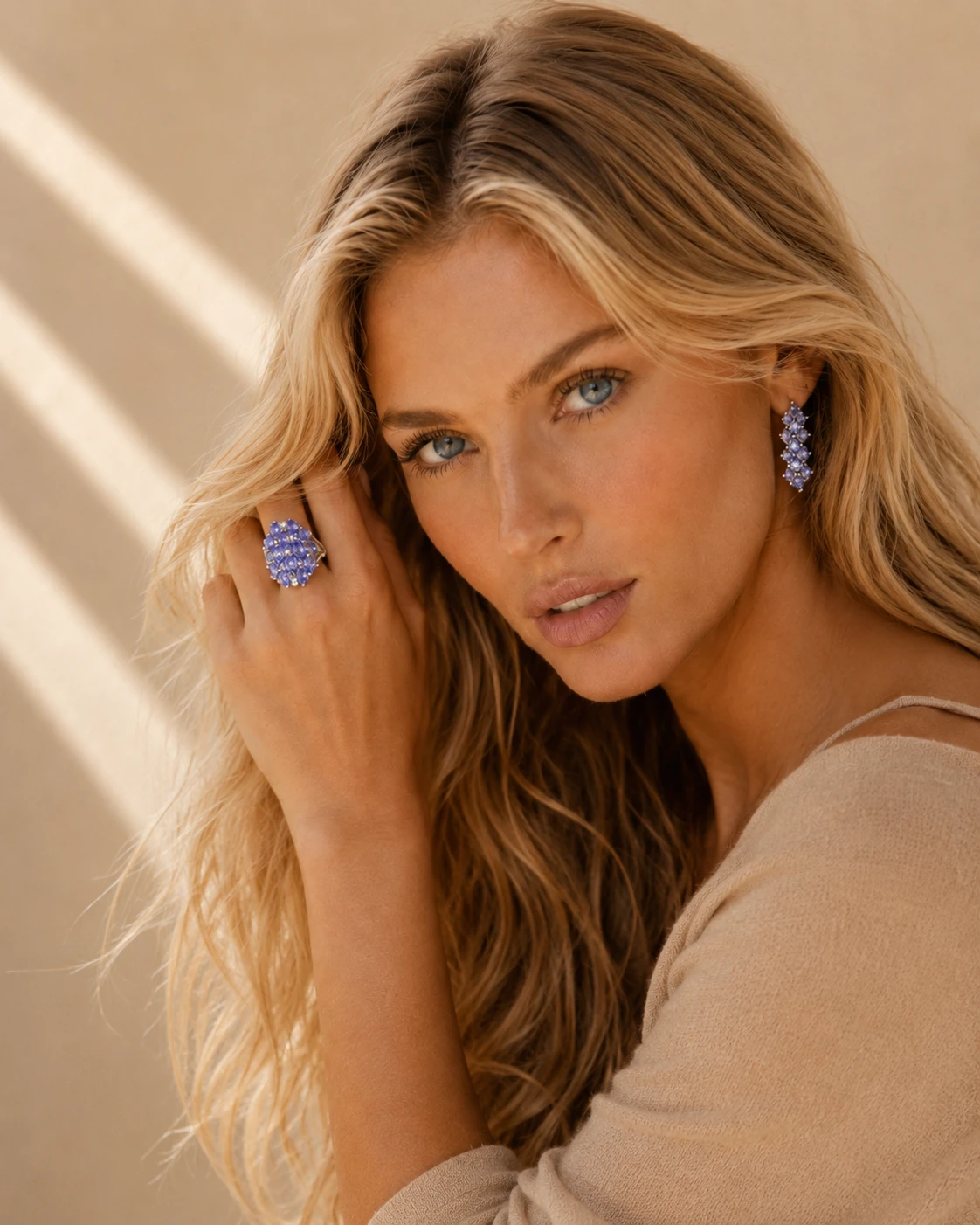
Tanzanite goes with almost anything, and the one decision that actually matters is whether your stone reads blue or violet. Everything else on this page is preference, offered as preference, because style rules in jewellery are mostly somebody’s taste written in the imperative.
What follows is how the metals genuinely differ, what each does to a violet-blue stone, and which of it is a practical question rather than an aesthetic one.
Start with the stone you have, not the stone in the photograph
Tanzanite is not one colour, so advice written for one colour will be wrong half the time.
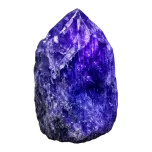
The stone is very strongly pleochroic, showing blue, red-violet and yellow-green down its three crystal axes, and the cutter decided which of those you see. It also shifts with the light: sapphire blue in natural light and violet under fluorescent light.
So before choosing anything, look at your stone in the light you actually live in. A stone that reads decidedly blue behaves like a sapphire for styling purposes. One that reads violet behaves more like an amethyst. Most sit somewhere between and lean one way, and knowing which way is worth more than any rule below.
Blue and violet want slightly different things
Blue leans cool, so it sits comfortably beside cool metals and cool colours, and it takes a warm metal as a deliberate contrast rather than a match.
Violet is a mixed hue with red in it, which makes it more flexible. It reads well against warm metals because the red note in the stone and the warmth of the metal agree, and it stays perfectly good against white metals, which read as a neutral frame.
That is the whole of the colour theory, and it is a starting point rather than a verdict. A blue stone in yellow gold is a strong, deliberate combination that plenty of people prefer to the safer one.
The metals, and how they actually behave
| Metal | With tanzanite | The practical part |
|---|---|---|
| Platinum | Neutral white frame, lets the stone set the colour | More resistant to scratching than gold and holds gemstones securely for a very long time |
| White gold | Same visual effect, usually rhodium plated | The plating can rub off over time, resulting in minor discoloration and a reduction of shine |
| Yellow gold | Warms a violet stone, contrasts a blue one | Alloy composition decides hardness; gold is alloyed because pure gold wears out easily |
| Rose gold | Flatters the red note in violet stones | Copper in the alloy is what makes it pink |
| Sterling silver | Cool white, softer look than platinum | 92.5% silver, soft, and it tarnishes |
Two rows deserve expanding, because they are where people are most often surprised after buying.
The rhodium question, which nobody mentions at the counter
Most white gold is not actually white enough on its own, so it is plated with rhodium to make it so.
That plating is a finish rather than the metal, and it can rub off over time, resulting in minor discoloration and a reduction of shine. On a ring worn daily it goes first at the back of the band and the high points. The remedy is straightforward: polishing and reapplying the rhodium to white gold is relatively straightforward and affordable, and it is a periodic job rather than a one-off.
None of that makes white gold a bad choice. It makes it a choice with a maintenance schedule attached, and knowing that in advance is the difference between a piece that ages well and one that disappoints you in year three. Platinum avoids it entirely by being white all the way through, at a higher price and a heavier feel.
Silver, honestly, because it is what we sell
Sterling silver is 92.5% silver with other metals making up the rest, and it has two properties worth stating plainly.
It tarnishes. The chemical reaction that causes silver to tarnish requires hydrogen sulfide, which occurs in our air, so silver items left out exposed will tend to tarnish over time. Stored properly and worn regularly, this is a minor and reversible thing. Left in a dish by a window for a year, it is not.
It is softer than gold or platinum. For a stone at 6 to 7 on the Mohs scale with perfect cleavage, a softer metal cuts both ways: prongs can be closed with less force, which is gentler at the moment of setting, and they also wear and loosen sooner, which means checking them more often.
Maison Tanzanite’s pieces are 925 sterling silver, and one of them is sterling silver with a gold layer, which is plated rather than solid gold. We would rather write that sentence than let a photograph imply otherwise.
Skin tone, as a preference and not a rule
You will read a great deal about undertones, and most of it is stated far more confidently than it deserves.
The observation underneath is real enough: warm metals and warm colours tend to harmonise with warmer complexions, cool with cooler, and many people find one group easier to wear. That is a tendency among some people, not a law, and it says nothing about what suits you specifically.
Treat it as one input. Hold the piece against your hand in daylight, look, and believe what you see over what a chart says. Plenty of people look best in the metal they were told to avoid, and nobody has ever been stopped at a door for it.
The same goes for any advice that assigns stones or metals by gender. Tanzanite is a violet-blue gem. It has no opinion about who wears it.
Colours it sits well beside
Violet-blue is easier to dress than people expect, because it is close to a neutral in most wardrobes.
It is comfortable against navy, charcoal, black, white, cream and grey, which covers most of what most people own. It becomes a deliberate accent against warm neutrals like camel and rust, where the contrast is the point. It competes with strong saturated blues and purples worn nearby, because two similar strong colours in the same frame make each other look uncertain.
For occasions the useful distinction is scale rather than colour. A small stone reads as a detail in daylight and at work. A large one is a statement in any light, and the honest question is whether you want to be making one that day.
Evening does something specific to this stone that is worth planning around. Warm indoor and candle light pushes tanzanite toward its violet reading, so a piece chosen in daylight for its blue will look meaningfully different across a dinner table. That is not a problem to be solved. It is closer to the reason to own the stone, and the only mistake is being surprised by it.
Accent stones, and what they are actually doing
Small white stones around a tanzanite are the usual choice, and they do a specific job: they raise the apparent brightness of the piece and give the eye a neutral reference that makes the violet-blue read more strongly.
Ask what the accents are. Diamond, white sapphire, topaz, zircon and cubic zirconia all look broadly similar at small sizes and differ enormously in price and durability, and a piece described only as having “accent stones” has not told you anything. This is one of the few points in styling that is also a value question.
| Accent stone | Hardness | What it means in a piece |
|---|---|---|
| Diamond | 10 | Hardest and dearest. Also brittle, and it has cleavage |
| White sapphire | 9 | Very hard with no cleavage. The quiet best value for durability |
| White topaz | 8 | Hard, but perfect basal cleavage in one direction |
| White zircon | 6 to 7.5 | Very brittle, so facet edges tend to chip and wear easily |
| Cubic zirconia | Synthetic, no natural counterpart | Legitimate when disclosed. Worth a fraction of the others |
The durability column matters more than it looks, because accent stones sit at the outside of a piece where knocks land first. A ring with brittle accents will lose one eventually, and replacing a small stone is a bench job with a cost attached.
Coloured accents are a stronger move and a riskier one. Green beside violet-blue is a genuine complement and can look superb; more blue beside blue usually flattens the main stone.
Setting style changes the accents’ effect as much as their colour does. Accents set flush in the metal read as texture and brightness. Accents raised in their own prongs read as a second row of gemstones and pull attention away from the centre. Neither is better, and a piece that cannot decide between them is the one to avoid.
Matching tanzanite to tanzanite
A piece with several tanzanites in it raises a question that catches people out, and the answer is reassuring.
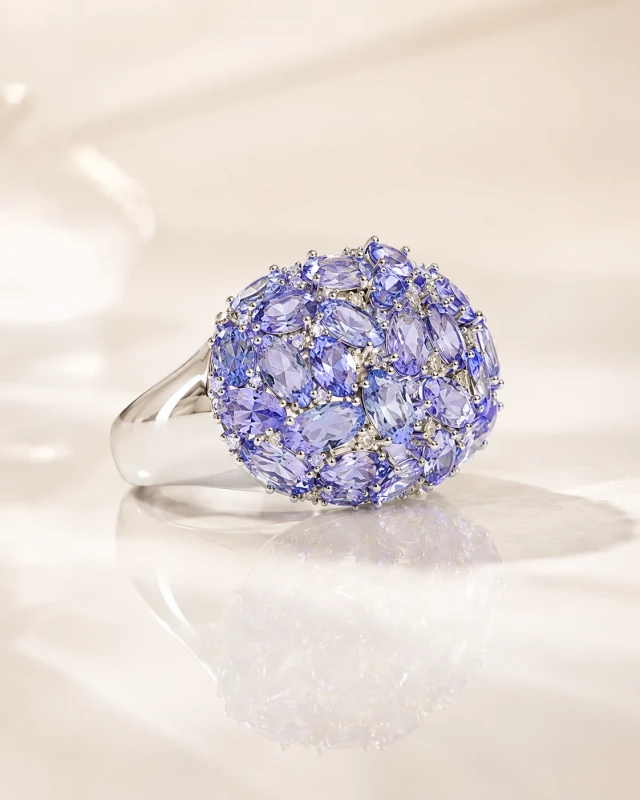
The small stones will be paler than the large one, and that is normal rather than a fault. Saturation depends on the depth of stone light travels through, so accent stones under two carats are commonly a lighter colour and deep colour generally requires a stone above five carats. A cluster of small tanzanites cannot look like one big one, because the physics will not allow it.
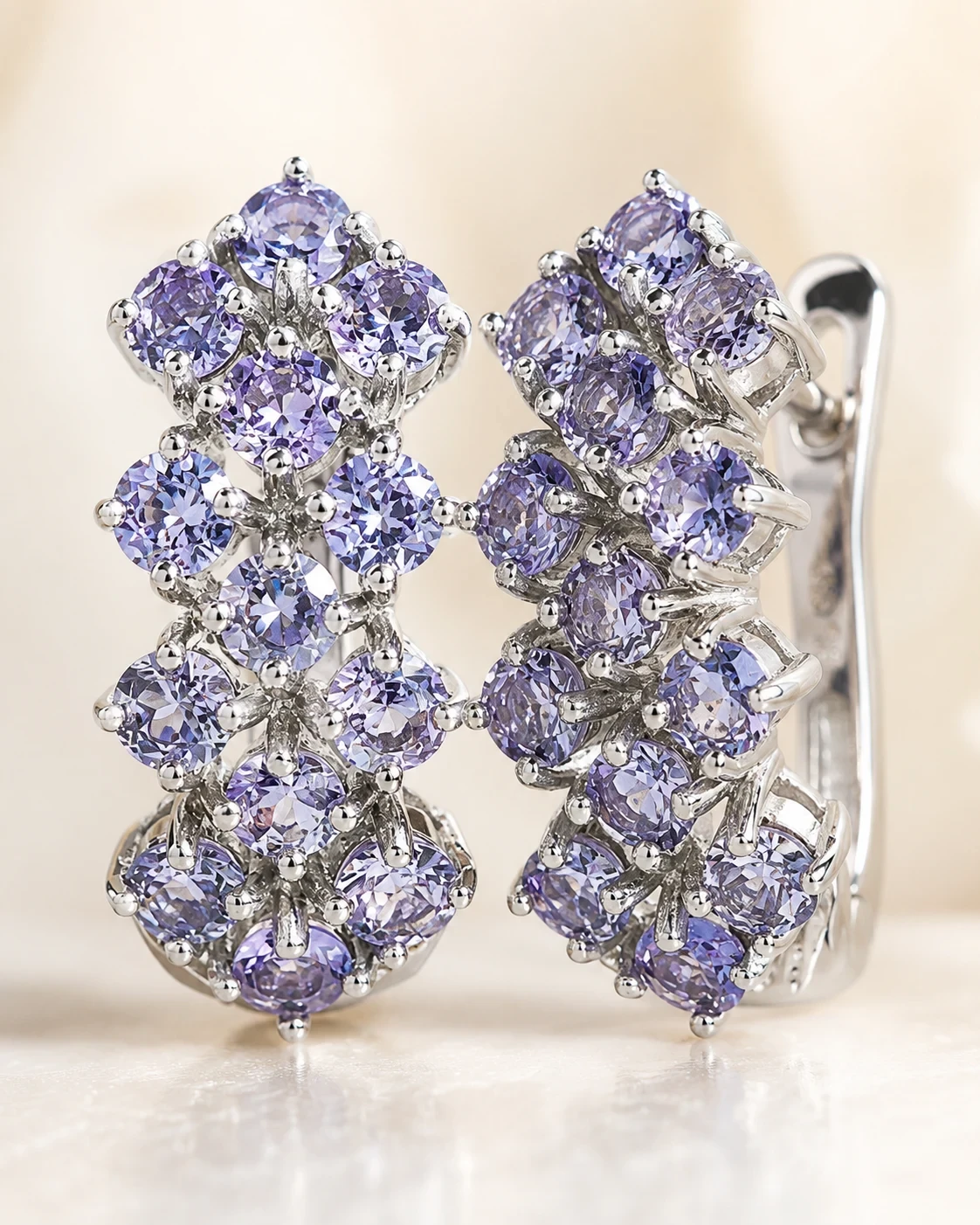
This has a styling consequence worth using deliberately. A cluster or pavé of small tanzanites reads as a soft violet-blue field rather than as a single intense point of colour, and that is a different and often more wearable effect. Pastel hues are more plentiful, more affordable, and have a subtle appeal of their own, and a piece built on that fact is honestly made rather than compromised.
What to watch for instead is tone consistency across stones that are the same size. Neighbouring stones of equal size in noticeably different tones look unsorted, and sorting is real work that a good maker does and a careless one skips. Look across a cluster in daylight and see whether the stones agree with each other.
If you are wearing separate tanzanite pieces together, the same logic applies at a larger scale. A pale pendant beside a vivid ring reads as two different stones rather than a set. Either match them deliberately or separate them by enough distance that the eye does not compare.
Rings, necklaces and earrings, and how they behave differently
The same stone asks for different things depending on where it sits.
Rings are where every practical consideration bites hardest, because hands meet doorframes and worktops. This is the piece where a protective setting earns its keep and where metal hardness matters most.
Necklaces and pendants are the easiest home for tanzanite, and this is not a small point. Nothing on a chain gets knocked, so the durability question that constrains rings largely evaporates, and a pendant sits at a distance where the colour shift between daylight and indoor light is most visible.
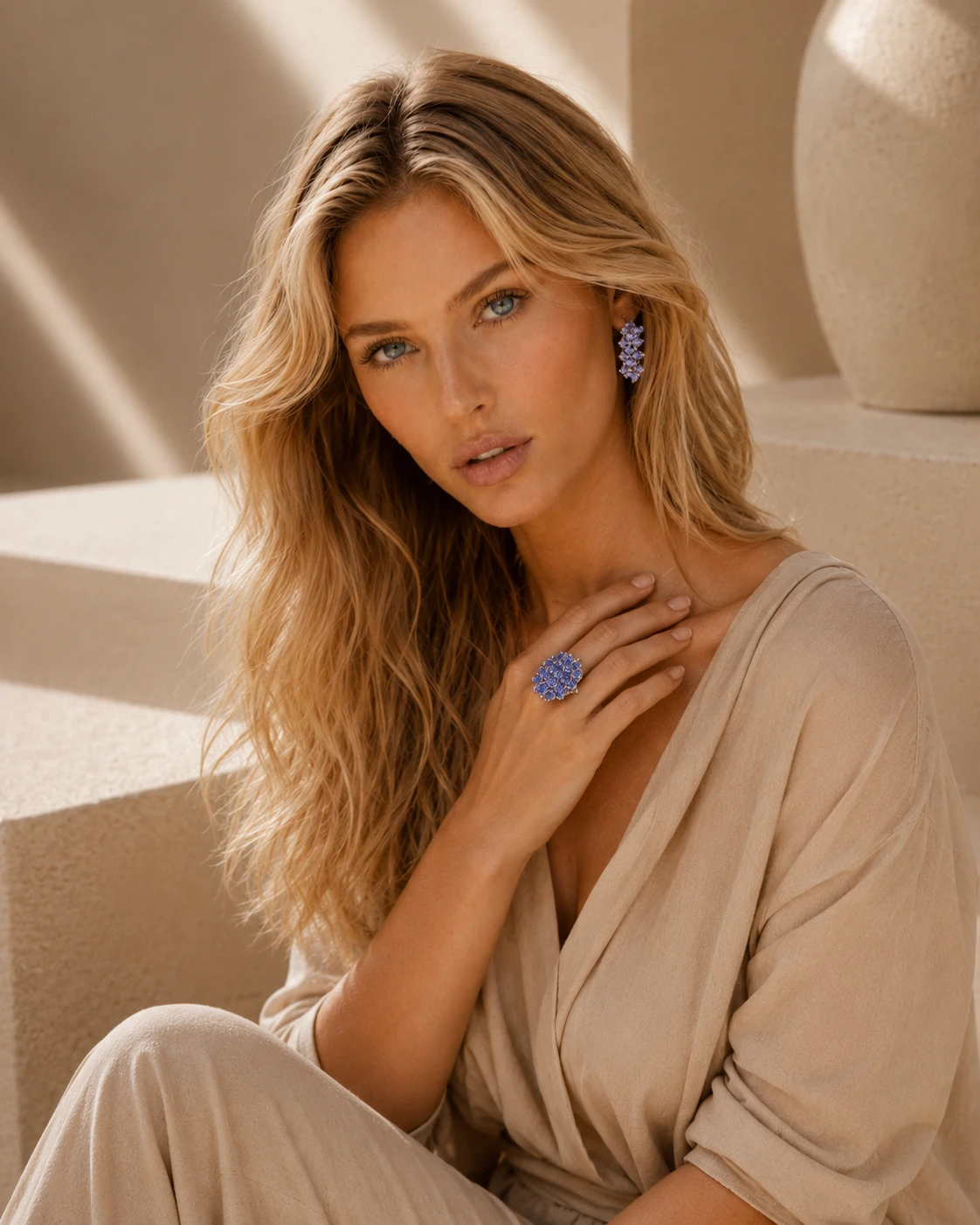
Earrings sit near the face, which is where the pleochroism does its best work, because the stones move constantly and catch different angles. Smaller stones do more here than their size suggests.
One more difference is worth knowing before buying a set. Rings are the piece most often resized, and resizing a tanzanite ring is a real operation that should involve removing the stone first. Necklaces and earrings never face that problem, so if you expect a ring size to change, buying the ring last is sensible.
If you are building a set, the usual advice is to match everything. The better advice is to match the metal and let the stones vary in size, because three identical stones at three scales looks considered and three identical stones at one scale looks like a display.
Where style advice goes wrong
Three places, and all of them are cases of a preference presented as a rule.
Rules that ignore your specific stone. Advice written about “tanzanite” cannot know whether yours reads blue or violet, and that difference changes the answer more than anything else on this page.
Rules that ignore the light. A combination judged under shop lighting is a combination judged in violet. Decide in the light you will wear it in.
Rules that outrank practicality. If the aesthetic answer is a raised prong setting on a ring for a working hand, the aesthetic answer is wrong. Durability is a constraint rather than a preference, and it is the one part of this article that is not a matter of taste.
Practicality, which quietly outranks all of it
Everything above assumes the piece survives being worn, and for tanzanite that assumption needs checking.
Hardness measures scratch resistance, not toughness, and tanzanite has both a modest hardness and a cleavage direction. Whatever the styling verdict, a protective setting on a ring is the choice that keeps the stone, and the honest care answer covers the habits that go with it.
Where to start
Look at your stone in daylight and decide whether it leans blue or violet. Choose the metal you actually like against your own hand. Then let the practical constraints settle the setting, because those are not negotiable in the way the rest of this is.
For what the cutter decided before any of this was possible, how a tanzanite is cut and set. For judging a stone before you style it, how to buy tanzanite, and for what the accent stones and the metal are doing to the price, what decides the price.
When you want to look at pieces, ours are here. They are sterling silver, one of them gold-plated, and each says so on its own page.
COMMON QUESTIONS
What does tanzanite go well with?
Most things, and the decision that matters is whether your particular stone reads blue or violet. A blue-leaning stone is cool and sits naturally beside white metals and cool colours, taking a warm metal as deliberate contrast. A violet-leaning stone has a red note that agrees with yellow and rose gold, and stays fine against white metals. Look at your own stone in daylight before following any rule.
What metal is best for tanzanite?
There is no single best, only trade-offs. Platinum is more resistant to scratching than gold and holds gemstones securely, at a higher price. White gold looks similar but is usually rhodium plated, and that plating rubs off over time and needs reapplying, which is straightforward and affordable but ongoing. Yellow and rose gold warm a violet stone. Sterling silver is softer and tarnishes, which is reversible with regular wear and proper storage.
Why are the small tanzanites in my ring paler than the big one?
Because saturation depends on the depth of stone light travels through, so the same material looks weaker in a smaller gem. Accent stones under two carats are commonly lighter, and deep colour generally requires a stone above five carats. A cluster of small tanzanites cannot look like one large one. What is worth checking is whether stones of the same size agree with each other in tone, which is a question about sorting.
Does tanzanite suit my skin tone?
Probably, and the undertone advice you will read is stated more confidently than it deserves. Warm metals tend to harmonise with warmer complexions and cool with cooler, but that is a tendency among some people rather than a rule about you. Hold the piece against your hand in daylight and believe what you see. The same applies to advice assigning stones or metals by gender.
Why does my tanzanite look different in the evening?
Because tanzanite reads sapphire blue in natural light and violet under fluorescent and warm indoor light. Warm evening lighting pushes the stone toward its violet reading, so a piece chosen in daylight for its blue will look meaningfully different at dinner. This is pleochroism doing what it does, and it is closer to the reason to own the stone than a problem with it.
SOURCES
- Tanzanite Value, Price, and Jewelry Information — International Gem Society Very strong pleochroism showing blue, red-violet and yellow-green; sapphire blue in natural light and violet under fluorescent light; hardness 6 to 7 with perfect cleavage.
- Platinum vs. White Gold: How to Choose — International Gem Society Platinum being more resistant to scratching than gold and holding gemstones securely for a long time; white gold's rhodium plating rubbing off over time with minor discoloration and reduced shine; replating being relatively straightforward and affordable.
- Jewelry Metals 101: Gold, Silver, and Platinum — International Gem Society Gold's softness as the reason for alloying; sterling silver at 92.5% silver; tarnish requiring hydrogen sulfide present in air.
- Tanzanite Buyer's Guide — GIA Accent stones under two carats commonly being a lighter colour, and deep colour generally requiring a stone above five carats.
- Tanzanite Description — GIA Pastel hues being more plentiful, more affordable and having a subtle appeal of their own.
- Gemstone Hardness and Wearability — International Gem Society Hardness measuring scratch resistance rather than toughness.
- Topaz Value, Price, and Jewelry Information — International Gem Society Topaz at Mohs 8 with perfect basal cleavage in one direction, cited in the accent-stone comparison.
- Zircon Value, Price, and Jewelry Information — International Gem Society Zircon at Mohs 6 to 7.5 and very brittle, with facet edges that tend to chip and wear easily.
- Sapphire Value, Price, and Jewelry Information — International Gem Society Sapphire at Mohs 9 with no cleavage planes, cited in the accent-stone comparison.