

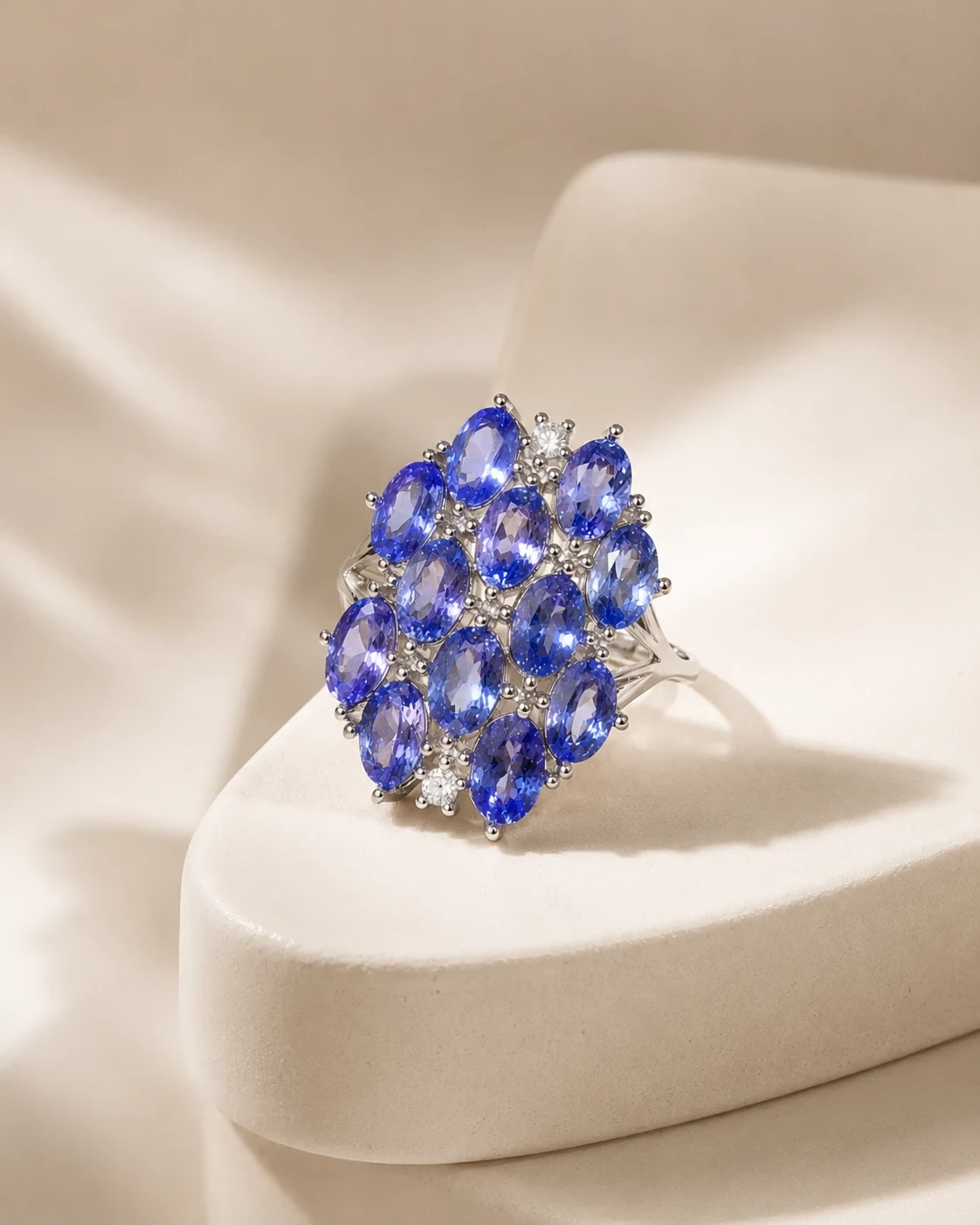
The most consequential decision in a tanzanite’s life is made before a single facet is cut, it takes about a minute, and it cannot be undone. Somebody holds the rough up, turns it, and decides which direction will face the sky. That choice fixes the colour of the finished gem permanently.
Everything else in cutting and setting is skill applied to that decision. This is how the work is done, in the order it happens, and what each stage can cost you if it goes badly.
One thing stated plainly first. Maison Tanzanite does not cut its own stones, does not employ a cutter and has no workshop. This article describes how the trade does the work, not how we do it, because we do not do it. It is here because knowing what a cutter decided is the difference between judging a stone and looking at one.
The decision before any facet
Tanzanite is trichroic, which is rare and is the whole problem.
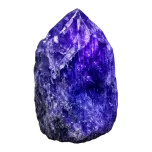
Most coloured stones show one colour. Tanzanite shows three, depending on which crystal axis you look down. It is very strongly pleochroic, and a blue stone displays blue, red-violet and yellow-green through its three axes. Those colours are all genuinely in the crystal at once. The cutter chooses which one the buyer will see.
Orient the rough one way and the finished stone faces up blue. Turn it and the same crystal faces up violet. Turn it again and you get the yellow-green axis, which nobody wants and which is the direction a careless cutter sometimes ends up nearest.
This is not a subtlety a buyer can inspect their way past afterwards. Once the stone is faceted, the orientation is set in the geometry. A violet stone cannot be recut blue without going back to rough and losing most of the weight, which is why the decision is worth more than the labour that follows it.
Why blue costs more than violet
Because of where the blue axis sits in the crystal, not because blue is better.
In most tanzanite rough the blue direction is the short one. Cutting a stone that faces up blue means orienting across the narrow dimension of the crystal, which yields a smaller finished gem from the same piece. Cutting for violet follows the long axis and yields more.
So a cutter facing a given crystal is choosing between a smaller blue stone and a larger violet one, and the market pays more per carat for the blue. Both choices are legitimate and neither is a trick. What matters to a buyer is knowing the trade happened: blue is dearer because there is less of it per crystal, and a seller framing blue as inherently finer is describing scarcity as quality.
Weight against colour, which is the constant temptation
Rough is bought by weight and finished stones are sold by weight, so every gram kept is money kept. Colour is the thing that gets sacrificed to keep it.
A cutter chasing yield orients closer to whichever axis preserves the most material rather than the one that produces the best face-up colour, and accepts a shallower cut to hold the weight in the belly of the stone. The result is heavier, cheaper per carat, and flatter to look at. The market rewards this often enough that it keeps happening.
You cannot see the orientation choice directly. You can see its consequence, because the quality of the cut makes a large difference to brilliance. A well cut stone returns light evenly across its whole face. A stone cut for weight returns it around the edges and goes dead in the middle.
Windows, extinction and what to look for
| What you see | What it means |
|---|---|
| A pale patch under the table that moves with the stone | A window. The pavilion is too shallow and light passes straight through instead of bouncing back |
| Dark zones that stay dark at every angle | Extinction. Often a proportion problem, sometimes an orientation one |
| Colour that shifts strongly as you tilt | Normal for tanzanite. This is the pleochroism, not a fault |
| Brilliance only at the rim | Weight kept in the belly at the expense of the centre |
The third row is worth dwelling on because buyers report it as a defect. A tanzanite that changes character as it moves is doing exactly what a trichroic stone does, and a stone that stayed identical from every angle would be more suspicious than one that did not. Judge the face-up colour, then enjoy the rest.
There is a fourth thing worth naming because it is invisible until it is not: colour zoning. Tanzanite rough is not always evenly coloured through its volume, and a cutter positioning the table over a richer band can produce a stone that reads well face up while a paler zone sits out of sight below. That is legitimate craft rather than deception, and it is another reason a loose stone beats a mounted one when you are judging seriously.
Tilt any stone you are shown. Thirty seconds of turning it under a light tells you more about the cut than any grade on a ticket, and there is no standard grading scale for tanzanite anyway.
Cutting a stone that has a plane of weakness
Tanzanite is 6 to 7 on the Mohs scale with perfect cleavage, and it has one direction of perfect cleavage. That combination governs the whole bench process.
Hardness and toughness are not the same property, and confusing them is where most damage starts. As the International Gem Society puts it, hardness measures scratch resistance, not toughness, while cleavage defines how a gemstone breaks when struck, much like grain in wood.
A cleavage plane is a direction along which the stone will split cleanly if struck right. It does not make the stone fragile in ordinary handling; it makes it unforgiving of one specific kind of accident. That is true of far more gems than people assume, and even diamond, with perfect cleavage, can chip or split.
For the cutter this means heat and vibration are the enemies. Aggressive wheels, sudden temperature changes and heavy pressure near the cleavage direction can open the stone on the lap, and a crystal that survives sawing can still part during polishing. The work is slow because it has to be.
Shapes, and why the same three keep appearing
Cushions, trillions and ovals are the most common shapes, and that is a consequence of the crystal rather than a fashion.
Tanzanite forms in elongated prismatic crystals. An outline that follows that shape wastes less, and less waste means the cutter can afford to prioritise colour instead of yield. A round brilliant cut from the same rough throws away far more material, which is why rounds carry a premium that has nothing to do with being better and everything to do with what was lost making them.
Emerald cuts and other step cuts appear too and behave differently: broad flat facets show colour in large clean planes rather than scattering it, which suits a saturated stone and mercilessly exposes a pale one. A step-cut tanzanite that looks good is usually genuinely good, because the cut has nowhere to hide.
The sequence, from rough to finished gem
Five stages, and the order is fixed because each one removes options from the next.
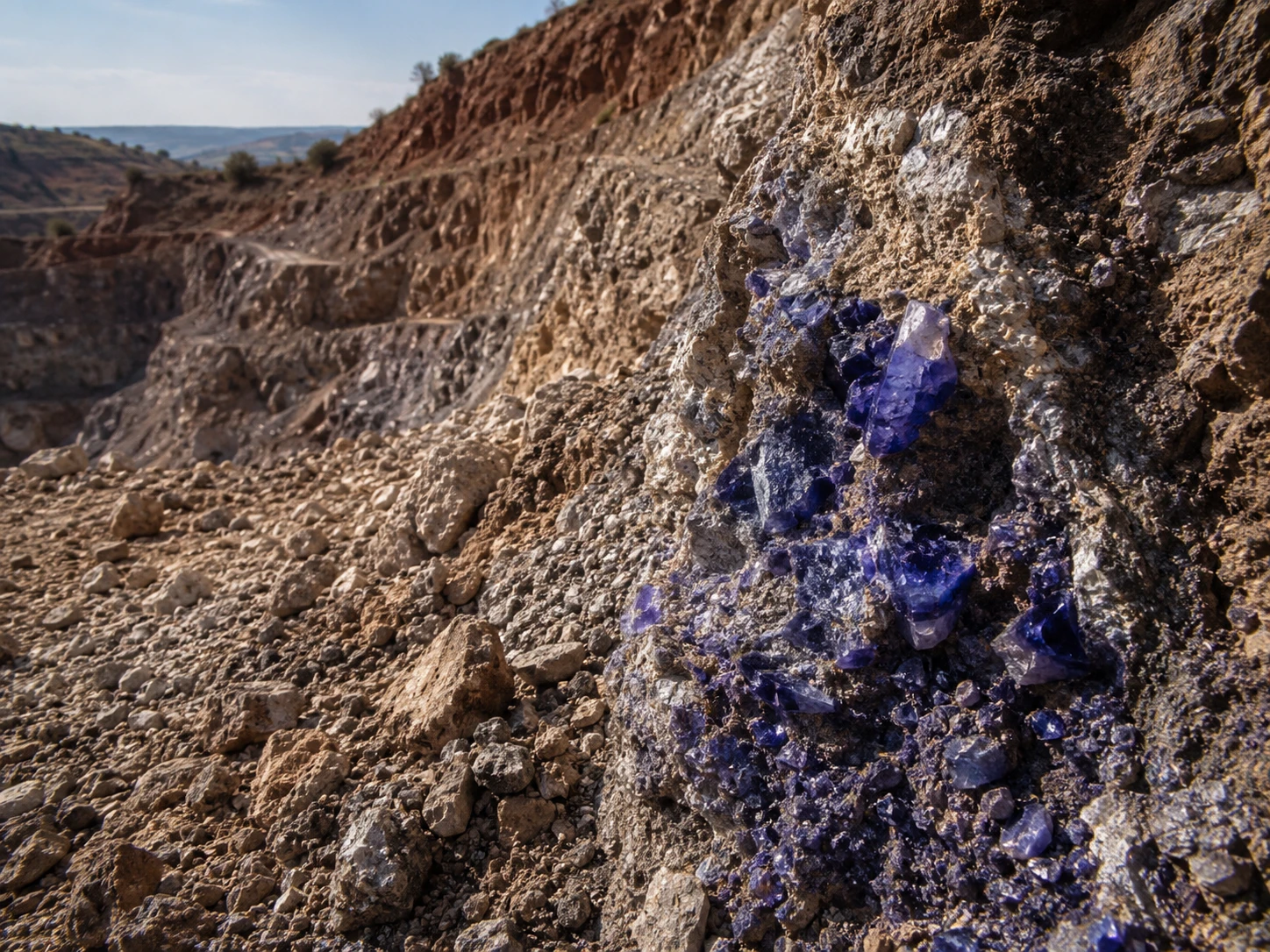
Sorting. Rough arrives graded roughly by size and apparent colour, and the first job is deciding what each piece can become. A crystal with an included core might yield two clean small stones instead of one flawed large one, and that call is made now or not at all.
Orienting. The decision described above. The cutter examines the crystal from every direction, often with a strong light behind it, and marks which axis will face up.
Sawing and preforming. The crystal is cut down toward the rough outline of the finished stone. This is where a cleavage plane is most likely to end the piece, and where the most weight is lost in a single step.
Faceting. The pavilion is cut first, because it governs how light returns and there is no point perfecting a crown above a pavilion that windows. Then the crown, then the table.
Polishing. Fine abrasives bring each facet to a flat, reflective plane. Facet junctions that meet crisply are the signature of care at this stage, and rounded or wandering junctions are the signature of speed.
The whole sequence loses most of the original crystal. Yields vary enormously with the quality and shape of the rough, and a cutter who keeps an unusually high proportion of the weight has almost always done it by compromising something else, most often the pavilion depth. High yield is a warning sign rather than a boast.
Setting a stone at 6 to 7
The setter inherits the cleavage problem and adds impact to it.
Prongs are the least protective option and the most common, because they let light in from the sides and show the stone off. For tanzanite they are a real compromise: a raised stone in fine prongs is the configuration most likely to meet a doorframe. Bezels, half bezels and channel settings enclose more of the girdle and take the knock instead of the stone.
There is a trade a buyer should be told about rather than discover. A protective setting hides the pavilion, which is where a window, a fracture or an old repair would be visible. That is not a reason to avoid bezels, which are what a stone like this actually wants. It is a reason to see the stone before it is set, or to ask for the laboratory report when you cannot.
Metal choice interacts with this more than it looks. A softer alloy lets a setter close prongs with less force, which is gentler on the stone but wears faster in use; a harder alloy holds its shape and demands more pressure at the moment of setting. Neither is the right answer everywhere, and a bench that has thought about it for your specific piece will say which it used and why.
Ring size adjustment is the other bench risk. Resizing puts heat and mechanical stress into a mount holding a stone with a cleavage plane, and the safe procedure is to remove the stone first. A jeweller who offers to resize a tanzanite ring quickly, with the stone in place, is offering you a saving you do not want.
What goes wrong, and at which stage
| Stage | The characteristic failure |
|---|---|
| Orientation | Cutting for weight, producing a large flat stone with mediocre colour |
| Sawing | Splitting along the cleavage plane and losing the crystal |
| Faceting | Overheating at the lap, opening an internal feature into a fracture |
| Proportioning | A shallow pavilion, giving a window that no polish will fix |
| Setting | A prong bearing on the cleavage direction, or too much pressure closing it |
| Resizing | Heat and stress applied with the stone still in the mount |
Only two of these can be repaired afterwards, and both cost weight. A window can sometimes be improved by recutting the pavilion, and a chipped girdle can sometimes be hidden by a new setting. Everything else in that table is permanent by the time the stone reaches a window display, which is the argument for judging the finished object rather than trusting the process behind it.
What the finished stone tells you about the work
More than a certificate does, because the things that matter most here are not the things a report records.
A GIA Colored Stone Identification Report records weight, measurements, shape, cutting style and colour, states whether the stone is natural or laboratory-grown, and names any detectable treatments. That settles identity, and identity is worth settling. It does not tell you whether the cutter chose colour over weight, whether the pavilion is honest, or whether the setter respected the cleavage direction.
For those, look at the stone. Even light return across the face means the proportions were chosen properly. A face-up colour you like, seen in daylight rather than under a display lamp, means the orientation went your way. A girdle without nicks and prongs that sit flat mean the setter was careful. Millimetre dimensions alongside the carat weight tell you whether the weight is spread across the face or hidden underneath it, which is the single most useful number a seller can give you and the one least often volunteered.
Where to start
Ask two questions and you will learn most of this from the seller rather than from an article. Which way does the colour lean, and what are the exact dimensions in millimetres.
For judging stones in the order that matters, how to buy tanzanite sets out colour, size, cut and clarity as one connected judgement. For why the letters on a ticket carry no information, why AAA means nothing. For the material itself and the trichroism that makes orientation matter at all, what tanzanite is. And because the cleavage plane the cutter worked around is still there afterwards, the honest care answer covers living with it.
If you would rather commission a piece around a specific stone than buy one finished, buying a loose tanzanite and having it set explains why setting it once matters here and what to agree before handing it over. Once the stone is cut, the metal around it is the next decision, and it is more practical than it looks: what does tanzanite go with covers metals, accents and what each costs to maintain.
When you want to look at finished pieces, ours are here. We did not cut them, we say so, and each one states its metal and the treatment of its stones.
COMMON QUESTIONS
Why does the way a tanzanite is cut matter so much?
Because tanzanite is strongly trichroic and shows blue, red-violet and yellow-green down its three crystal axes. The cutter decides which of those faces up, and that decision is fixed in the geometry of the finished stone. A violet stone cannot be recut blue without returning to rough and losing most of the weight, so orientation is worth more than all the labour that follows it.
Why is blue tanzanite more expensive than violet?
Because in most rough the blue direction is the short axis, so cutting for a blue face-up yields a smaller finished stone from the same crystal. Blue costs more because there is less of it per crystal, not because blue is inherently finer. A seller presenting blue as better quality is describing scarcity as though it were quality.
What is a window in a gemstone?
A pale patch under the table that moves with the stone as you tilt it. It means the pavilion is too shallow, so light passes straight through instead of reflecting back to your eye. It is usually the result of cutting to keep weight, and no amount of polishing fixes it. Tilting a stone for thirty seconds under a light reveals it.
Does tanzanite need a special setting?
It benefits from a protective one. Tanzanite is 6 to 7 on the Mohs scale with one direction of perfect cleavage, so bezels, half bezels and channel settings that enclose the girdle are safer than fine raised prongs. The trade-off is that a protective setting hides the pavilion, where a window or a fracture would show, so see the stone loose or ask for the laboratory report.
Can a tanzanite ring be resized safely?
Only with care, and ideally with the stone removed first. Resizing puts heat and mechanical stress into a mount holding a stone with a cleavage plane. A jeweller offering to resize a tanzanite ring quickly with the stone still in place is offering a saving you do not want.
SOURCES
- Tanzanite Value, Price, and Jewelry Information — International Gem Society Very strong pleochroism with blue stones showing blue, red-violet and yellow-green through the three axes; hardness 6 to 7; perfect cleavage; conchoidal to uneven fracture.
- Tanzanite Buyer's Guide — GIA Cut quality making a large difference to brilliance; cushions, trillions and ovals as the most common shapes; the absence of a standard grading scale; the contents of a Colored Stone Identification Report.
- Gemstone Hardness and Wearability — International Gem Society Hardness measures scratch resistance rather than toughness; cleavage defines how a gem breaks when struck, much like grain in wood; even diamond with perfect cleavage can chip or split.
- Tanzanite: A blue gemstone found in only one place on Earth — Geology.com One direction of perfect cleavage.
- Tanzanite Quality Factors — GIA The description of exceptional colour as an intense violetish blue with red flashes of pleochroic colour from within.