


Tanzanite wears best where it is least likely to be knocked or rubbed: in earrings and pendants first, then brooches, with rings and bracelets asking the most care. That order follows directly from the stone. It sits at 6 to 7 on the Mohs scale with a cleavage that can split it under a sharp blow, and the pieces that live on the hands take far more contact than the pieces that hang from the ears or rest below the collarbone. None of this rules out a tanzanite ring. GIA’s view is that tanzanite can be worn in all types of jewellery with proper precautions against rough wear and hard blows. It does mean that the type of piece is one of the biggest decisions you make about a tanzanite, often bigger than the choice of stone.
This entry goes through each kind of jewellery in turn, explains why position matters so much for this material, and sets out what to look for in the setting when you do choose the more exposed pieces.
Why the type of piece matters so much with tanzanite
Two properties decide how a stone survives daily life: hardness, which is resistance to scratching, and toughness, which is resistance to breaking and chipping. GIA’s care guide places tanzanite at 6 to 7 on the Mohs scale with fair to poor toughness and cleavage, a tendency to break along a plane when struck. So tanzanite is exposed on both fronts. It scratches when rubbed against harder materials, and it can chip or split when knocked.
Whether that happens depends heavily on where the stone sits on the body. The International Gem Society notes that settings play a major role in protecting stones, especially in rings, which undergo the most daily stress. Hands meet door handles, worktops, bags, railings and other hands all day. Ears and necklines meet very little. The same stone, cut and set the same way, faces a completely different life in a ring than in an earring.
Dust adds a quieter risk to everything. The same International Gem Society guide notes that household dust contains quartz at 7 to 7.5, hard enough to scratch softer stones, which is why pieces that are handled and wiped often, rings above all, lose their polish soonest.
| Piece | Exposure to knocks | Exposure to abrasion | Overall suitability for tanzanite |
|---|---|---|---|
| Stud or drop earrings | Low | Low | Excellent for everyday wear |
| Pendant on a chain | Low to moderate | Low | Excellent, with a sensible chain length |
| Brooch | Low | Low | Very good, occasional wear |
| Cocktail or dress ring | High on occasions worn | Moderate | Good for occasional wear |
| Everyday or engagement ring | High | High | Possible with a protective setting and care |
| Bracelet | High | High | The most demanding; best for occasional wear |
Earrings: the easiest place for tanzanite
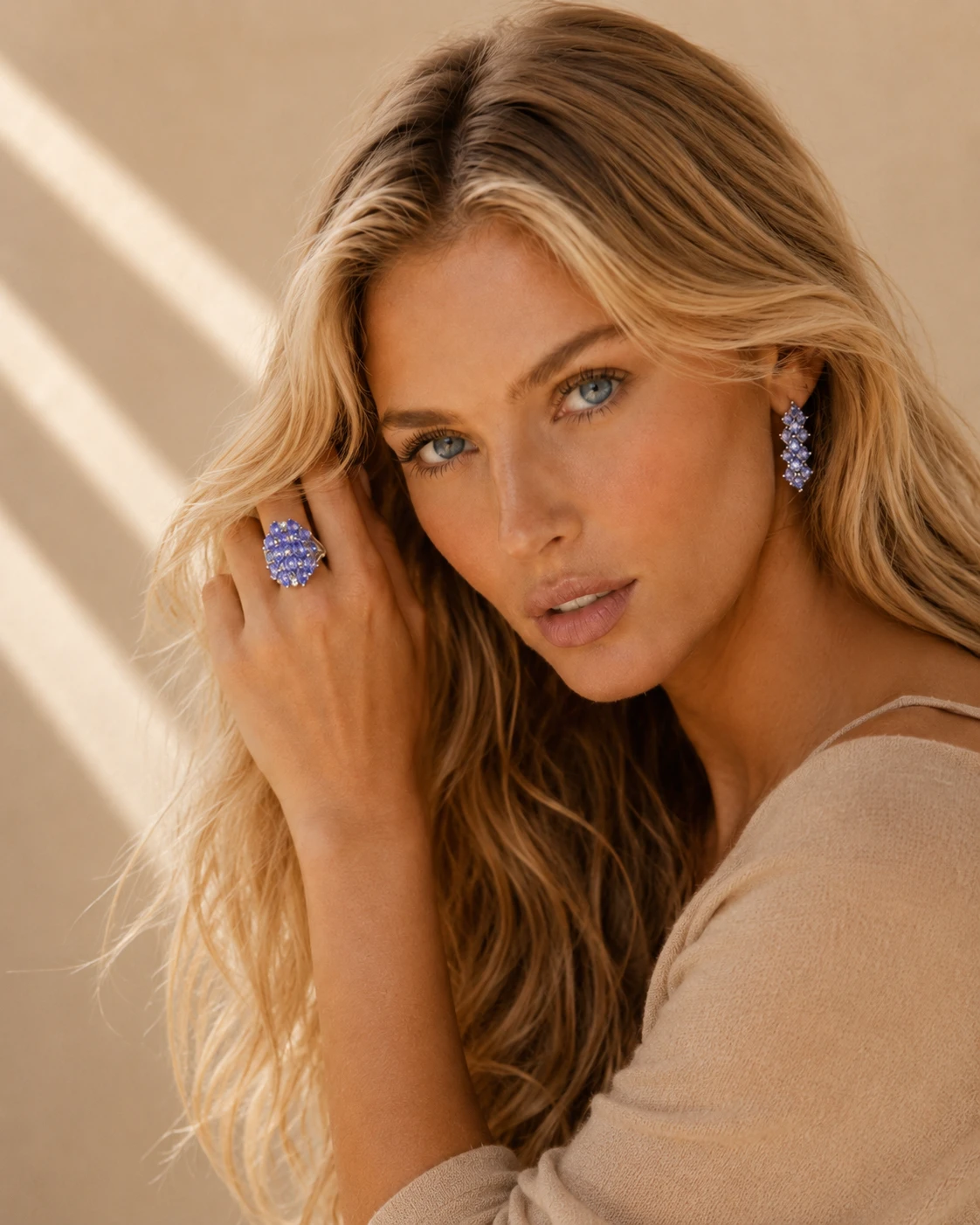
Earrings are, for most people, the safest way to wear tanzanite daily. They sit away from the hands, rarely meet hard surfaces, and are not rubbed against other jewellery while worn. Studs are the most protected of all, held close to the ear with little movement. Drops and hoops swing more and can knock against a phone, a collar or a car headrest, but the forces are small compared with a hand striking a doorframe.
The main risks with earrings are at the beginning and end of the day. Putting them in and taking them out means handling the stones, and dropping one onto a tiled bathroom floor is the most common way an earring stone gets chipped. Do it over a towel or a soft surface. Store pairs together with their backs on, so the posts cannot scratch the stones, as described in how tanzanite should be stored.
Earrings also suit tanzanite’s colour. Stones near the face are seen at conversational distance and in changing light, which shows off the shift between blue and violet; the International Gem Society notes that tanzanite can look almost sapphire blue in natural light and more violet under fluorescent light. Matching two stones is the harder part, since colour varies with size and orientation, a trade-off explained in carat or colour in tanzanite.
Pendants: a good home for larger stones
A pendant hangs below the collarbone, away from most knocks, and it is the natural setting for a larger tanzanite. GIA notes that the finest and deepest colours are usually seen in stones over 5 carats, and a pendant is where a stone of that size can be worn often without constant risk.
Pendants have two specific hazards. The first is swing: a pendant on a long chain can strike a table edge when you lean forward, or knock against a desk. A chain length that keeps the stone resting against the body when you move helps. The second is the chain itself, which can tangle with other necklaces and drag the stone against their clasps or stones. Wear a tanzanite pendant alone or with metal-only chains, and take it off before sleeping, when a pendant is most likely to be twisted and pressed.
A pendant’s setting should still protect the girdle and the points of the stone. A bezel or a well-made claw setting with the stone slightly recessed from the edge of the metal gives most knocks something other than the stone to hit.
Brooches and other occasional pieces
Brooches deserve more attention than they receive. Pinned to a lapel or a scarf, a stone is almost entirely out of harm’s way, handled only when the piece goes on and comes off. For a large or particularly fine tanzanite that its owner wants to see rather than protect in a drawer, a brooch is one of the gentlest ways to wear it.
The only real risk is the clasp. A brooch that falls because its pin was not secured falls stone first more often than not. A safety catch is worth having on any brooch carrying a valuable stone, and a jeweller can add one to an older piece.
Rings: possible, with the right choices
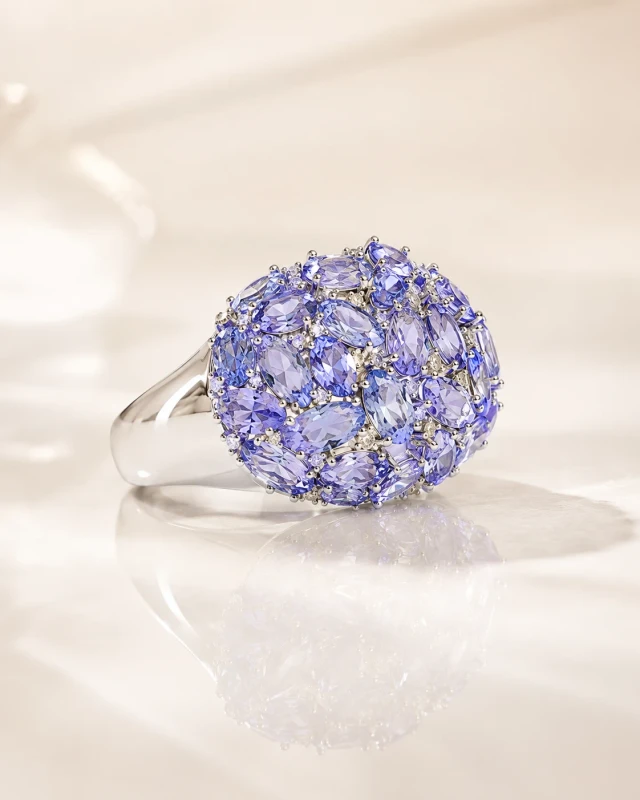
A tanzanite ring is entirely possible, and many people wear one happily. It simply needs more deliberate choices than any other piece, because the ring is where the stone meets the world.
The first choice is the setting. The International Gem Society’s advice for vulnerable stones is to choose a protective setting that surrounds the stone with metal and to avoid designs that leave the gem exposed, such as a high, open solitaire. For tanzanite that usually means a full or partial bezel, a low profile, or a halo of metal or harder stones that stands slightly proud of the tanzanite’s girdle. How a setter approaches this is covered in how a tanzanite is cut and set, and what to specify when commissioning one in buying a loose tanzanite and having it set.
The second choice is how often it is worn. A tanzanite cocktail ring worn for evenings is a very different proposition from a ring worn every day through work, cooking and exercise. The same guide suggests reserving soft-stone rings for special occasions, and for tanzanite that is sound advice unless the setting is designed for daily wear.
The third choice is what it sits next to. A tanzanite ring beside a diamond band will be abraded by the band all day. If the ring is an engagement ring, the full picture is in tanzanite engagement rings.
When a piece is the wrong home for tanzanite
Some pieces are simply a poor match for this stone, and it is better to say so than to sell them.
Bracelets are the clearest case. A bracelet sits at the wrist, which meets desks, keyboards, car doors and handbags constantly, and a line of stones in a tennis-style bracelet exposes every stone’s girdle to knocks. A tanzanite bracelet can be lovely for an evening; as an everyday piece it asks a great deal of a stone that GIA rates as fair to poor in toughness.
Rings worn for manual work are the second. Gardening, gym sessions, sports, cooking with heavy pans and any job involving tools will eventually chip or scratch a tanzanite, however good the setting. Taking the ring off for those activities is the only real protection.
Children’s jewellery and pieces for very active wearers are the third. A stone that needs its wearer to be careful is a poor choice for someone who is not in a position to be.
And cufflinks, while not impossible, meet tables and desks with every gesture. A harder stone, or a tanzanite set well below a protective metal rim, suits them better than an exposed faceted stone.
| If you want | Better choice | Why |
|---|---|---|
| An everyday tanzanite with no worry | Stud earrings or a short pendant | Least contact with hard surfaces |
| To wear a large, fine stone often | Pendant or brooch | Shows the stone at size with little risk |
| A tanzanite ring for daily wear | Low bezel or protected setting, removed for manual tasks | Metal takes the knocks the stone cannot |
| A tanzanite bracelet | Occasional wear only, or a bangle with stones set flush | Wrists meet hard surfaces constantly |
| A gift for someone unfamiliar with gem care | Earrings or a pendant | Forgiving if care instructions are forgotten |
Building a set: which pieces to combine
Many people buy tanzanite as a set, or build one over time, and the durability order is a useful guide to the sequence. Earrings and a pendant make the most wearable core: they can be worn together daily with little risk, and they frame the face with colour from two directions. A ring can join them for occasions, chosen in a protective setting. A bracelet, if it comes at all, is the piece to add last and wear least.
Matching across a set is easier than matching a pair. The earrings need to match each other closely, because they are seen side by side. A pendant and a ring sit far enough apart that a slight difference in tone reads as variety rather than mismatch. That gives some freedom: the finest, most saturated stone can go in the pendant, where it is seen most and risked least, while the ring carries a smaller or slightly lighter stone that will not be a disaster if it takes a knock.
If the set will be worn with other jewellery, think about neighbours as well. A diamond tennis bracelet on the same wrist as a tanzanite ring, or a diamond pendant tangling with a tanzanite one, brings the harder stone into contact with the softer. Wearing tanzanite as the only gemstone on the hand or neck is the simplest rule.
Looking after each type of piece
The cleaning method is the same for every tanzanite piece. GIA advises that warm, soapy water is always safe, with a soft brush to reach behind the stone, and that ultrasonic and steam cleaners are never recommended for tanzanite. What differs between pieces is how often they need it and what to check while cleaning.
Rings need the most frequent attention. Soap, lotion and skin oil collect under the stone and dull its colour within days, and rings are also where settings wear first, so each clean is a chance to look at the claws or bezel. Earrings collect hair products and make-up, and their posts and backs deserve a look for bending. Pendants mostly need their chains checked, especially at the clasp and at the bail where the chain passes through, since a worn bail is how pendants are lost.
Whatever the piece, dry it with a soft cloth by patting rather than rubbing, and let it reach room temperature before and after washing. GIA’s warning against sudden temperature changes applies to the stone whatever it is set in.
Matching the metal and the piece
Once the type of piece is chosen, the metal affects both its look and its protection. Harder alloys hold prongs and bezels firmly for longer, while very soft metals can wear thin at the claws with time, which matters most in rings. In earrings and pendants, where wear on the metal is slight, the choice can be made almost entirely on appearance.
On appearance, white metals tend to keep tanzanite looking cool and blue, while yellow gold warms the setting and can bring out the violet. The combinations that work, and the colours that sit well beside tanzanite in a set, are covered in what tanzanite goes with.
Whatever the metal, check settings periodically. Claws wear, bezels can lift, and a stone that is secure in a new piece may be loose after a few years of wear. A jeweller’s inspection once a year for pieces worn often is inexpensive and catches problems before a stone is lost.
Where to start
Choose the piece before the stone. For everyday wear with the least risk, earrings and pendants are the natural homes for tanzanite, and a pendant or brooch is the best place for a large, fine stone. Rings are possible with a protective, low setting and the habit of removing them for manual tasks. Bracelets and pieces for very active wearers are the hardest match. Set the stone so that metal, not tanzanite, meets the world first, check the setting each year, and the stone will reward the care with decades of colour.
COMMON QUESTIONS
What type of jewellery is best for tanzanite?
Earrings and pendants, because they are rarely knocked or rubbed. Brooches are also gentle. Rings and bracelets take the most contact, so they need protective settings and more care.
Can you wear a tanzanite ring every day?
You can, with a protective, low setting such as a bezel, and by removing it for manual work, sport and heavy housework. GIA says tanzanite can be worn in all jewellery with precautions against rough wear and hard blows.
Are tanzanite earrings durable?
They are the most forgiving way to wear tanzanite, since ears meet very few hard surfaces. The main risk is dropping them while putting them in or taking them out, so do that over a soft surface.
Is a tanzanite bracelet a good idea?
For occasional wear it can be lovely. As an everyday piece it is demanding, because wrists meet desks, doors and bags constantly and a line of stones exposes every girdle to knocks.
SOURCES
- Tanzanite Care and Cleaning Guide — GIA Mohs 6 to 7, fair to poor toughness and cleavage; can be worn in all types of jewellery with precautions against rough wearing or hard blows.
- Gemstone Hardness and Wearability — International Gem Society Rings undergo the most daily stress; choose protective settings that surround the stone; reserve soft-stone rings for special occasions; dust contains quartz at 7 to 7.5.
- Tanzanite Quality Factors — GIA Finest and deepest colours usually over 5 carats.
- Tanzanite Value, Price, and Jewelry Information — International Gem Society General gemmological background, colour behaviour under different light.