Colour matters more than carat in tanzanite, almost always. A smaller stone with a saturated violetish blue is a better stone, and usually a better use of the same money, than a larger one that reads pale or greyish across a room. The complication is that in tanzanite the two are not independent: colour deepens with size, so the finest colours tend to arrive in larger stones, and a small stone cannot always show the depth a large one can. The useful question is therefore not “carat or colour?” but “what is the smallest stone that shows the colour I want?”, and that is the stone to buy.
What follows explains why colour wins, why size and colour are tangled together in this particular gem, how to judge the trade-off in front of a real stone, and the cases where carat is the right thing to spend on.
Why colour carries most of the value
With coloured gemstones, colour is the main thing a buyer is paying for, and tanzanite is no exception. GIA’s guide to tanzanite quality factors notes that, as with most coloured stones, paler colours are more available and affordable than saturated ones. The same guide describes the finest tanzanites as an intense violetish blue with red flashes of pleochroic colour coming from within the stone. That is the top of the market, and it is defined almost entirely by colour.
Clarity, by contrast, rarely separates one good tanzanite from another. GIA observes that much of the tanzanite sold for jewellery has inclusions visible only under magnification, so any eye-visible inclusion causes a drop in value. In practice, a buyer comparing well-chosen stones is comparing colour and size, with clarity acting as a pass or fail check rather than a sliding scale.
Treatment does not change the calculation either. GIA notes that because most tanzanite on the market has been heated, heating has little effect on price, and the International Gem Society advises buyers to assume all blue to violet tanzanites have received heat treatment. Colour is what the heating produces and what the eye sees, so colour is what the price follows. Our entry on how tanzanite is graded explains why the letter grades sellers attach to that colour mean less than they appear to.
Why size and colour are tangled together in tanzanite
In most gem buying, carat and colour are separate dials. In tanzanite they are connected, for a physical reason. Colour in a transparent stone depends partly on how far light travels through it before reaching the eye. A deeper, larger stone gives light a longer path, and the colour intensifies. A small, shallow stone of the same rough gives a short path, and the colour looks lighter.
GIA puts it plainly: the finest and deepest colours are usually seen in sizes over 5 carats, and smaller stones are often less intense in colour. This is why a parcel of small tanzanites cut from the same material can look noticeably paler than a single large stone from that material, and why a 1 carat stone with a truly saturated colour is uncommon and priced accordingly.
The consequence for buyers is that the question “should I buy a bigger stone or a better colour?” often has a hidden third option: a slightly larger stone may be the way to get the colour. The trade-off is real, but it is not a straight choice between two independent qualities.
The cutter’s choice, which shapes what you are offered
Tanzanite is strongly pleochroic, showing different colours along different crystal directions. The International Gem Society describes it as naturally trichroic, showing blue, red-violet and yellow-green through its three crystal axes, with heating removing most of the brownish and yellowish component. This makes orientation at the cutting wheel decisive for the colour you see face-up.
GIA describes the resulting dilemma directly. Violet-purple tanzanites are more plentiful than stones with a stronger blue component, and a cutter orienting for blue often has to sacrifice weight, so the cutter essentially makes a choice between a smaller top-colour gem and a larger violet-purple one. That decision is made long before a stone reaches a showcase, and it means the market already contains two families: bluer stones that are smaller for their rough, and more violet stones that kept their weight.
Knowing this changes how you read a price list. A larger violet stone and a smaller blue stone at a similar price are not a bargain and a rip-off; they are the two outcomes of the same cutting decision. How that decision is made at the wheel is covered in how a tanzanite is cut and set.
| What you compare | Larger stone, paler or more violet | Smaller stone, saturated violetish blue |
|---|---|---|
| Colour across a room | Reads lighter, sometimes greyish in dim light | Reads clearly as tanzanite blue |
| Colour at arm’s length | Larger face shows more pleochroic flashes | Concentrated colour, fewer visible facets |
| Price per carat | Lower | Higher |
| Likely total price | Similar, depending on the two stones | Similar, depending on the two stones |
| Wearing risk | Larger table, more exposure to knocks | Smaller, easier to protect in a setting |
| What it says about the cut | Weight kept, colour secondary | Colour prioritised, weight sacrificed |
How to judge the trade-off with a stone in front of you
Look at the stone face-up, which is the only way anyone will ever see it once it is set. Look in daylight near a window, then under ordinary indoor light. The International Gem Society notes that in natural light tanzanite can appear an almost sapphire blue, while in fluorescent light it may look more violet. A stone that holds a colour you like under both is a safer purchase than one that only works under the showroom’s lamps.
Then step back. Hold the stone or the piece at the distance people will actually see it, across a table or across a room. Pale stones lose most at distance; their colour collapses toward grey. Saturated stones keep their identity. If you cannot tell from two metres that a stone is tanzanite, extra carats will not change that.
Compare stones side by side rather than one at a time. The eye adapts quickly to a single colour and forgets it just as quickly. Two or three candidates next to each other, on a white card, make differences in saturation obvious in seconds. Ask to see a smaller stone of better colour alongside the larger one you are considering; the comparison usually settles the question on its own.
Finally, check the colour is even. A stone with a saturated centre and pale ends, or a visible window where you can see straight through the middle, is using its size badly. The colour you pay for should fill the face.
A practical ranking when the budget is fixed
With a fixed budget, the following order of priorities serves most buyers well.
| Priority | What to secure | Why it comes here |
|---|---|---|
| First | A colour you like at a normal viewing distance, in daylight and indoor light | This is the stone’s value and its whole visual point |
| Second | Even colour across the face, no large window | Otherwise part of the stone is paid for and not seen |
| Third | Eye-clean clarity | Eye-visible inclusions lower value in this gem |
| Fourth | A cut that looks lively, not dull or glassy | A good cut shows the colour; a poor one hides it |
| Fifth | The largest size the first four allow | Size is a multiplier on everything above, not a substitute |
This ordering means that when you run out of budget, you give up size rather than colour. If the stone that shows your chosen colour is 1.2 carats rather than 2, buy the 1.2. The broader sequence for a purchase, including paperwork, is in how to buy tanzanite.
When colour should not win outright
There are honest exceptions, and they are worth naming.
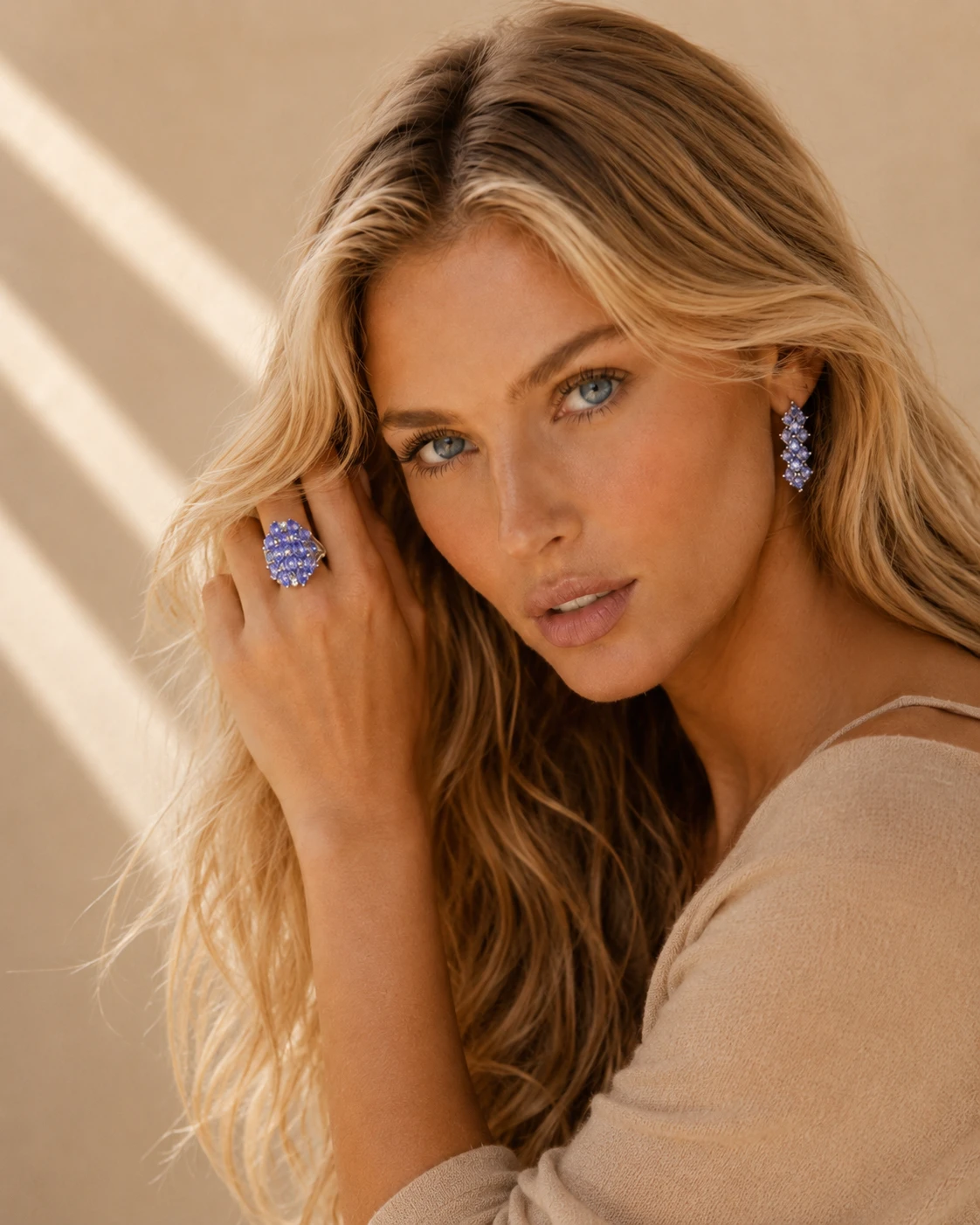
The first is where size is the design. A cocktail ring or a pendant built around a single large stone depends on presence at a distance. If the piece is meant to be seen across a room and the budget will not reach a large saturated stone, a larger stone of good but lighter colour may serve the design better than a small intense one that disappears in the setting. The trade-off is still colour against size, but here size has a job to do.
The second is personal preference for lighter tones. Some people genuinely prefer a lighter, more lavender tanzanite, particularly with yellow gold or against certain skin tones. Market value favours saturation; your own eye does not have to. If you are buying to wear rather than to resell, buy the colour you like, and enjoy paying less for it. Pairing ideas are in what tanzanite goes with.
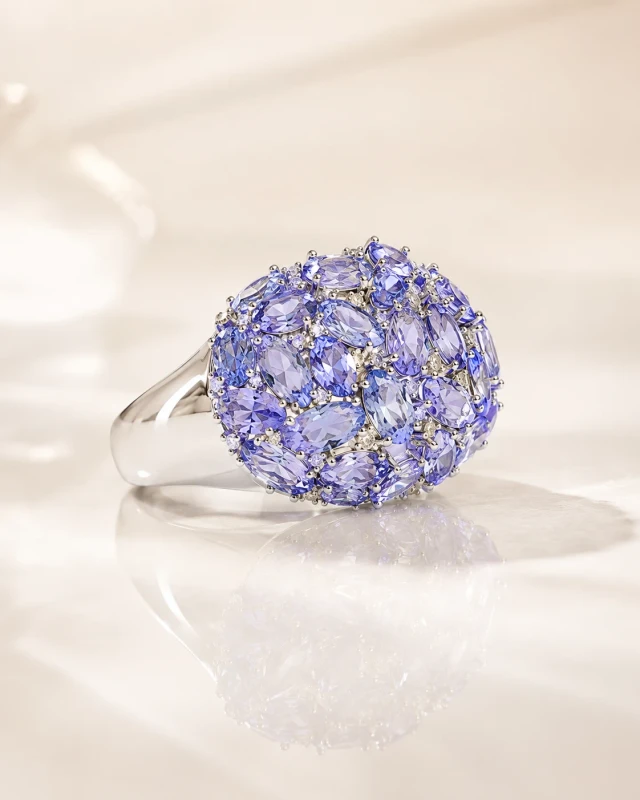
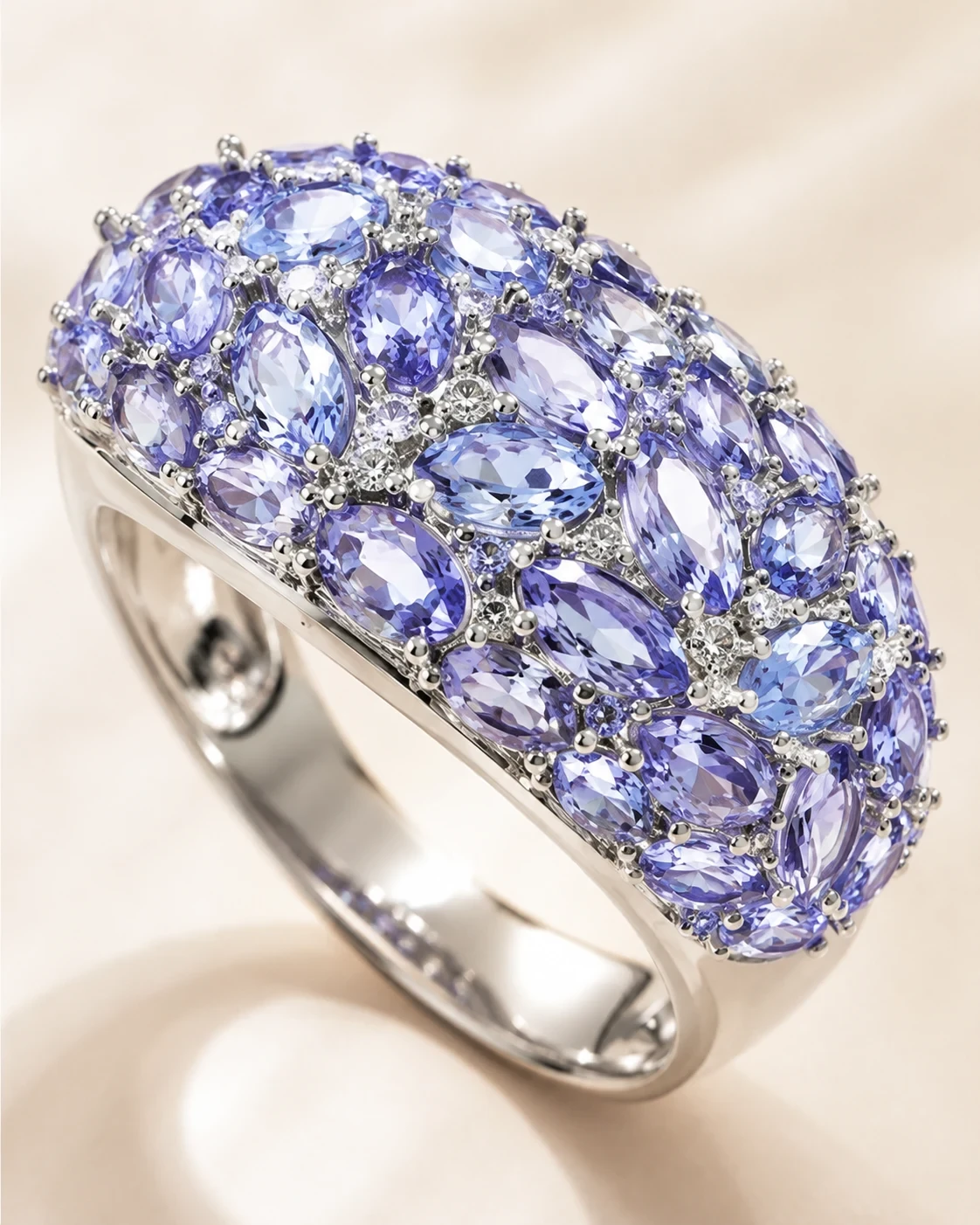
The third is small accent stones. In a cluster or a pavé band, individual stones are too small to show deep colour whatever you pay, and the overall effect comes from many stones together. Chasing top colour in 2 millimetre accents costs a great deal for a difference almost no one can see.
And one limitation applies to everything above: a larger stone is a larger target. GIA’s care guide places tanzanite at 6 to 7 on the Mohs scale, with fair to poor toughness and cleavage, so a big table in an exposed ring takes more knocks. Size bought for impact should come with a setting that protects it.
Pairs and sets, where the trade-off tightens
Earrings, a pair of side stones, or a line of graduated stones in a bracelet change the arithmetic. A single stone only has to be beautiful; a pair has to be beautiful and alike. Because tanzanite’s colour shifts with size, depth and orientation, two stones of the same weight cut from different rough can look noticeably different next to each other, one bluer, one more violet, one a shade lighter. The eye catches that at once when the stones sit a few centimetres apart on either side of a face.
Matching narrows the choice of stones, and a narrower choice costs more. In practice this pushes buyers of pairs toward slightly smaller stones, because it is easier to find two well-matched stones at a modest size than two at a large one. That is usually the right compromise: a matched pair of moderate stones reads as deliberate, while a large mismatched pair reads as a mistake, however many carats it holds. When comparing pairs, look at them together in daylight, then turn them so each shows its face-up colour, and judge the match before the size.
The setting changes the colour you end up with
The colour you judge loose is not quite the colour you will wear. Metal reflects into a stone through its pavilion and sits around its edge, and the surrounding colour shifts how the eye reads the tanzanite. White metals tend to leave the blue and violet looking cooler and cleaner. Yellow gold warms the surroundings and can make a violet stone look richer, while pushing a paler stone toward lavender.
This matters for the carat and colour decision in one specific way. If you already know the piece will be set in yellow gold and you like a warmer effect, a slightly lighter, more violet stone may give you the look you want at a lower price than a saturated blue. If the setting will be white metal and the look you want is a deep, cool blue, colour becomes even more important, because nothing around the stone will add warmth or depth. Where you can, look at candidate stones against a sample of the metal before choosing, rather than on a white tray alone.
What neither carat nor colour tells you
Neither measure tells you how the stone was cut, and a good cut matters because it decides how much of the colour reaches your eye. A stone cut too shallow to save weight may show a window, an area of washed-out colour in the centre. A stone cut too deep may look dark and inky, especially under indoor light. Both can carry a good colour grade on paper and still disappoint on the hand.
Neither tells you whether the stone is tanzanite at all. No synthetic tanzanite is known, but the International Gem Society notes that many simulants do exist, and the only proof of identity is a gemmological test. The checks worth insisting on are covered in how to tell if a tanzanite is real.
And neither tells you what the stone will be worth later. We do not quote prices or forecasts, for the reasons given in what decides the price of a tanzanite: a meaningful figure needs a date, a market, a quality and a basis, and it is wrong within a season.
Where to start
Decide the colour first, looking at real stones in real light, then find the smallest stone that shows it evenly at the distance it will be seen. Spend any remaining budget on size only after colour, evenness, clarity and cut are secure. Make the exceptions deliberately: a large statement stone for a design that needs presence, a lighter tone you genuinely prefer, or small accents where top colour cannot be seen anyway. And protect whatever you buy, because in tanzanite a larger stone is also a more exposed one.
COMMON QUESTIONS
Does carat or colour matter more in tanzanite?
Colour, in almost every case. A saturated violetish blue carries most of a tanzanite's value, and GIA notes paler colours are more available and affordable. Buy the smallest stone that shows the colour you want evenly, then add size only if the budget allows.
Why do small tanzanites look paler?
Colour depends partly on how far light travels through the stone. Smaller, shallower stones give light a shorter path, so they read lighter. GIA observes that the finest and deepest colours are usually seen in stones over 5 carats.
Is a bluer tanzanite better than a more violet one?
The market pays more for a stronger blue component, because violet stones are more plentiful and cutting for blue often costs weight. Your own preference can reasonably differ; buy for your eye if you are buying to wear.
When is it worth choosing a bigger tanzanite over better colour?
When size is the point of the design, such as a statement ring seen across a room, or when you genuinely prefer a lighter tone. For small accent stones, top colour is rarely visible anyway, so paying for it makes little sense.
SOURCES
- Tanzanite Quality Factors — GIA Paler colours more available and affordable; finest and deepest colours usually over 5 carats; cutter's choice between smaller top-colour gem and larger violet-purple one; clarity and heating effects on price.
- Tanzanite Value, Price, and Jewelry Information — International Gem Society Trichroism; appearance in natural versus fluorescent light; assume heat treatment; synthetic tanzanite unknown, simulants exist.
- Tanzanite Care and Cleaning Guide — GIA Mohs 6 to 7, fair to poor toughness and cleavage.
- Tanzanite — Geology.com Examples of stone size and quality grade in the market; trichroic crystal colours.