


You cannot reliably tell a real tanzanite from a good simulant by looking at it, and every article that tells you otherwise is either selling something or repeating advice that will damage your jewellery. A laboratory report settles it. Nothing you do at a kitchen table does.
That said, there is a great deal you can observe without touching the stone, and there are specific things a seller should be able to answer. This is what actually works, what proves nothing, and what will cost you a gem.
What not to do, ever
Start here, because the popular advice is the dangerous part.
Do not scratch it. The scratch test is the most commonly recommended and the most destructive. Tanzanite is 6 to 7 on the Mohs scale with perfect cleavage, which means it is soft enough to mark and structured so that pressure in the wrong direction can split it. There is one direction of perfect cleavage running through every tanzanite ever cut, and a scratch test applies exactly the kind of directional force that finds it. You will damage a real stone to find out it was real.
Do not heat it. Applying a flame or hot water to test a stone is advice from people who have never watched one crack. Thermal shock is a genuine risk in a gem with a cleavage plane.
Do not use chemicals. Acetone, bleach and jewellery dips can attack coatings, damage settings and remove nothing useful. If a stone is coated, you will have destroyed evidence rather than gathered it.
Do not put it in an ultrasonic cleaner. Not as a test, and not as cleaning either.
Every one of those tests is destructive, none of them separates tanzanite from its better simulants, and all of them are freely recommended online. The correct response to “is this real?” is a laboratory, not a toolkit.
What you can check, safely
Three things, none of which touches the stone.
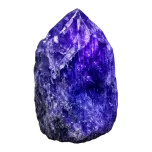
Watch it move. Tanzanite is very strongly pleochroic, showing blue, red-violet and yellow-green down its three crystal axes. Rotate the stone slowly under a steady light. A decisive swing between blue and violet is characteristic. Most glass shows none of this at all, because glass has no crystal structure to produce it.
Change the light. Tanzanite reads sapphire blue in natural light and violet under fluorescent light. Carry it from a window to an indoor lamp and watch. A stone that looks identical in both is behaving unlike tanzanite.
Look for what is too perfect. Round bubbles, swirled internal streaks and a complete absence of any internal feature at a low price are all more consistent with glass than with a natural gem.
There is a fourth observation that costs nothing and is often decisive: the price. A stone offered far below what comparable material sells for is the single strongest indicator in this article, and it points at a simulant rather than a bargain. Nobody sells fine tanzanite cheaply by accident, and the sums saved are never worth the odds.
None of these is proof. Pleochroism can be mimicked by other doubly refractive materials, and a skilled simulant will survive all three. They are screening observations that tell you when to stop and ask for paperwork, not tests that confirm anything.
The simulants, and what they actually are
The first thing to know is reassuring and unusual: to date, synthetic tanzanites are unknown. There is no laboratory-grown tanzanite to worry about, unlike sapphire and diamond, where lab-grown material is produced at scale.
What exists instead are simulants, which are different materials imitating tanzanite rather than tanzanite made in a factory.
| Simulant | What it actually is | How a laboratory separates it |
|---|---|---|
| Synthetic forsterite | A grown magnesium silicate, the most convincing imitation | Refractive index and optical character |
| Synthetic sapphire | Corundum grown in the right colour | Much higher RI and specific gravity |
| YAG | Yttrium aluminium garnet, a synthetic with no natural counterpart | Singly refractive, so no pleochroism at all |
| Glass | Moulded or cut glass, sometimes coated | No pleochroism, gas bubbles, low hardness |
| Coated stones | A pale or colourless base with colour applied to the surface | Magnification at the girdle and facet junctions |
The measurements that separate all of these are unremarkable laboratory work. Tanzanite has a refractive index of 1.692 to 1.700 and a specific gravity of 3.35, and those two numbers exclude most of the table above in a few minutes. The reason you cannot do it at home is that measuring them requires instruments and a mounted stone often cannot be measured at all.
Coatings, which are the modern problem
The buying guides warn about them specifically, and they are the treatment most likely to be undisclosed. The tanzanite market, as the International Gem Society puts it, overflows with treated stones, simulants, and overpriced specimens.
A coating puts colour on the outside of a stone rather than in it. That makes a pale or near-colourless base look like fine material, and it wears off. Coatings concentrate at facet junctions and around the girdle, so magnification is where they show, which is another job for somebody with a loupe and experience rather than for a buyer holding the piece.
Coating is a different matter from heating. Heating is near universal in tanzanite, permanent, and creates no additional care requirement. Coating is neither universal nor permanent, and a stone whose colour can be worn off is not the stone that was sold.
What a laboratory report settles, and what it does not
That is identity, and identity is exactly the question this article is about. If you want to know whether the stone is tanzanite, this is the document that says so.
It does not grade quality, because there is no standard quality-grading scale for tanzanite, and GIA evaluates it without grading it. A report will not tell you whether the colour is good, whether the cut is honest, or whether the price is fair.
There is one further limit worth knowing, because it is the thing sellers exploit. In many cases it is challenging for gemmological laboratories to determine whether a tanzanite has been heated. A report that does not name heat treatment is not a report certifying the stone unheated. It usually means the question could not be settled, and a seller converting that silence into a premium is charging you for an absence of evidence.
An in-house card is not a laboratory report
This is the single most common piece of misdirection in coloured stones, and it is worth being blunt about.
| Document | What it proves |
|---|---|
| Report from an independent laboratory | Identity, natural or grown, detectable treatments |
| A shop’s own certificate or appraisal card | What that shop asserts about its own stock |
| A grade such as AAA or AAAA | Nothing comparable. Individual companies create these descriptions for their own goods |
| A valuation for insurance | A replacement figure, usually above what you paid |
| A receipt describing the stone | A contractual description, which is genuinely useful if disputed |
The first row and the second row are different objects, and they are routinely presented in similar folders with similar seals. A card produced by the seller is the seller’s opinion of the seller’s goods. That is not dishonest in itself, and it becomes dishonest the moment it is called a certificate in a way that implies independence.
Ask who issued the document. If the answer is the shop, the document tells you what the shop says, and the shop was already telling you that. Ask it plainly and without embarrassment: a seller who deals in genuine material has been asked before and has a straightforward answer ready.
Zoisite that is not tanzanite
A specific naming problem, and a fair question rather than a scam in most cases.
Tanzanite is a variety of zoisite, and zoisite is occasionally found in pink, green and yellow. Although some sellers call those tanzanite, GIA calls them zoisite. A green zoisite sold as green tanzanite is not a simulant and not glass. It is real zoisite, correctly identified as a mineral and incorrectly named as a variety.
This matters commercially because the name carries the price. If you are offered tanzanite in a colour other than blue or violet, the honest description is zoisite, and a seller using the more valuable name for the less valuable variety has told you something about how they trade.
Buying online, where you cannot look at all
Most tanzanite is now bought from a photograph, which removes every safe check in this article at once.
You cannot judge a trichroic stone from an image. The photograph shows one of three colours, under one light, at one angle, after whatever the camera and the editor did to it. A listing that states which lighting the stone was photographed in is being straight with you. One that does not is showing you a face and calling it the stone.
So the checks move from the object to the seller. Does the listing give millimetre dimensions as well as carat weight? Does it name the treatment, and does it say who determined it? Is there an independent report, and is the report number one you can verify with the issuing laboratory directly rather than a scan in the listing? Does the description use a company grade as though it were a standard?
Then read the return terms before the description. How long, from what date, who pays return shipping, and whether the period survives your having the stone independently examined. That last point is the one that matters and the one most often quietly excluded. A seller confident in their material has no reason to object to you verifying it inside the return window, and a seller who does object has answered your question.
If you already own one and now you are worried
The useful order is different when the purchase is behind you.
First, do nothing to the stone. Everything in the first section of this article applies more strongly now, because whatever you own, damaging it makes matters worse and proves nothing.
Second, find the paperwork and read who issued it. A great deal of anxiety resolves at this step, in both directions: an independent report answers the question, and a shop’s own card explains why you are still asking.
Third, if it still matters, have it examined. An independent laboratory will identify it, and a competent jeweller with a loupe can often spot a coating or an obvious simulant in minutes without any risk to the piece. Neither is expensive relative to the sums usually involved.
Fourth, if the stone turns out not to be what was sold, the remedy is commercial rather than gemmological. A receipt describing the stone is a contractual description, and a description that proves false is the strongest position a buyer can be in. That is the real reason to insist on written descriptions at the time of purchase, long before any doubt arises.
A practical order of operations
Ask, look, then verify, in that order, and stop as soon as something does not hold.
Ask what it is, whether it has been treated and who says so. Ask for the exact dimensions in millimetres alongside the carat weight, because a seller who cannot produce them has probably not examined the stone closely either. Ask who issued any document you are shown.
Look at it in daylight and then indoors, and rotate it. You are not proving anything; you are checking that the stone behaves the way tanzanite behaves.
Verify with an independent laboratory if the sum involved matters to you, and understand what the report will and will not decide. On a mounted stone this may require the piece to be sent away, which is a reason to prefer buying a loose stone when you are buying seriously.
Then read the return policy before any of it, because a generous return period is worth more than any test in this article. It is the seller telling you they expect the stone to survive independent scrutiny, and it is the only mechanism that protects you if it does not.
Where to start
Identity is the easy question here and quality is the hard one. If the stone is genuine, everything that decides what it is worth is still ahead of you: how to buy tanzanite sets those factors out in order, and why AAA means nothing explains why the grade on the ticket will not help.
For the material itself and the pleochroism the safe checks rely on, what tanzanite is. For how it separates from the blue stones it is most often confused with, tanzanite against sapphire and diamond.
When you want to look at pieces, ours are here. Each one states its metal, the treatment of its stones, and what the smaller stones actually are, which is the description a buyer should be able to check rather than trust.
COMMON QUESTIONS
How can you tell if a tanzanite is real?
Not reliably by yourself, and not by any home test. Rotating the stone under a steady light should show strong pleochroism, and carrying it from daylight to a fluorescent lamp should shift it from sapphire blue toward violet. Those are screening observations, not proof, because other doubly refractive materials can mimic them. Identity is settled by an independent laboratory report, which states whether the stone is natural and names any detectable treatment.
Can I scratch or heat a tanzanite to test it?
No. Never do either. Tanzanite is 6 to 7 on the Mohs scale with one direction of perfect cleavage, so a scratch test applies exactly the directional force that can split it, and heat risks thermal shock. Chemical dips and ultrasonic cleaners are equally bad. Every one of these popular tests is destructive, and none of them separates tanzanite from its better simulants.
Is there fake or lab-grown tanzanite?
There is no lab-grown tanzanite: to date, synthetic tanzanites are unknown. What exists are simulants, meaning other materials imitating it. The usual ones are synthetic forsterite, which is the most convincing, YAG, synthetic sapphire, glass, and pale stones with colour coated onto the surface. A laboratory separates all of them using refractive index and specific gravity.
Does a certificate prove a tanzanite is good quality?
No. A Colored Stone Identification Report settles identity: weight, measurements, shape, cutting style, colour, whether the stone is natural, and any detectable treatment. It does not grade quality, because no standard grading scale exists for tanzanite. It also cannot usually confirm a stone is unheated, since laboratories often find heat detection challenging, so a report silent on heating is not a report certifying it unheated.
Is a jeweller's own certificate the same as a lab report?
No, and the difference matters. An independent laboratory report states what a neutral third party determined. A shop's own certificate or appraisal card states what that shop asserts about its own stock, which is what the shop was telling you anyway. Grades like AAA are descriptions individual companies create for their own goods. Always ask who issued the document.
SOURCES
- Tanzanite Value, Price, and Jewelry Information — International Gem Society Hardness 6 to 7 and perfect cleavage; refractive index 1.692 to 1.700 and specific gravity 3.35; very strong pleochroism showing blue, red-violet and yellow-green; sapphire blue in daylight and violet under fluorescent light; synthetic tanzanites unknown to date.
- Tanzanite Buying Guide — International Gem Society The simulants named, including synthetic forsterite, YAG, synthetic sapphire and glass; coating treatments to watch for; the market overflowing with treated stones, simulants and overpriced specimens.
- Tanzanite Buyer's Guide — GIA The contents of a Colored Stone Identification Report; no standard grading scale and GIA evaluating without grading; AAA as a description individual companies create for their own goods; pink, green and yellow zoisite being called zoisite rather than tanzanite.
- Tanzanite Quality Factors — GIA Laboratories often finding it challenging to determine whether a tanzanite has been heated.
- Tanzanite: A blue gemstone found in only one place on Earth — Geology.com One direction of perfect cleavage in every tanzanite.