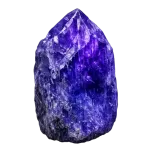
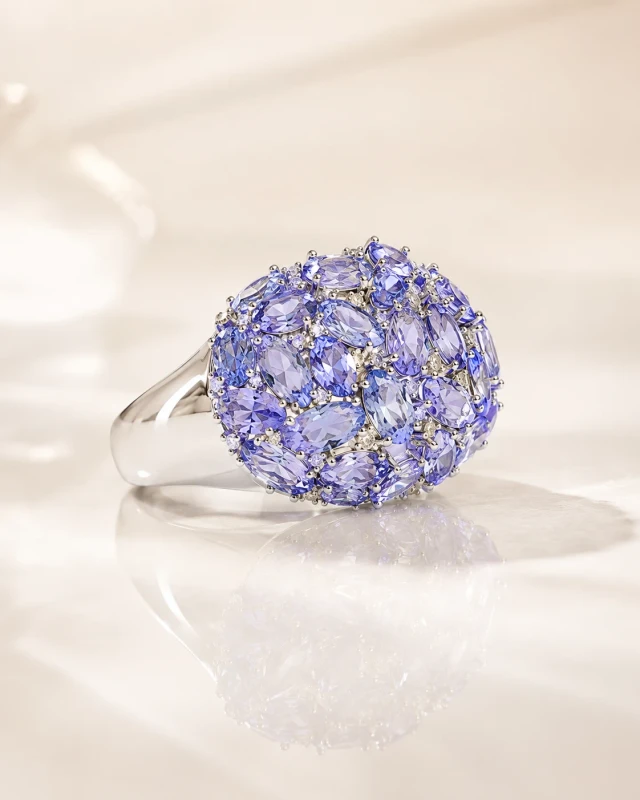
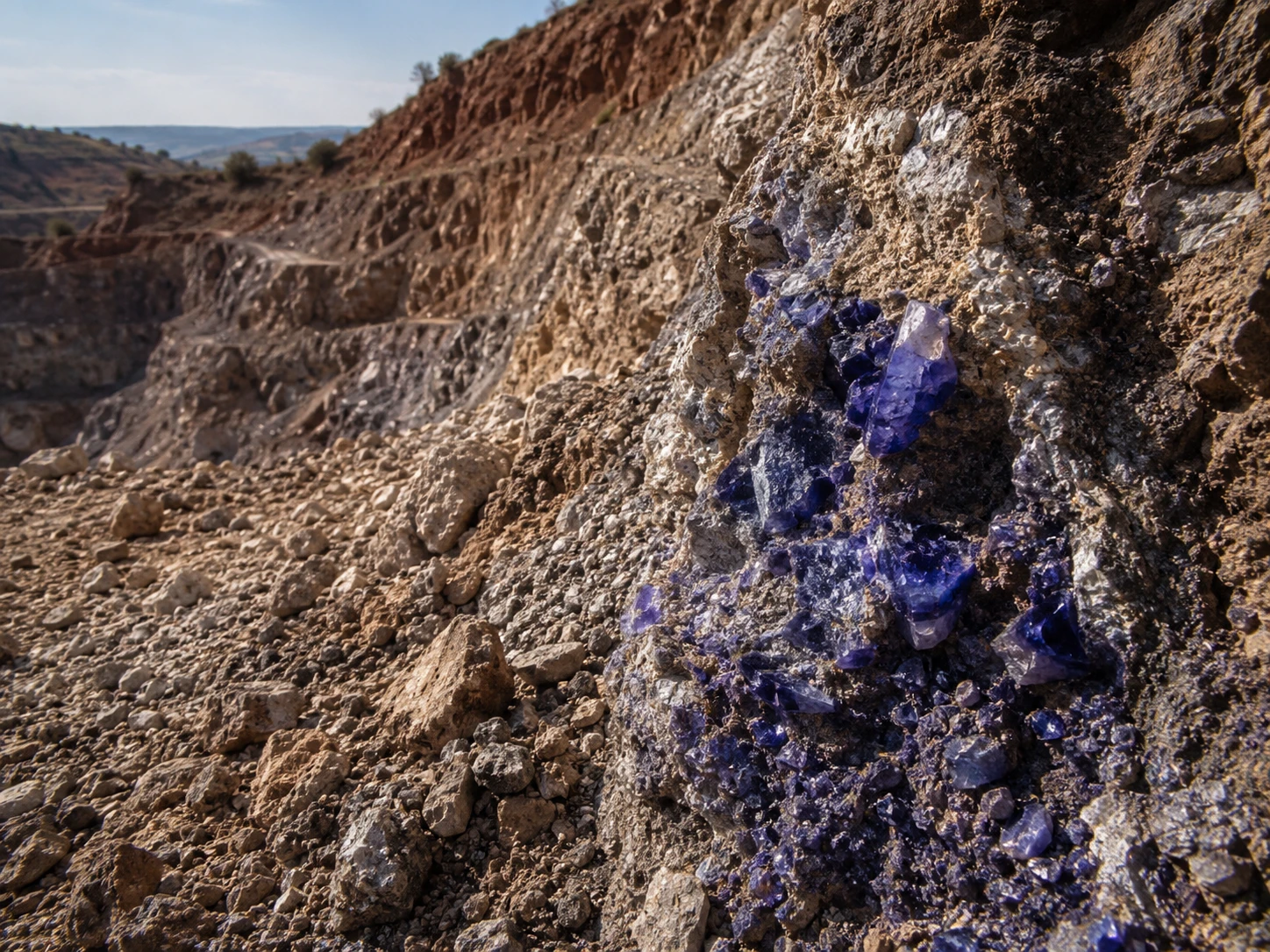



Store tanzanite on its own, in a soft-lined compartment or pouch, away from harder stones and away from sudden changes of temperature. That is most of the answer. Tanzanite sits at 6 to 7 on the Mohs scale, so diamonds, sapphires, rubies and even the quartz in ordinary household dust can scratch it, and its cleavage means a hard knock in a crowded box can chip it. Travel adds two further rules: keep the piece with you rather than in checked luggage, and pack it so it cannot move. None of this is elaborate. It simply means treating a tanzanite as the softest thing in the jewellery box, which it usually is.
The detail below covers why storage matters more for this stone than for most, how to set up a drawer or box, what to do when travelling, and the few situations where the usual advice does not apply.
Why storage matters more for tanzanite than for most gems
Most damage to jewellery does not happen dramatically. It happens slowly, in drawers and bags, where pieces lie against each other and rub each time the drawer opens. Whether that rubbing leaves marks depends on hardness: a harder material scratches a softer one, and materials of equal hardness do not scratch each other. The International Gem Society’s guide to hardness and wearability sets out the principle and notes that diamond is much harder than corundum, even though they are only one step apart on the scale.
Tanzanite is at a disadvantage in almost any mixed collection. GIA’s care guide gives it 6 to 7 on the Mohs scale, with fair to poor toughness and cleavage, a tendency to break along a plane when struck. So it loses twice in a crowded box. Any diamond, sapphire or ruby that touches it can scratch its facets, and a sharp knock from a heavier piece can chip or cleave it.
Even dust counts. The International Gem Society points out that household dust contains quartz, a mineral with a hardness of 7 to 7.5, hard enough to scratch materials below it. Wiping a dusty tanzanite with a dry cloth drags those particles across the surface. Good storage keeps the stone clean as well as separate, which is one reason a closed box or pouch is better than an open dish.
Setting up a drawer or jewellery box
The aim is simple: every tanzanite piece should have a space where nothing harder can touch it and it cannot slide into anything.
| Storage option | How well it protects tanzanite | Best used for |
|---|---|---|
| Individual soft pouch, one piece per pouch | Good, if pieces are not piled on top of each other | Rings and earrings, and travel |
| Box with separate fabric-lined compartments | Very good, if compartments suit the piece size | A home collection |
| Ring roll or slotted ring tray | Good for rings, stones held apart | Several rings together |
| Original presentation box | Good for one piece, bulky for many | Pieces worn occasionally |
| Open dish or tray shared with other jewellery | Poor, pieces rub and collect dust | Nothing valuable |
| Loose in a bag or pocket | Poor, knocks and abrasion | Avoid entirely |
Within a box, a few habits help. Keep tanzanite in its own compartment, not sharing with a diamond ring or a sapphire pendant. Hang or lay necklaces so the pendant cannot swing against other pieces; a chain left tangled pulls the pendant into whatever is next to it. Store earrings in pairs with their backs on, so posts do not scratch the stones. If a piece has other gemstones in it, such as a tanzanite with diamond accents, remember that the diamonds are part of the same piece and are already set safely; the risk is from other pieces, not from its own accents.
Close the lid. It keeps dust off the stones and stops light and warmth from a sunny windowsill reaching the box. GIA describes tanzanite as stable under normal wearing conditions, resistant to the effects of heat, light and common chemicals, so light is not the main concern, but a closed box also keeps the stones cleaner, and cleaner stones need less handling.
Which pieces are most at risk, and why
Not every tanzanite piece faces the same storage risk. The shape of the piece, how the stone is set and what it tends to lie against all change what can go wrong in a drawer.
| Piece | Main storage risk | What helps most |
|---|---|---|
| Ring with a raised centre stone | Table and crown knocked or scratched by other rings | Ring roll or slot, stone facing up, nothing beside it |
| Ring with a low bezel setting | Less exposed, but the band can scratch neighbours | Own slot, apart from softer stones |
| Stud earrings | Posts scratching the stones, lost backs | Stored as a pair, backs on, own compartment |
| Drop earrings and pendants | Stones swinging against other pieces | Laid flat or hung apart, chain untangled |
| Bracelet or line of stones | Stones rubbing each other if coiled tightly | Laid out straight or in a long compartment |
| Loose stone | Chipping on edges, easy to lose | A padded stone box or a folded stone paper |
Loose stones deserve a word of their own, because people often keep them for years before deciding on a setting. A loose tanzanite has no metal protecting its girdle or its points, so it should never share a container with another stone. Jewellers keep loose stones in folded stone papers or small padded boxes, one stone each, labelled with the weight and any report number. That is worth copying at home, and it also means you always know which report belongs to which stone.
Temperature, heat and the places not to leave it
The same GIA guidance adds an important qualification: tanzanite should not be subjected to very high temperatures or sudden temperature changes. For storage, that rules out a few places people do use. A car’s glovebox in summer, a windowsill in direct sun, the shelf above a radiator or the top of a warm appliance are all places where a piece can become hot and then cool quickly.
Sudden change is the part to avoid. A tanzanite that has sat in a hot car and is then rinsed under cold water, or put into a cold bag in winter straight from a warm pocket, experiences exactly the kind of shock GIA warns against. In ordinary life this is easy to avoid: store pieces at room temperature, let them come to room temperature before cleaning, and do not use a hot or cold place as temporary storage.
Chemicals are a smaller concern in storage, but not none. GIA notes tanzanite can be attacked by hydrochloric and hydrofluoric acids. Nobody keeps jewellery next to those deliberately, but it is a reason to keep a jewellery box away from the cupboard where household cleaners live, and away from bathroom shelves where sprays settle on everything.
The short stops between wears
Much of the damage attributed to storage actually happens in the minutes a piece spends off the hand rather than in the jewellery box. A ring taken off to wash up and left on the edge of the sink, a pair of earrings dropped into a coat pocket with keys, a bracelet put on the bathroom shelf while applying hand cream: these are the moments when a tanzanite meets hard surfaces, harder objects and drains.
A small lidded dish with a soft lining, kept wherever you usually take jewellery off, solves most of this. Put it next to the bed, by the kitchen sink or in the hallway, and use it every time, so the habit does not depend on remembering. If you take a ring off at the gym or at work, a pocket-sized pouch does the same job and costs almost nothing.
Avoid the common improvised places. A sink edge risks a fall onto ceramic or into the drain. A pocket shared with keys or coins guarantees contact with metal and grit. A bathroom shelf collects sprays and humidity. None of these will ruin a stone on the first occasion, but they are exactly the repeated small exposures that good storage is meant to prevent.
Travelling with tanzanite
Travel concentrates every risk above into a small space: pieces are packed tightly, bags are thrown and pressed, temperatures change quickly, and the pieces are out of your control for hours if checked in.
Keep it with you. The US Transportation Security Administration advises travellers with valuable items such as jewellery to keep them with them at all times and not put them in checked baggage, and notes that you can ask to be screened in private. The same logic applies on any airline: checked luggage is handled roughly and is occasionally lost, and a hold can be cold.
Pack it so it cannot move. A small hard-sided travel case with padded compartments is ideal. If you do not have one, put each piece in its own soft pouch, then wrap the pouches in a scarf or sock and place them in the middle of your hand luggage, where the bag’s other contents cushion them. A ring rattling loose in a toiletry bag, next to tweezers and nail files, is how stones get chipped.
Take less. The simplest protection is to travel with the pieces you will wear and leave the rest at home. A tanzanite you do not need on holiday is safest in its own compartment in a drawer.
Hotel safes are useful for pieces you are not wearing that day, but put the piece in its pouch before it goes in. A metal safe floor, keys, a watch and a phone are all harder than tanzanite.
When the usual storage advice is not enough
Some situations call for more than a soft pouch, and it is better to be honest about the limits of good storage.
Storage does not protect a stone that is already loose. If a prong is bent or a setting has worn, a stone can fall out in the box as easily as on the hand. Check settings before storing a piece for a long time, and have a jeweller look at any ring you wear daily at least once a year. What happens when something has already gone wrong is covered in what can be repaired.
Storage does not undo wear. A ring worn every day next to a diamond band will abrade however carefully it is stored at night, because most of its contact happens on the finger. That specific hazard is explained in wearing a tanzanite ring with a wedding band.
Storage is not security. A soft-lined box on a dresser protects against scratches, not against loss or theft. Valuable pieces need insurance and records: photographs, receipts and any laboratory report, kept somewhere other than the box itself. The paperwork is described in insuring and valuing a tanzanite.
And storage is not cleaning. Put pieces away clean and dry, but do not use storage time as a reason to clean them aggressively. GIA notes that warm, soapy water is always safe, and that ultrasonic and steam cleaners are never recommended for tanzanite.
Putting a piece away clean, step by step
Storing a piece dirty traps skin oils, lotion and dust against the stone and under the setting, which dulls the colour and makes the next clean harder. A short routine before putting a piece away for more than a few days keeps this in hand.
Let the piece reach room temperature first, especially if it has come in from the cold or from a warm pocket. Wash it in warm, soapy water, the method GIA describes as always safe, using a soft brush to reach behind the stone where residue collects. Rinse in water of the same temperature, not colder or hotter. Dry it with a soft, clean, lint-free cloth by patting rather than rubbing, then leave it to air dry fully before it goes into a closed box or pouch, so no moisture is trapped. Finally, look at the setting under good light while it is clean: a clean piece is the easiest time to spot a lifted prong.
Long-term storage and pieces you rarely wear
A tanzanite kept for special occasions spends most of its life in storage, so its storage matters more than its wearing. For these pieces, the original presentation box or a dedicated compartment is worth the space. Keep the laboratory report or purchase documents with a note of where the piece is, and look at the piece every few months: check that the stone is still secure and that nothing has shifted against it.
Pieces inherited or bought second-hand are worth inspecting before they go into long-term storage. Older settings can be worn thin, and abrasion on facet edges is easier to deal with before it becomes a chip. If a piece is going to sit for years, a jeweller’s check of the setting first is cheap insurance.
For a collection that is growing, it helps to separate by hardness as a rule rather than piece by piece. Keep diamonds, sapphires and rubies together in one section, and softer stones, tanzanite among them, in another. That arrangement means you never have to remember which piece can scratch which.
Where to start
Give every tanzanite its own soft-lined space, away from harder stones, dust and heat. Store pieces clean, at room temperature, and with the lid closed. When travelling, keep them with you, pack each in its own pouch in the middle of your hand luggage, and take only what you will wear. Check settings before long storage, keep documents apart from the box, and remember that storage protects against scratches and knocks, not against loose settings, daily wear or theft. The broader habits that keep a tanzanite in good condition are in the honest care answer.
COMMON QUESTIONS
How should tanzanite be stored?
On its own, in a soft-lined compartment or pouch, away from harder stones such as diamond, sapphire and ruby. Keep the box closed to keep dust off, and away from heat sources and places where temperature changes suddenly.
Can tanzanite be stored with diamonds?
Not touching them. Diamond is far harder than tanzanite and will scratch it on contact. Keep them in separate compartments or pouches; diamond accents already set in the same piece are not the problem.
Should I pack tanzanite in checked luggage?
No. Keep valuable jewellery with you in hand luggage, as the US Transportation Security Administration advises. Put each piece in its own pouch and pack it in the middle of the bag so it cannot move.
Does light or heat damage stored tanzanite?
GIA describes tanzanite as stable to heat, light and common chemicals under normal conditions, but warns against very high temperatures and sudden temperature changes. Avoid hot cars, sunny windowsills and radiator shelves as storage.
SOURCES
- Tanzanite Care and Cleaning Guide — GIA Mohs 6 to 7, fair to poor toughness and cleavage; stable under normal conditions; avoid very high temperatures and sudden changes; acids; ultrasonic and steam cleaners never recommended.
- Gemstone Hardness and Wearability — International Gem Society Harder minerals scratch softer ones; equal hardness does not scratch; diamond much harder than corundum; household dust contains quartz at 7 to 7.5.
- What Can I Bring? Jewelry — US Transportation Security Administration Keep valuable items such as jewellery with you at all times, not in checked baggage; private screening available.
- Tanzanite Value, Price, and Jewelry Information — International Gem Society General gemmological background on tanzanite.