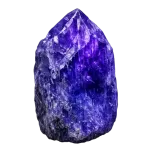
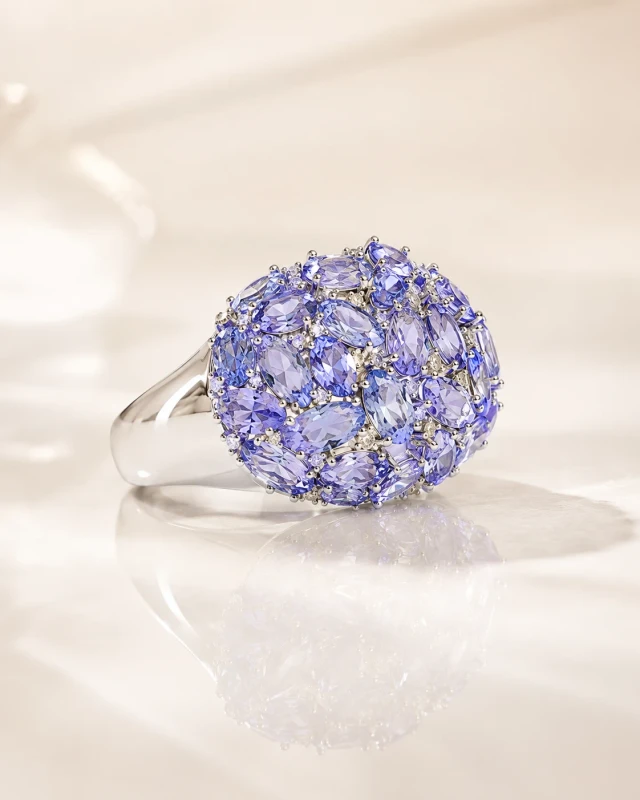
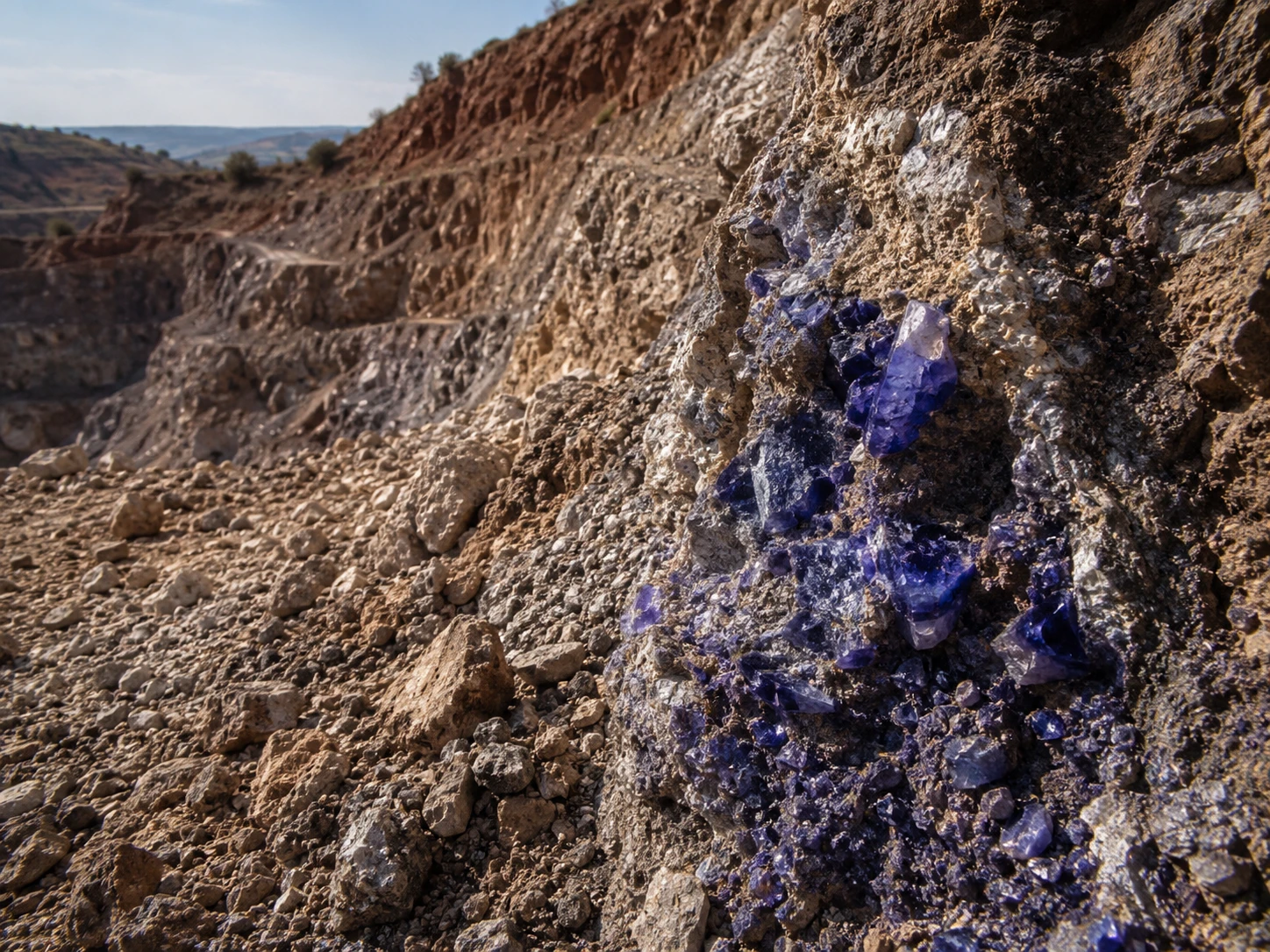
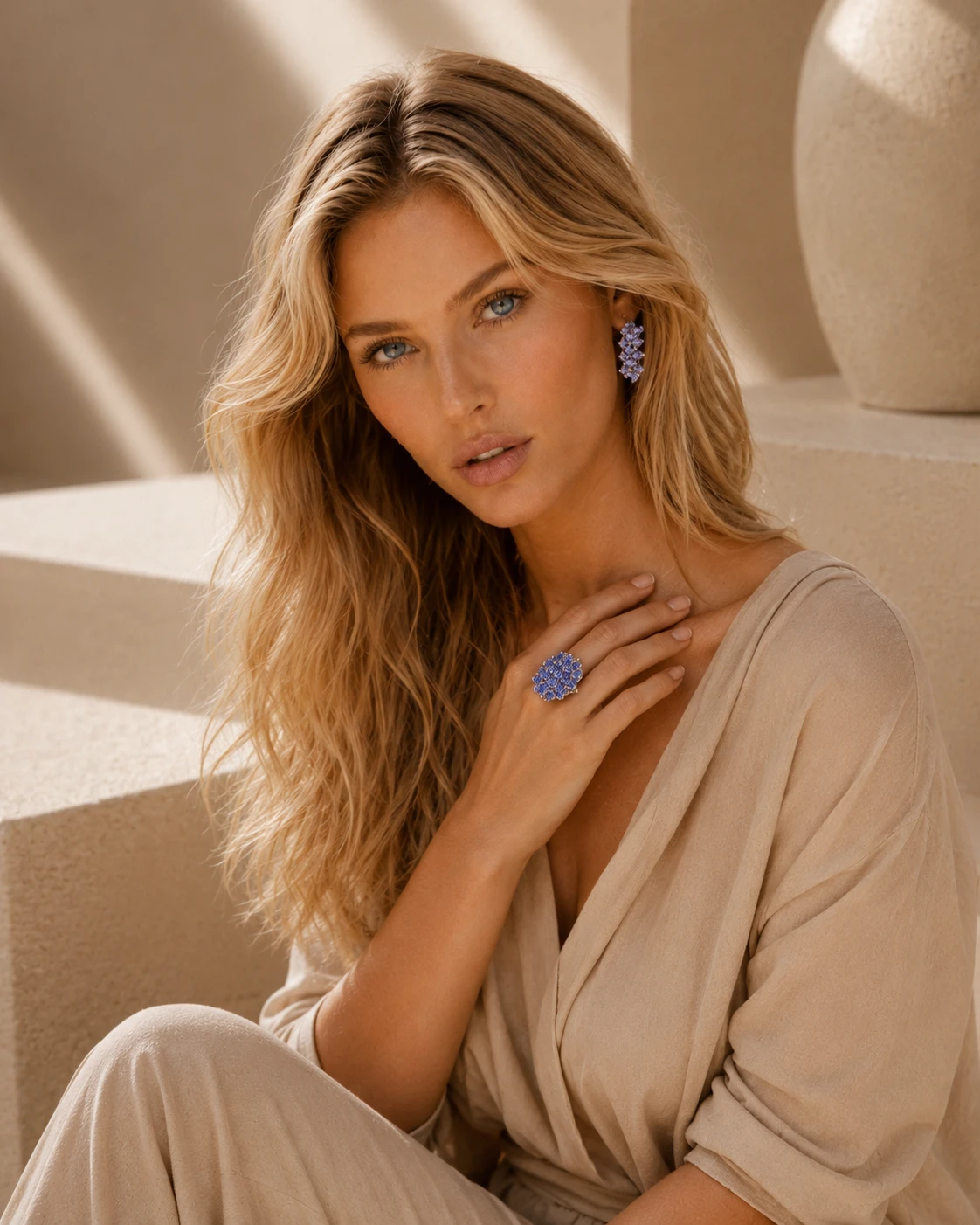
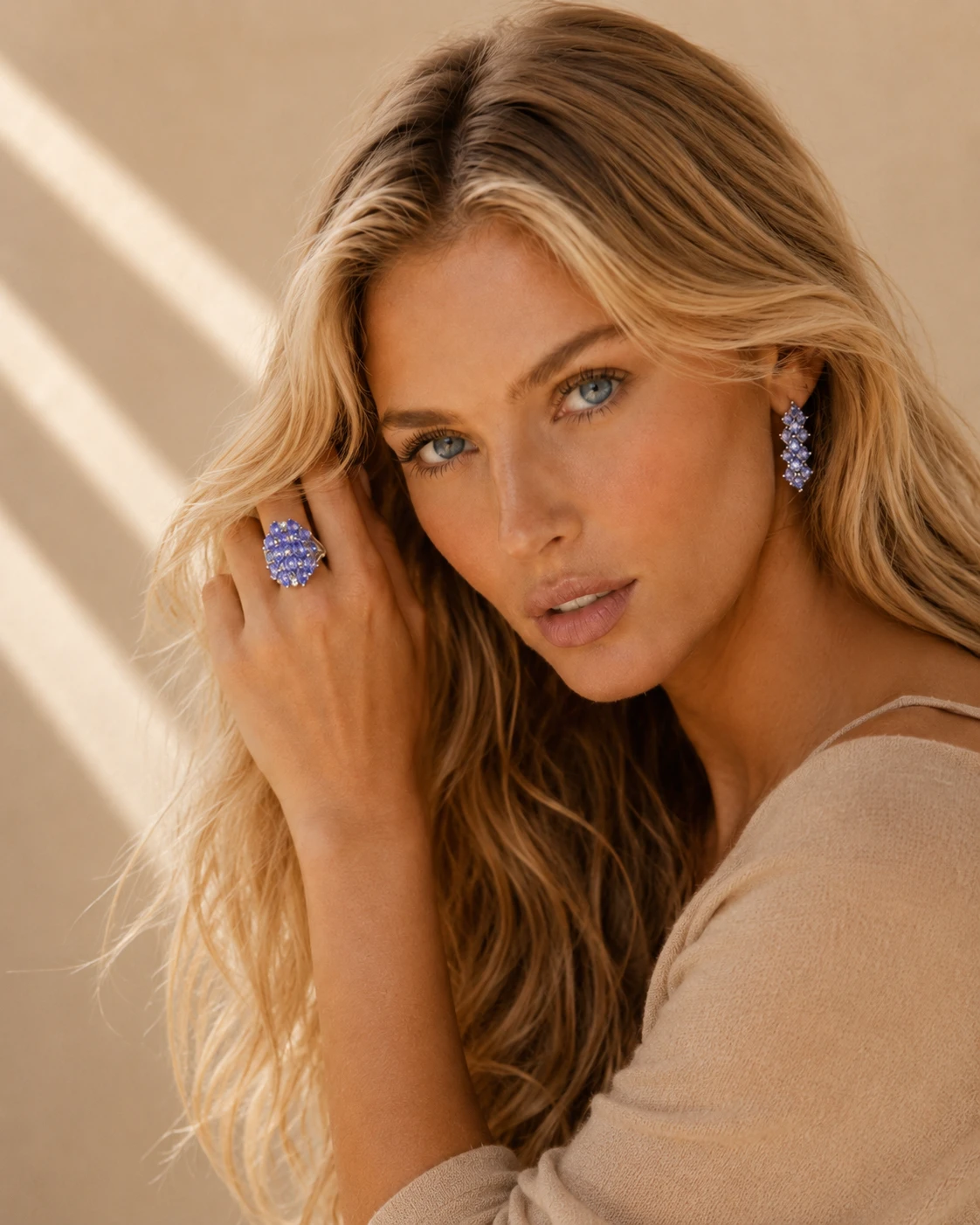
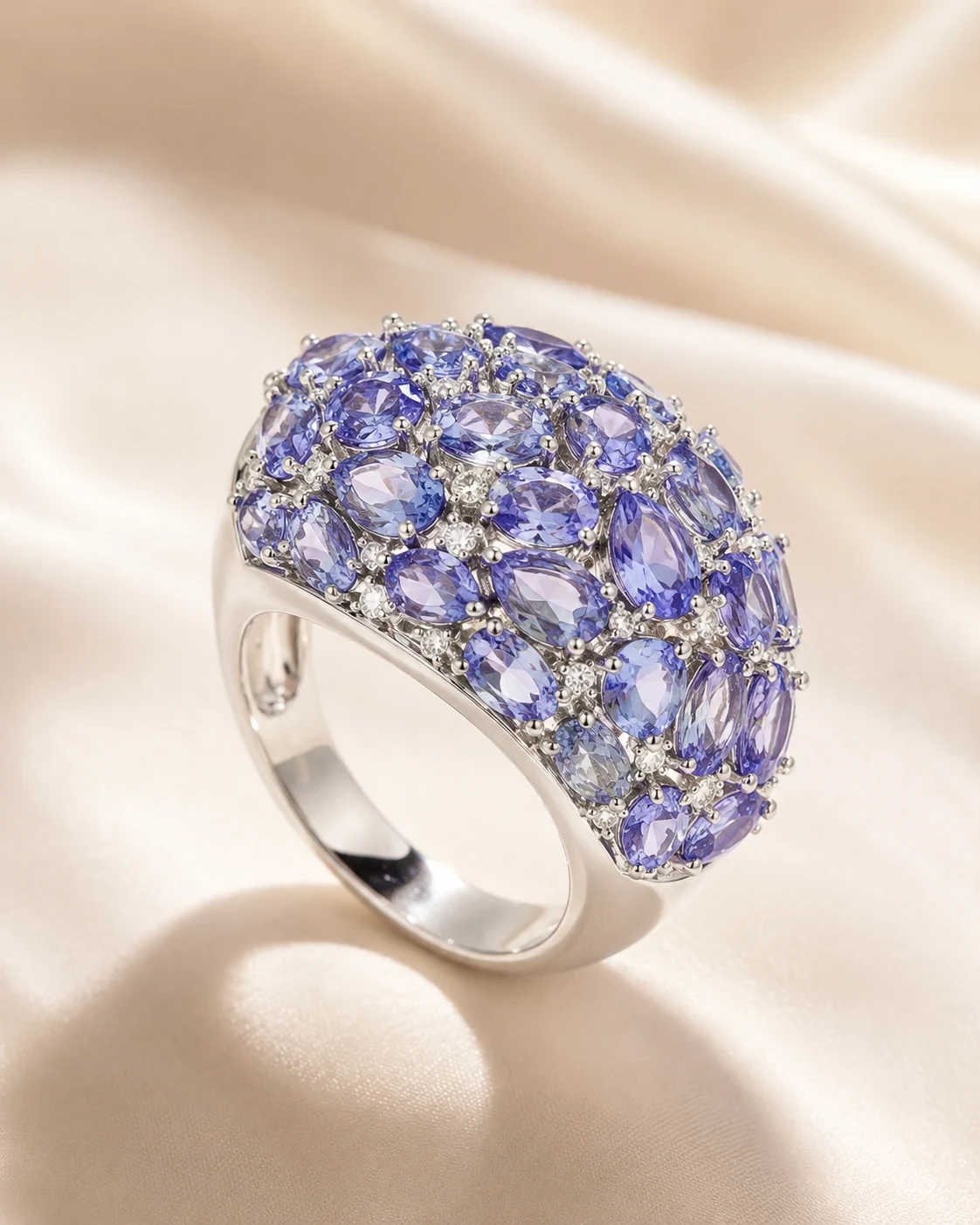
Tanzanite pairs well with several other gemstones: colourless accents that brighten it, green tsavorite that contrasts with it, warm yellow and pink stones that soften it, and pearls that give it a classic frame. Every pairing, though, has a durability consequence as well as a visual one. Tanzanite sits at 6 to 7 on the Mohs scale, so the harder stones beside it will scratch it wherever they touch, and the softer ones will be scratched by it. The best combined pieces are designed with both in mind.
Why hardness matters in a combined piece
In a single-stone piece, the main threat is the outside world. In a piece with several stones, the stones themselves become a threat to each other. Hardness measures scratch resistance, and a harder material abrades a softer one through contact, slowly and invisibly at first, then as dulled facet edges and fine scratches.
Contact happens in two ways. Stones set so close that they touch can rub as the metal flexes slightly with wear. And pieces worn or stored together, such as a ring beside a band or a necklace in a drawer with earrings, rub against each other whenever they move. Both are design questions as much as care questions, and both start with how the stones are cut and set, covered in how a tanzanite is cut and set.
How the common partners compare
| Partner stone | Hardness relative to tanzanite | Visual effect | Main design concern |
|---|---|---|---|
| Diamond | Much harder | Brightness and contrast | Diamond abrades tanzanite on contact |
| Sapphire | Much harder | Blue on blue, or colour contrast | Same abrasion risk as diamond |
| Tsavorite garnet | Slightly harder | Strong green and violet contrast | Small gap, easily managed |
| Yellow or pink stones | Varies by species | Warmth, softer contrast | Check each stone’s hardness |
| Pearl | Much softer | Classic, gentle | Tanzanite and metal can scratch the pearl |
The figures behind the table are well established. Sapphire is second only to diamond in hardness among natural gems, at 9, tsavorite sits at 7 to 7.5, and pearls at 2.5 to 4.5, which is softer than many everyday materials.
Diamond and other colourless accents
The most common partner is a ring of small colourless stones around a tanzanite, or accents scattered between several tanzanites. Colourless accents brighten the piece, reflect light into the blue and violet, and give the eye a point of contrast that makes the colour look deeper.
The abrasion risk is real but manageable. Small accents held in their own claws or bezels, with metal between them and the tanzanite, rarely touch the larger stone. The risk rises when accents sit in a halo pressed directly against the tanzanite’s girdle, or when the setting loosens over time and stones begin to move. A periodic check of the settings, and a halo designed with a thin line of metal between the accents and the centre, does most of the work.
The same logic applies with more force to a diamond band worn beside a tanzanite ring, which rubs against it all day. That problem has its own guide: wearing tanzanite with a wedding band.
Sapphire: blue with blue
Sapphire and tanzanite together can create a layered blue, or a deliberate contrast when a pink, yellow or white sapphire is used. Visually the pairing works well, and sapphire’s hardness and lack of cleavage make it the sturdier stone.
The trade-off is the same as with diamond: sapphire is far harder, so contact will wear the tanzanite. In a combined piece, the tanzanite should sit where it is least exposed, often as the centre stone protected by a raised setting or bezel, with the sapphires as accents held apart by metal.
There is also a colour consideration. Blue sapphire and blue tanzanite can look similar at a glance, and placed side by side, the slight differences in hue can look like a mismatch rather than a choice. A clear contrast, or a deliberate gradient, usually reads better than two near-identical blues.
Tsavorite: the natural complement
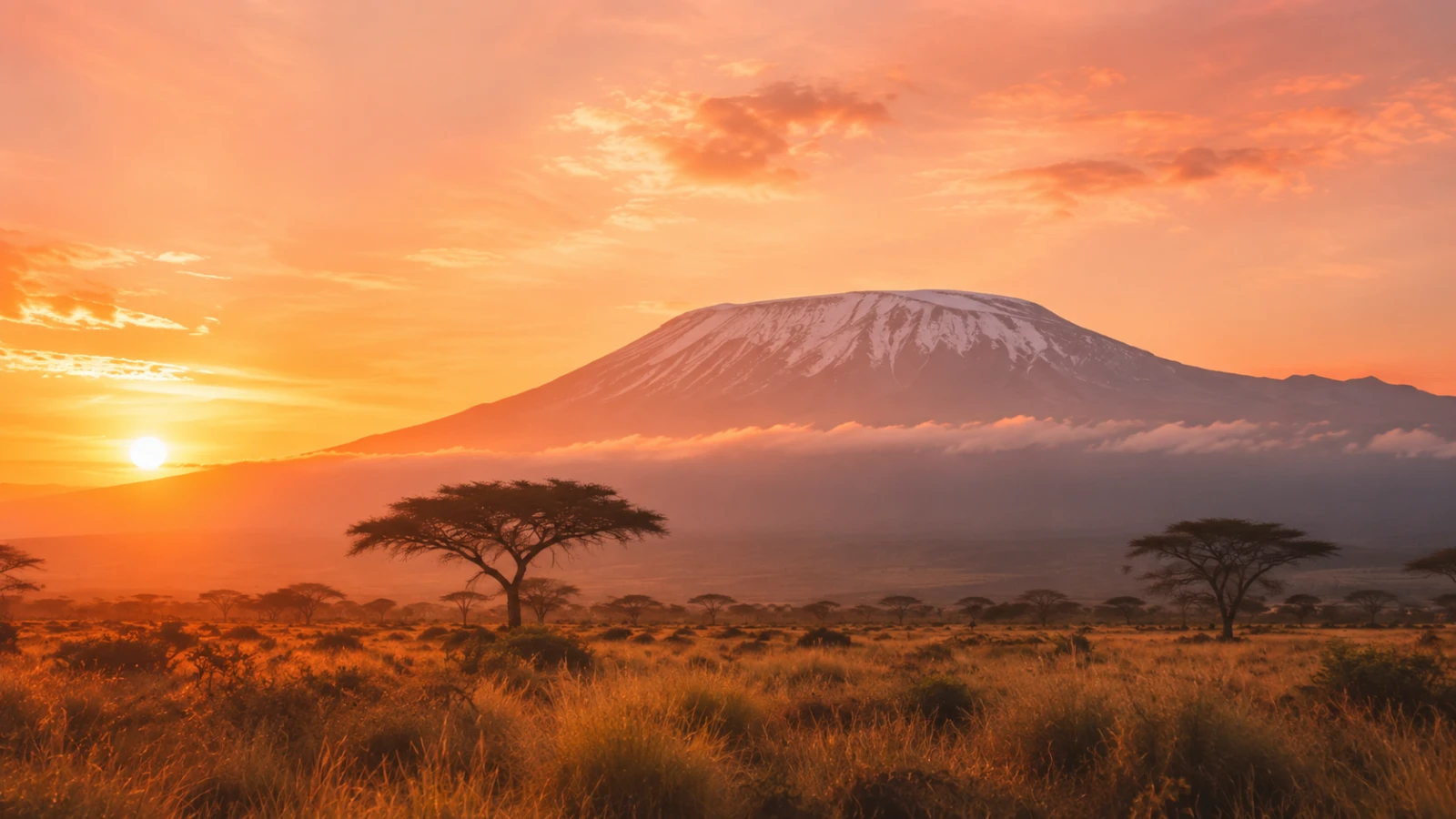
Tsavorite, the green garnet, makes a striking partner. Green and blue-violet sit near opposite sides of the colour wheel, so each makes the other look more intense. There is also a story in the pairing: tsavorite and tanzanite come from the same region of northern Tanzania, where tanzanite has only one source, the Merelani hills, and the two are discussed together in the guide to Merelani tanzanite and tsavorite.
Durability is the easiest of the pairings to manage. Tsavorite is a little harder than tanzanite and has no cleavage, so it is the tougher of the two, but the hardness gap is small. Standard good setting practice keeps both in good condition for a long time.
Warm colours: yellow, pink and peach stones
Yellow and pink stones soften tanzanite’s coolness and create a more romantic or playful palette. The choice of stone matters: a yellow sapphire is much harder than tanzanite, a citrine close to it, and some pink and peach stones softer. Before choosing a warm partner, check its hardness and its own care needs, because the piece will need care that suits all its stones at once.
Warm stones also change how tanzanite reads. Next to yellow, the violet in a tanzanite becomes more noticeable; next to pink, the blue can look cooler. Viewing the stones together, in daylight and warm indoor light, before setting them shows the effect better than any description.
Pearls: the softer partner
Pearls and tanzanite make an elegant combination, especially in earrings and pendants. The relationship is reversed: here tanzanite is the harder material, and the pearl is the one at risk. Pearls are easily scratched by other gems and damaged by cosmetics and perfume, and their surface lustre is what gives them their value.
In a combined piece, the pearl should not rub against the tanzanite or its setting, and the piece should be put on after perfume and hairspray and wiped gently after wearing. Cleaning has to follow the pearl’s rules rather than the tanzanite’s: no soaking, no detergents, just a soft, slightly damp cloth.
Why some colour pairings work better than others
Colour pairings work for the same reasons in jewellery as in painting. Complementary colours, those opposite each other on the colour wheel, intensify each other: placed beside green tsavorite, a tanzanite looks more violet and more vivid, and the green looks greener. Analogous colours, those next to each other, create calm, harmonious pieces: tanzanite with blue sapphire or a pale aquamarine reads as one cool family.
Neutral partners, colourless stones and white pearls, do something different again. They add no colour of their own, so the eye reads the tanzanite as the only colour in the piece, and its blue or violet looks purer. That is why colourless accents are the default partner for a single tanzanite: they frame rather than compete.
Tanzanite’s own trichroism adds a subtlety. A stone that faces up between blue and violet can be pushed toward one or the other by its partner. A warm partner brings out the violet; a cool partner brings out the blue. Choosing the partner is therefore partly choosing which side of the stone’s character the piece will show.
Which pieces suit mixed stones best?
Earrings and pendants are the most forgiving pieces for combinations. They take few knocks and are rarely in contact with other jewellery while worn, so the hardness differences between stones matter mainly in storage. That makes them the natural home for pairings with pearls or softer warm-coloured stones.
Rings are the most demanding. A ring is knocked, gripped and worn beside other rings, so any hardness difference between its stones is tested every day. For rings, the safest combinations are tanzanite with small colourless or tsavorite accents in their own settings, and the tanzanite placed where the metal protects it.
Bracelets sit between the two. They take knocks against desks and door frames, and stones in a line bracelet can rub as the links move. A bracelet that mixes tanzanite with harder stones needs settings that keep each stone separate, or the tanzanites will wear first.
Does the metal colour change the pairing?
Yes, and noticeably. White metals keep the palette cool and let colourless accents read as bright white, which suits tanzanite with diamond-like accents or with blue stones. Yellow gold warms everything, pushing tanzanite toward violet and making warm partners look richer, which suits pairings with yellow or pink stones and with pearls. Rose gold sits between the two and flatters pink partners in particular. The guide to tanzanite settings and metals covers metal choice for single stones; for mixed pieces, it helps to view the stones against a sample of the intended metal before deciding.
Family pieces and heirloom combinations
Combined pieces are often made by adding to something that already exists: a tanzanite set into a ring that once held another stone, accents added to a pendant, a pearl strand given a tanzanite clasp. These pieces carry meaning, and they also bring older settings and older stones into contact with new ones. Before combining, have the existing piece checked: old claws can be thin, older stones may have chips or wear, and a design made for one stone may not protect a tanzanite well. A jeweller can often adapt the setting so the new stone sits safely, which is a better result than fitting a tanzanite into a mount that was never meant for it.
Designing a combined piece well
| Design choice | Why it helps | Where it matters most |
|---|---|---|
| Metal between stones | Stops harder stones touching tanzanite | Halos, clusters, pavé |
| Tanzanite in the protected position | Less exposure to knocks and rubbing | Rings with accents |
| Softest stone furthest from contact | Protects pearls and soft stones | Earrings, pendants |
| Matching care needs | One cleaning routine fits all stones | Any mixed piece |
| Periodic setting checks | Loose stones start to rub | Rings worn daily |
The principle is simple: the harder stone always wins, so the design should make sure stones meet only metal, not each other.
What to check when buying a combined piece
A combined piece rewards a closer look before buying. Check that each stone sits in its own setting, with metal between it and its neighbours, rather than stones pressed directly against each other. Look at the tanzanite’s girdle and facet edges for signs of wear where harder stones are close. Ask what the accent stones are, since colourless accents vary widely in hardness and durability, and the description should name them.
Check that the care instructions suit every stone in the piece. A seller who recommends an ultrasonic cleaner for a piece with tanzanite or pearls is giving advice that would damage it. And for rings, check the settings are tight and even: a small accent that has started to move is the first sign that stones may begin to rub.
Replacing an accent stone
Small accents are lost more often than centre stones, because their settings are finer. Replacing one is usually straightforward for colourless accents, which are easy to match in size and colour. Coloured accents such as tsavorite or warm stones are harder, because the replacement must match the colour of the others. Keeping a record of the piece, with photographs in daylight and indoor light, makes a later match much easier, and the guide to tanzanite damage and repair covers what a jeweller can do when the tanzanite itself needs attention.
Should the accents be natural or synthetic?
Some combined pieces use synthetic or simulant accents to keep the price down. That is a legitimate choice as long as it is disclosed, and it changes the durability picture: a colourless simulant may be softer or harder than a diamond, and its care needs differ. Ask what the accents are and expect a clear answer in the description, because a piece described only as having white stones leaves out information that affects how it wears and what it is worth.
Storing and cleaning mixed pieces
Mixed pieces need care that respects the most delicate stone. That usually means warm water, mild soap and a soft brush for pieces without pearls, and only a damp cloth for pieces with them. Ultrasonic and steam cleaners are unsuitable for tanzanite and pearls alike. Store each piece in its own soft-lined compartment, so it cannot rub against other jewellery, as described in the guide to storing tanzanite.
When is a combined piece the wrong choice?
When the wearer wants something for hard daily use with minimal care. A ring that combines a tanzanite with diamond accents needs its settings checked and a little more care than a single stone. A piece mixing tanzanite with pearls needs gentle handling every time it is worn. For someone who wants to wear one piece through everything, a single tanzanite in a protective setting, or a harder stone altogether, is the more practical choice.
The short version
Tanzanite pairs beautifully with colourless accents, tsavorite, warm-coloured stones and pearls. Harder partners such as diamond and sapphire will scratch it wherever they touch, and softer pearls will be scratched in turn, so good combined pieces separate stones with metal, place the more vulnerable stone where it is protected, and follow a care routine that suits the most delicate stone in the piece.
COMMON QUESTIONS
What gemstones go well with tanzanite?
Colourless accents such as diamond brighten tanzanite's blue and violet; green tsavorite gives a strong complementary contrast; warm yellow and pink stones soften it; and pearls give a classic, gentle pairing. Which suits a piece depends on the colour effect wanted and on how the stones will wear against each other.
Will diamonds scratch tanzanite in the same piece?
Only where they touch or rub. Diamond is far harder than tanzanite, so if stones are set so that they can rub against each other, the tanzanite will wear. Designs that hold each stone in its own setting, separated by metal, avoid it.
Can tanzanite and pearls be worn together?
Yes, and they look good together, but pearls are much softer than tanzanite and are damaged by chemicals, perfume and abrasion. In a combined piece, the pearl usually needs the more protective position, and the piece should be cleaned with the pearl's needs in mind.
Is tsavorite a good partner for tanzanite?
Visually, very. The green of tsavorite and the blue-violet of tanzanite are near complements, and both were found in the same region of Tanzania. Tsavorite is slightly harder and has no cleavage, so it is the tougher of the two, but the gap is small enough that careful setting manages it easily.
SOURCES
- Gemstone Hardness and Wearability — International Gem Society Hardness as scratch resistance; diamond at 10 and corundum at 9; harder materials abrade softer ones on contact.
- Tanzanite (Zoisite) Value, Price, and Jewelry Information — International Gem Society Tanzanite at 6 to 7 on the Mohs scale and its care requirements.
- Sapphire Value, Price, and Jewelry Information — International Gem Society Sapphire hardness 9, second only to diamond among natural gems, no cleavage.
- Tsavorite Value, Price, and Jewelry Information — International Gem Society Tsavorite hardness 7 to 7.5.
- Pearl Value, Price, and Jewelry Information — International Gem Society Pearl hardness 2.5 to 4.5; pearls scratched by other gems and damaged by cosmetics; put pearl jewellery on last.
- Tanzanite — GIA Tanzanite's single source in the Merelani hills of northern Tanzania.