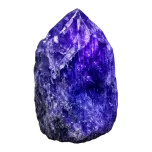


Merelani produces a second gemstone, it was found in the same year as tanzanite, it gets its colour from the same element, and it is never treated. Tsavorite is the green one, and the pair of them coming out of the same small hillside is one of the stranger coincidences in gemmology.
It is not really a coincidence. The two stones are related by chemistry and separated by timing, and understanding how explains something about tanzanite that no article about tanzanite alone can.
Two gems, one hill, one year
Tanzanite was identified at Merelani in 1967. Tsavorite was first discovered in Tanzania in 1967 as well, and the Merelani Hills are among its sources.
The name came from elsewhere. Tsavorite is named after Tsavo East National Park in Kenya, where the material was later found and from where it was commercialised, so the gem carries a Kenyan name and a Tanzanian first discovery. Tanzanite went the other way, taking the name of its country from a shop in New York.
Both were unknown to the world before that year. A single small area in northern Tanzania produced two new gemstones inside twelve months, which is not a thing that happens.
It is worth pausing on how recent that is. Almost every gemstone in a jeweller’s window has been known for centuries and often for millennia. These two entered the trade within the lifetime of people still working in it, and the science describing how they formed is more recent still. Gemmology is not a closed subject, and Merelani is the clearest evidence of it.
The same element, two colours
Tanzanite is blue because of vanadium. Tsavorite is green because of vanadium.
The blue in tanzanite comes from small amounts of vanadium within the zoisite mineral structure. Tsavorite takes its green from traces of vanadium, principally, and chromium. Same colouring element, entirely different result, because colour in a gemstone is not a property of the impurity alone. It is a property of the impurity sitting in a particular crystal structure, in a particular oxidation state, absorbing particular wavelengths.
Put vanadium into zoisite and you get violet-blue. Put it into grossular garnet and you get green. The element is a passenger; the host mineral decides what you see.
This is also why heating changes tanzanite and would do nothing useful to tsavorite. The heat works on the vanadium’s oxidation state within the zoisite structure specifically. There is no equivalent lever in garnet.
Where the vanadium came from
Both gems inherited it from the same source, which is the part of the story that makes the coincidence stop being one.
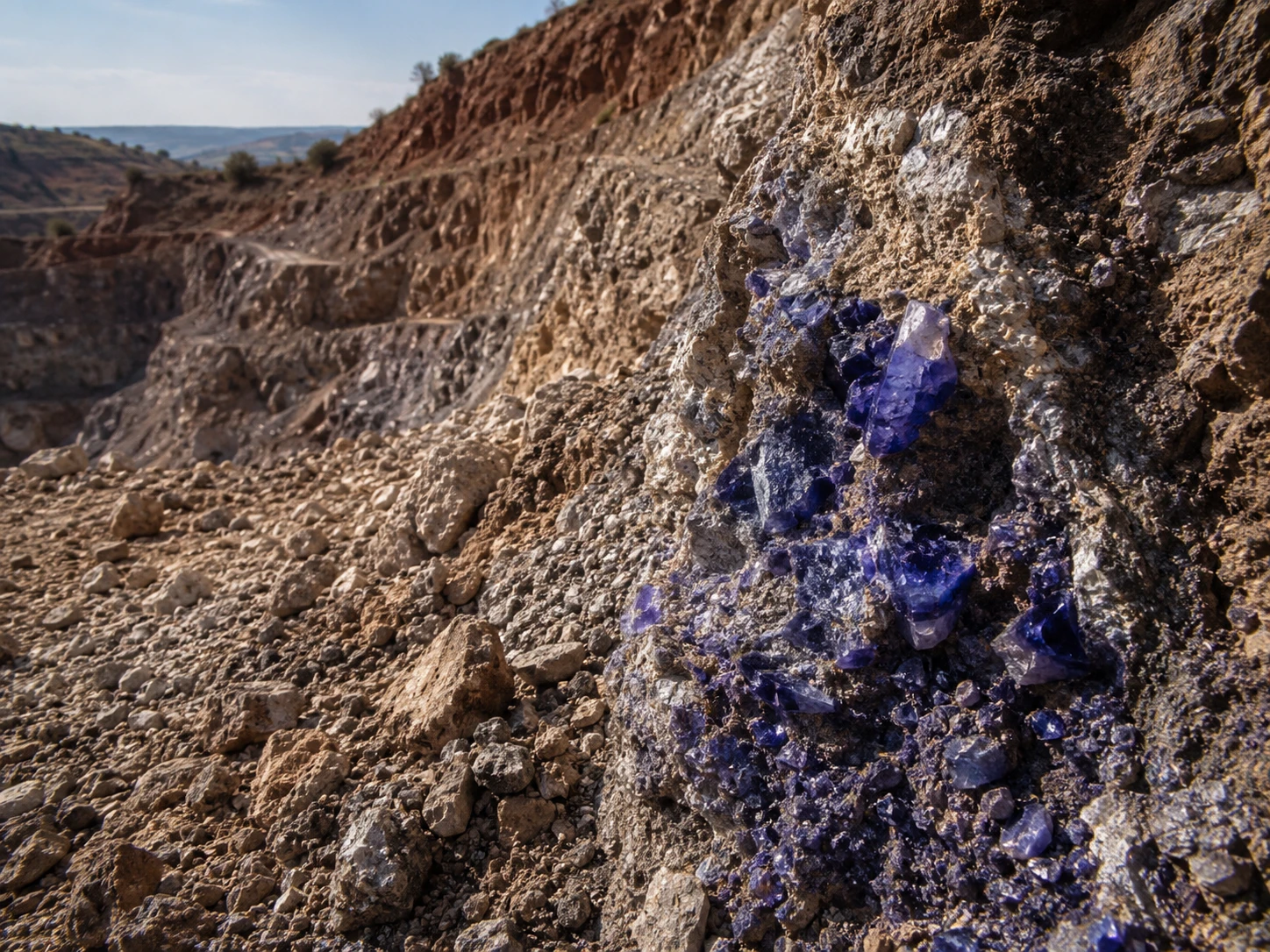
Doctoral research on the deposit at the University of Stellenbosch describes organic carbon-rich mudstone horizons and limestone beds deposited in a back-arc or fore-arc spreading basin, and identifies the organic carbon-rich mudstone layers as the first phase of vanadium accumulation.
Dead organic matter on an ancient sea floor concentrated vanadium. Everything afterwards, both gems included, is that vanadium being redistributed by metamorphism into whatever minerals the conditions favoured at the time.
It is worth sitting with how ordinary the starting material was. Not a rare intrusion or an exotic fluid, but mud with organic matter in it, of the kind that accumulates on sea floors everywhere. What made Merelani was not an unusual ingredient. It was an unusual sequence applied to a common one.
So the two stones are not neighbours by accident. They are siblings drawing on one reservoir.
The order they formed in, which is everything
Here is the part that explains the difference between them.
The same study places tsavorite first: vanadium-rich green grossular garnet crystallised in tension zones within and in proximity to the boudins during prograde metamorphism, meaning on the way up in temperature and pressure. Tanzanite came much later, with mineralisation occurring during the retrograde stages, at about 585 million years ago, on the way back down.
Garnet on the heating curve, zoisite on the cooling curve. Two different minerals were stable at two different moments in one long metamorphic event, and both got their vanadium from the same rock.
That sequence is why a deposit that produces tsavorite might produce tanzanite and why most tsavorite deposits do not. The garnet needs the prograde conditions. The zoisite needs the retrograde ones, plus water, plus the system not being disturbed in between.
Tsavorite against tanzanite
| Property | Tsavorite | Tanzanite |
|---|---|---|
| Mineral | Grossular garnet, Ca3Al2Si3O12 | Zoisite, Ca2Al3(SiO4)3(OH) |
| Hardness | 7 to 7.5 | 6 to 7 |
| Cleavage | None | Perfect, one direction |
| Refractive index | 1.72 to 1.744 | 1.692 to 1.700 |
| Specific gravity | 3.55 to 3.73 | 3.35 |
| Pleochroism | None. Garnet is singly refractive | Very strong |
| Treatment | None normally | Heating, near universal |
| Sources | Tanzania, Kenya, Madagascar and others | Merelani only |
Read the cleavage row and the treatment row together and you have the practical summary. Tsavorite is the sturdier stone and the more honest one to sell, since it arrives as it came out of the ground. Tanzanite is the rarer one and the one that changes colour as it moves.
Wearing the two, which is not the same experience
| If you want | Tsavorite | Tanzanite |
|---|---|---|
| A ring worn daily | The safer of the two by a clear margin | Needs a protective setting |
| One colour that stays put | Yes | No, and that is the point of it |
| An untreated stone | Available as standard | Not realistically available |
| A single-origin stone | No | Yes |
| Resistance to a knock | No cleavage plane to split along | One direction of perfect cleavage |
The first row is the one that matters most in practice. A stone at 7 to 7.5 with no cleavage tolerates daily life considerably better than one at 6 to 7 with perfect cleavage, and if somebody is choosing between the two for a ring that never comes off, that is the deciding fact rather than the colour.
The third row is the one people find surprising. If untreated material is important to you on principle, tsavorite is available that way as a matter of course and tanzanite effectively is not. Anybody selling you certified unheated tanzanite at a premium is selling a certainty that is much easier to come by one mineral over.
What tanzanite has that tsavorite does not is the colour shift and the single origin. Those are real and they are not small, and they are the reason the blue stone became famous while the green one stayed a connoisseur’s gem despite being the more practical object.
Why one is treated and the other never is
Because tsavorite does not need it and tanzanite mostly does.
Tsavorite comes out green. There is no brown phase to remove and no oxidation state to shift, so these gemstones don’t receive any treatments or enhancements, and that untreated status is part of what collectors value.
Tanzanite comes out brown far more often than blue, and heating converts it. The result is permanent and creates no additional care requirement, and the trade treats it as the default state of the material rather than as a disclosure event. The full account is in is all tanzanite heat treated.
Two gems from one hillside, one of which is essentially always altered and one of which essentially never is. The difference is not ethics or effort. It is what the vanadium happened to be doing in each host mineral when the rock cooled.
What mining one alongside the other means
The two gems sharing a deposit has consequences that reach the shop counter.
They do not come out together in equal measure. The ore structure that concentrates tanzanite is the boudinaged, repeatedly folded horizon described above, and tsavorite occupies tension zones associated with the same boudins from an earlier stage. A working face can therefore yield one, the other, or both, and the mix varies with exactly where in the sequence the rock being worked sits.
What follows from that is reasoning rather than a documented fact, and it is worth flagging as such. Merelani is known for tanzanite, and tsavorite is mined in several countries while tanzanite is mined in one. It would be reasonable to expect the green stone to be the secondary concern of operations there, with the sorting and documentation built around the blue one. We have not found a source establishing that, so it is offered as an inference and not as a finding.
The checkable part is the part that matters anyway: ask which stone a given seller actually specialises in, and treat the description of the other one with the scrutiny you would give any secondary line.
None of this changes what either gem is. It is a reminder that the economics of a mine shape what reaches you and how well it is documented, and that neither of those is a property of the crystal.
Zoisite that is not tanzanite
The deposit’s mineral also occurs in colours that are not blue, and this creates a naming problem worth knowing about.
Zoisite is occasionally found in pink, green and yellow. Although some sellers call those tanzanite, GIA calls them zoisite. That is not a technicality: tanzanite is specifically the blue to violet variety, and the name carries the price.
So a green stone offered as green tanzanite is real zoisite with a misleading label rather than a simulant or a fake. It is worth exactly what green zoisite is worth, which is considerably less, and a seller who reaches for the more valuable name has told you something about how they trade.
Green zoisite is also easy to confuse with tsavorite in a description, and the two are entirely different minerals: one is a silicate hydroxide with a cleavage plane, the other a garnet with none. Ask for the mineral name rather than the marketing one.
Buying either one from the same source
A practical note, because sellers of one often sell the other.
If a dealer offers both, ask which stone the price is really about. Tsavorite and tanzanite are priced on different logics: the garnet is scarcer in fine large sizes and untreated by default, the zoisite is single-origin and treated by default, and a shop that prices them by a shared internal grading scheme is applying a system neither stone has.
Ask for mineral names in writing. Green zoisite, tsavorite and green grossular are three descriptions that can attach to superficially similar green stones, and only one of them is the expensive one. A written description is the thing that settles a dispute later.
And apply the same lighting discipline to both, for opposite reasons. Tanzanite needs daylight because it changes with the bulb. Tsavorite needs daylight because green stones are the ones most flattered by shop lighting designed to sell them. In both cases the window is where the honest conversation happens.
What the shared origin does not mean
Coming from a famous deposit does not make a particular stone good, and this is where origin stories get misused.
Every tanzanite shares the Merelani origin, so origin distinguishes nothing between two tanzanites. Tsavorite is found in Tanzania, Kenya, Madagascar and elsewhere, so Merelani material is not automatically superior to Kenyan material either. In both cases what decides whether a stone is worth its price happened after it left the ground: how it was oriented, how it was cut, how clean it is, how saturated.
Nor does a shared deposit imply a shared quality standard. There is no standard grading scale for tanzanite, and the geological story tells you nothing about the individual gem in front of you. It is context rather than evidence.
The useful version of the origin story is the one in this article: it explains why the stone behaves as it does. The useless version is the one that ends with a reason to buy today.
Which to choose, if you are choosing
Not a question most people arrive with, and worth answering because the two stones are genuinely substitutable for some purposes and not at all for others.
If the piece is a ring for daily wear and the wearer is hard on their hands, tsavorite is the better engineering answer and nobody should feel they have settled. The hardness and the absence of a cleavage plane compound over decades in a way no setting fully replaces.
If the appeal is a colour that behaves differently in daylight and lamplight, only tanzanite does that, and no green stone substitutes for it. The same goes for the single origin, which tsavorite cannot claim because it is mined in several countries.
If the piece is earrings or a pendant, the durability argument largely evaporates and the choice becomes purely one of colour and price. That is the honest place to buy tanzanite without qualification.
And if the deciding factor is untreated material on principle, the answer is tsavorite, plainly. Waiting for verifiable untreated tanzanite is waiting for something the laboratories cannot reliably confirm.
Where to start
For the full account of how the deposit formed and why there is no second one, why tanzanite is found in only one place. For the chemistry the vanadium is sitting in, what tanzanite is made of. For how tanzanite compares with the stones it competes with commercially rather than geologically, tanzanite against sapphire and diamond.
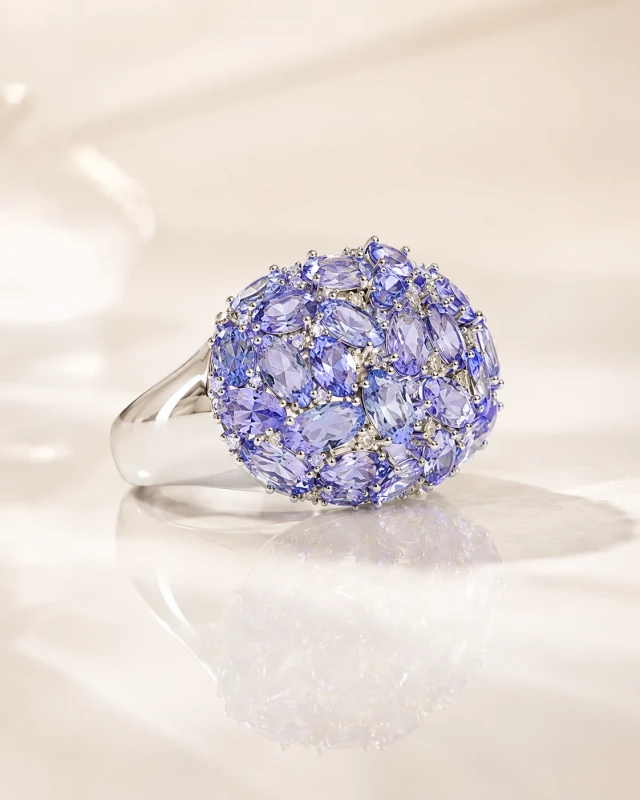
When you want to look at pieces, ours are here. They are tanzanite, from the same eight square miles as the tsavorite, formed a little later on the way down.
COMMON QUESTIONS
What else is found at Merelani besides tanzanite?
Tsavorite, the emerald-green variety of grossular garnet, which was also first discovered in Tanzania in 1967 and occurs in the Merelani Hills. It is named after Tsavo East National Park in Kenya, where it was later found and commercialised, so it carries a Kenyan name and a Tanzanian first discovery. Zoisite from the area also occurs in colours other than blue.
Why are tanzanite and tsavorite different colours if both come from vanadium?
Because colour is a property of the impurity sitting in a particular crystal structure, not of the element alone. Vanadium in zoisite produces violet-blue; vanadium, principally with chromium, in grossular garnet produces green. The host mineral decides what you see. It is also why heating changes tanzanite and would do nothing useful to tsavorite, since the heat works on the vanadium's oxidation state within zoisite specifically.
Is tsavorite more durable than tanzanite?
Yes, and by a clear margin for daily wear. Tsavorite is 7 to 7.5 on the Mohs scale with no cleavage at all. Tanzanite is 6 to 7 with one direction of perfect cleavage. If someone is choosing between the two for a ring that never comes off, that is the deciding fact rather than the colour.
Is tsavorite treated?
Normally not. Tsavorite comes out of the ground green, so there is no brown phase to remove and no oxidation state to shift, and these gemstones do not receive treatments or enhancements. That untreated status is part of what collectors value. It is the opposite of tanzanite, where heating is near universal, and the difference is chemistry rather than ethics or effort.
Why did tsavorite form before tanzanite?
They were stable at different points of one long metamorphic event. Doctoral research on the deposit places vanadium-rich green grossular crystallising in tension zones near the boudins during prograde metamorphism, on the way up in temperature and pressure, while tanzanite mineralisation occurred during the retrograde stages at about 585 million years ago, on the way back down. Garnet on the heating curve, zoisite on the cooling curve.
SOURCES
- Tsavorite Garnet Value, Price, and Jewelry Information — International Gem Society Formula Ca3Al2Si3O12 with V and Cr; hardness 7 to 7.5; no cleavage; refractive index 1.72 to 1.744; specific gravity 3.55 to 3.73; colour from vanadium principally with chromium; first discovered in Tanzania in 1967; Merelani Hills among its sources; normally receiving no treatments or enhancements.
- The geology and petrology of the Merelani tanzanite deposit, NE Tanzania — Bernard Olivier, University of Stellenbosch Organic carbon-rich mudstone horizons and limestone beds deposited in a back- or fore-arc spreading basin; those layers as the first phase of vanadium accumulation; vanadium-rich green grossular crystallising in tension zones near the boudins during prograde metamorphism; tanzanite mineralisation on the retrograde path at ca. 585 Ma.
- Tanzanite Value, Price, and Jewelry Information — International Gem Society Hardness 6 to 7; perfect cleavage; refractive index 1.692 to 1.700; specific gravity 3.35; very strong pleochroism.
- Tanzanite: A blue gemstone found in only one place on Earth — Geology.com Small amounts of vanadium within the zoisite structure as the cause of the blue colour.
- Tanzanite Buyer's Guide — GIA Zoisite occurring in pink, green and yellow being called zoisite rather than tanzanite; the absence of a standard grading scale.
- History of Tanzanite — American Gem Society The 1967 identification of tanzanite at Merelani and Tiffany's 1968 naming, supporting the same-year claim alongside the tsavorite discovery date.