


For most coloured gemstones, origin is an expensive question that laboratories answer with instruments and a price list. For tanzanite it is the one question nobody needs to ask, because there is only one answer available. Every tanzanite came from the Merelani Hills, so an origin report would tell you what the word tanzanite already told you.
That sounds like the end of the article, and it is not, because origin and traceability are different questions and the second one is much harder. This is what can genuinely be established about where a tanzanite has been, what cannot, and which claims to treat carefully.
Why origin determination exists at all
In gems with many sources, where a stone came from changes what it is worth, sometimes enormously.
Sapphire is the clearest case. It is mined in Sri Lanka, Kashmir, Myanmar, Thailand, Australia and Montana among others, and the material differs by locality: Kashmir stones command the highest prices for a velvety texture, Sri Lankan material tends slightly grayish to violet-blue, Australian stones are typically dark.
When a name on a report can multiply a price, laboratories develop the analytical work to assign one, buyers pay for it, and the whole apparatus of origin determination comes into being. It is careful science and it is also, frankly, a market response to a price gap.
For tanzanite, the question collapses
There is no gap to arbitrage, because there is nowhere else for the stone to come from.
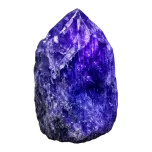
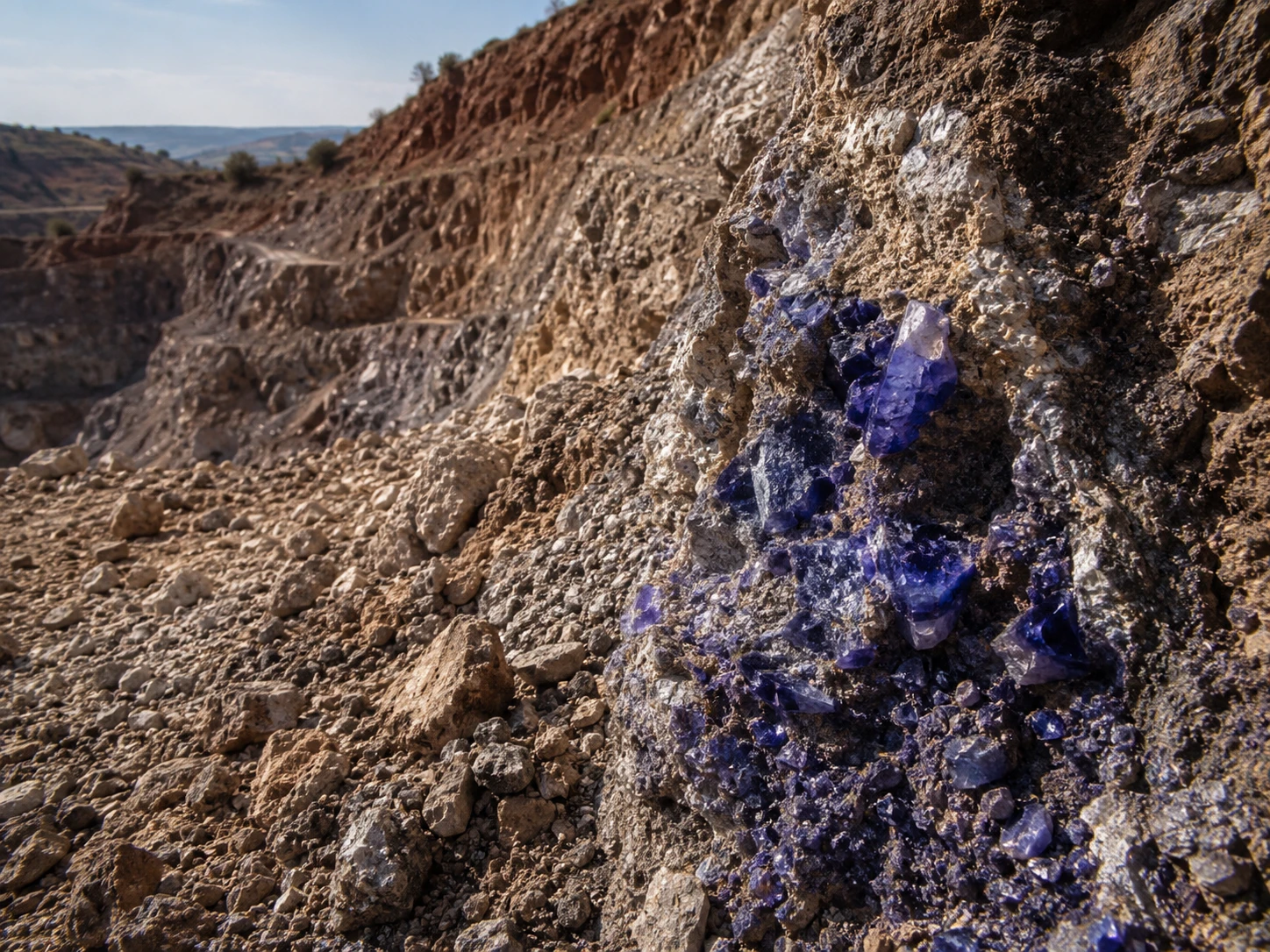
Tanzanite is only found in one small area in northern Tanzania, and the sole source is the Merelani Hills in the Lelatema Mountains, an area of about eight square miles. Establishing that a stone is tanzanite establishes where it formed, in a single step, with no additional testing and no additional fee.
This is a genuine and underappreciated advantage. The service that costs real money for sapphire and ruby is unnecessary here, and the argument that consumes so much oxygen in other gem markets simply does not arise. If it is tanzanite, it is Merelani.
The corollary matters just as much: origin therefore distinguishes nothing between two tanzanites. A seller emphasising Merelani provenance is describing a property every tanzanite in the world shares. Everything that decides whether a particular stone is worth its price happened after the rough left the ground.
How origin is determined for other stones, briefly
Worth understanding, because it explains why the tanzanite answer is so different.
A laboratory assigning origin to a sapphire is not reading a label. It is comparing the stone’s trace-element chemistry, its inclusions and its spectral behaviour against reference collections of material of known provenance, and then making a probabilistic judgement. Deposits that formed under similar geological conditions produce similar stones, so the answer is sometimes confident and sometimes a list of possibilities.
Two things follow that buyers rarely hear. Origin opinions are opinions, expressed with a stated confidence, and two laboratories can disagree about the same stone. And the whole method depends on the reference collections being good, which means it works best for well-studied deposits and worst for new ones.
For tanzanite none of this apparatus is needed. There is one deposit, so there is nothing to distinguish it from and no probabilistic judgement to make. The identification is the origin.
A quiet advantage worth naming
The absence of an origin question removes an entire category of dispute, expense and fraud from this market.
Nobody sells a Merelani tanzanite at a premium over a non-Merelani one, because there is no such thing. Nobody pays a laboratory to argue about it. No stone loses half its value when a second opinion reassigns it. And a whole class of misrepresentation, the falsely attributed locality, is impossible.
Set against the things tanzanite makes harder for a buyer, and there are several, this is one it makes considerably easier. It is worth putting on the other side of the ledger.
What a report actually establishes
| Question | Can a laboratory answer it? |
|---|---|
| Is this tanzanite? | Yes, definitively |
| Where did it form? | Yes, by implication, since there is one source |
| Is it natural rather than grown? | Yes. No synthetic tanzanite is known |
| Has it been treated? | Sometimes. Heat is often challenging to determine |
| Which block or shaft did it come from? | No |
| Who mined it, and under what conditions? | No |
| What is its quality grade? | No. There is no scale |
A Colored Stone Identification Report records weight, measurements, shape, cutting style and colour, states whether the stone is natural or laboratory-grown, and names any detectable treatments. That is the top half of the table and it is real, useful information.
The bottom half is where people expect more than exists. A report is an analysis of an object, not a history of it. Instruments read the stone; they cannot read where it has been or whose hands it passed through.
Traceability is a different question
Origin is a physical fact about a crystal. Traceability is a documentary claim about a journey, and the two are constantly conflated.
Knowing that all tanzanite comes from Merelani tells you nothing about the route a specific stone took: which block it was worked from, who bought the rough, where it was cut, how many dealers handled it, or what any of them recorded. That chain is made of paperwork rather than physics, and paperwork can be complete, partial, absent or wrong.
The deposit is formalised into licensed blocks and worked at very different scales. Block C is the largest, accounting for over 50% of the mining area, and is the only mechanised block, while the rest is worked at smaller scale. Material from operations of that different a character enters the same market and becomes indistinguishable once it is cut.
So a traceability claim is only as good as the documents behind it, and the right response to one is to ask what those documents are and who issued them.
What we cannot tell you
The honest position for this house, stated plainly.
Maison Tanzanite does not buy rough, does not operate at the mine, and cannot trace an individual stone to a block, a shaft or a date. Nobody here has stood on that hillside. Saying otherwise would be easy and would be false.
What we can say is what every piece states on its own page: the metal, the treatment of the stones, and what the smaller stones actually are. That is a claim about the object in front of you, which is the kind of claim we can support.
If a seller does claim full traceability, that is not automatically doubtful. It is a claim that should come with documents you can inspect, issued by somebody other than the seller, naming the specific stone. A traceability assertion with no paper behind it is a sentence, and a sentence is not a chain of custody.
Blocks, and why they do not appear on paperwork
The natural follow-up question is whether a stone can at least be traced to a part of the deposit, and the practical answer is no.
Rough is bought, sorted and combined by weight and quality rather than by shaft. Parcels are assembled from multiple sources, sold on, split, re-sorted and cut in different places. By the time a stone is faceted it has usually passed through several hands, and nothing about the finished gem records which. Two stones cut from the same parcel can end up on different continents, and two stones in the same shop window can have entirely different histories.
This is ordinary for coloured stones rather than peculiar to tanzanite, and it is why chain-of-custody claims in this trade are difficult everywhere. It is also why a claim tied to a specific block deserves more scrutiny than a general one, not less: it is a more precise assertion, so it needs more precise evidence.
The claims worth reading carefully
| Claim | What would actually substantiate it |
|---|---|
| “Merelani tanzanite” | Nothing needed. All tanzanite is |
| “Direct from the mine” | Purchase documentation naming the operation and the parcel |
| “Fully traceable” | Third-party records covering every transfer, tied to this stone |
| “Certified origin” | Redundant here, and not what an identification report is for |
| “Certified untreated” | Rarely supportable, since detection is often inconclusive |
| “Ethically sourced” | An auditable standard, named, with a body behind it |
None of those phrases is inherently dishonest, and several describe things that can be true. The point is that each has a specific evidentiary requirement, and the requirement is almost never volunteered alongside the phrase.
We deliberately do not use the last row’s language about our own pieces. We have no auditable evidence to attach to it, and a term like that without evidence is decoration.
Why the single source is still worth knowing
None of the above makes the origin story pointless. It makes it explanatory rather than evaluative.
The deposit is why the stone behaves as it does. Vanadium concentrated in organic carbon-rich mudstone horizons deposited in a back-arc or fore-arc spreading basin is why the colour exists at all, and tanzanite mineralisation occurring during the retrograde stages at about 585 million years ago is why the crystals formed as they did. That geology is the reason for the trichroism, the cleavage plane and the fact that heating works.
It also explains the treatment position. Some blue zoisite is found naturally, but most is produced by heat-treating brown zoisite, which is why a claim of natural blue is a claim about a genuine but uncommon case, and why it needs documented history rather than assertion.
Origin as explanation is durable and checkable. Origin as a reason to pay more is neither.
Buying from Tanzania, which changes less than you think
A recurring idea is that buying nearer the source means buying better, or at least buying more traceably. Neither follows.
Proximity to a deposit is not evidence about a particular stone. The same material leaves that hillside and disperses worldwide, and a stone bought in Arusha and a stone bought in Amsterdam may have been cut in the same workshop from the same parcel. Being close to the mine changes the price structure and the recourse available to you, not the gem.
The recourse point is the one worth weighing. A dispute across a border, in another jurisdiction, with a seller you cannot return to, is a dispute you will probably not win. If you buy while travelling, buy from somewhere that hands you an independent laboratory report with the stone rather than promising one afterwards, and treat the discount as partly the price of giving up the ability to complain.
None of that is an argument against buying in Tanzania. It is an argument against treating geography as a substitute for documentation, which is what the romance of a single-source gem quietly encourages.
What to ask instead
If origin cannot differentiate stones and traceability usually cannot be verified, the useful questions are about the object.
Ask for the exact dimensions in millimetres alongside the carat weight. Ask which way the colour leans and to see the stone in daylight. Ask whether it has been heated and who determined that. Ask for the identification report and read what it actually says rather than what the folder implies.
If provenance genuinely matters to you as a principle rather than as a price factor, the honest move is to ask the seller what they can document and then accept the answer, including when the answer is very little. Most sellers of coloured stones cannot document much, and the ones who say so plainly are more trustworthy than the ones who produce a confident sentence.
Those questions can all be answered, and the answers can all be checked. That is a better use of a conversation than asking a seller to confirm something that is true of every stone they will ever sell.
Second-hand and inherited stones
The origin question is easiest of all here, and a different question takes its place.
An inherited tanzanite needs no provenance research to establish where it formed, because the answer is fixed. What it may need is identification, since older family pieces are frequently described from memory and memory converts blue stones into sapphires and back again with some freedom.
The useful step is an identification report rather than an origin enquiry. It settles what the stone is, whether it is natural, and what treatment is detectable, and those three facts are what an insurer or a buyer will want. It also occasionally resolves a family story in an unexpected direction, which is worth being prepared for.
One date is worth knowing when handling older pieces. Tanzanite entered the trade in the late 1960s, so a piece that genuinely predates that cannot contain one, whatever the description says. That is a rare case where a stone’s short history is directly useful as evidence.
Where to start
For the full geology of the deposit and why there is no second one, why tanzanite is found in only one place. For the second gem the same hillside produced, the other gem from Merelani.
For what a report settles about identity and what it cannot, how to tell if a tanzanite is real, and for the treatment question in full, is all tanzanite heat treated.
When you want to look at pieces, ours are here. They come from the same eight square miles as every other tanzanite, and we would rather say that than imply we know more than we do.
COMMON QUESTIONS
Can a laboratory prove where a tanzanite came from?
It does not need to. Tanzanite is found in only one small area of northern Tanzania, the Merelani Hills, so identifying a stone as tanzanite establishes where it formed in a single step. The origin determination that costs real money for sapphire or ruby is unnecessary here, and no separate origin report is required or meaningful.
Does Merelani provenance make a tanzanite more valuable?
No, because every tanzanite has it. A seller emphasising Merelani origin is describing a property that every tanzanite in the world shares, so it cannot distinguish one stone from another. Everything that decides what a particular stone is worth happened after the rough left the ground: how it was oriented, how it was cut, how saturated and how clean it is.
Can a tanzanite be traced to a specific mine or block?
In practice, no. Rough is bought, sorted and combined by weight and quality rather than by shaft, then sold on, split, re-sorted and cut in different places. Nothing about the finished gem records which block it came from. A claim tied to a specific block is a more precise assertion than a general one, so it needs more precise evidence, not less.
What does an identification report actually prove?
It records weight, measurements, shape, cutting style and colour, states whether the stone is natural or laboratory-grown, and names any detectable treatments. That settles identity, and for tanzanite identity implies origin. It does not record the stone's history, who handled it, or its quality, since there is no grading scale for tanzanite to be graded against.
Should I buy tanzanite in Tanzania to be sure of its origin?
Origin is not the reason to. The same material disperses worldwide, and a stone bought near the mine may have been cut in the same workshop from the same parcel as one bought in Europe. What changes is the price structure and your recourse: a dispute across a border with a seller you cannot return to is one you will probably not win. If you do buy abroad, insist on an independent report handed over with the stone.
SOURCES
- Sapphire Value, Price, and Jewelry Information — International Gem Society The six principal sapphire sources and their differing character, including Kashmir commanding the highest prices, used as the contrast case where origin determination matters.
- Zoisite: The mineral zoisite information and pictures — Geology.com Tanzanite occurring only in one small area in northern Tanzania; some blue zoisite found naturally while most is produced by heat-treating brown zoisite.
- Tanzanite: A blue gemstone found in only one place on Earth — Geology.com The roughly eight square mile mining area; Block C as over 50% of the area and the only mechanised block.
- Tanzanite Value, Price, and Jewelry Information — International Gem Society The Merelani Hills in the Lelatema Mountains as the sole source; synthetic tanzanites unknown to date.
- Tanzanite Buyer's Guide — GIA The contents of a Colored Stone Identification Report and the absence of any standard quality-grading scale.
- Tanzanite Quality Factors — GIA Laboratories often finding it challenging to determine whether a tanzanite has been heated.
- The geology and petrology of the Merelani tanzanite deposit, NE Tanzania — Bernard Olivier, University of Stellenbosch Organic carbon-rich mudstones deposited in a back- or fore-arc basin as the vanadium source, and tanzanite mineralisation on the retrograde path at ca. 585 Ma.
- History of Tanzanite — American Gem Society The 1967 discovery and 1968 naming, supporting the point that a piece predating the late 1960s cannot contain tanzanite.