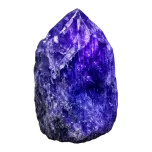
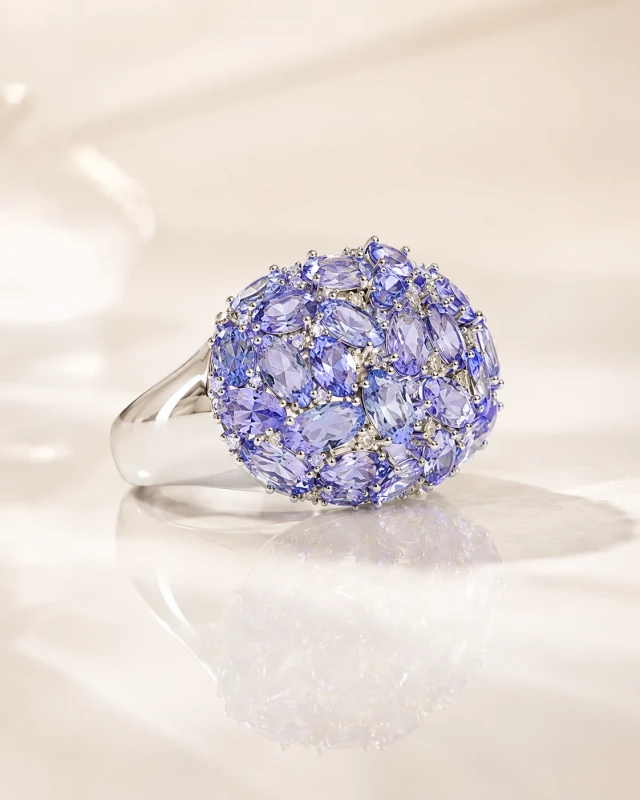
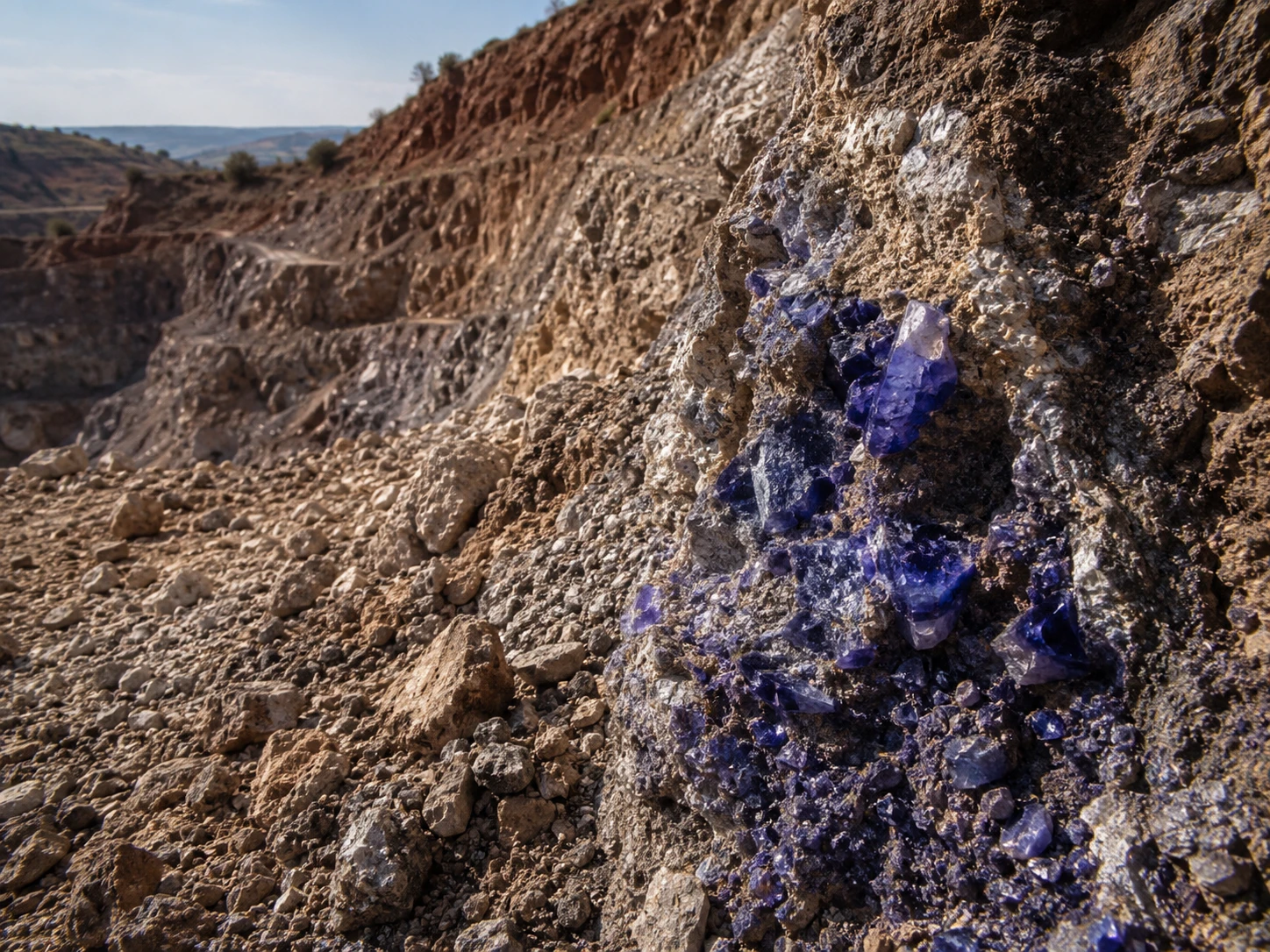


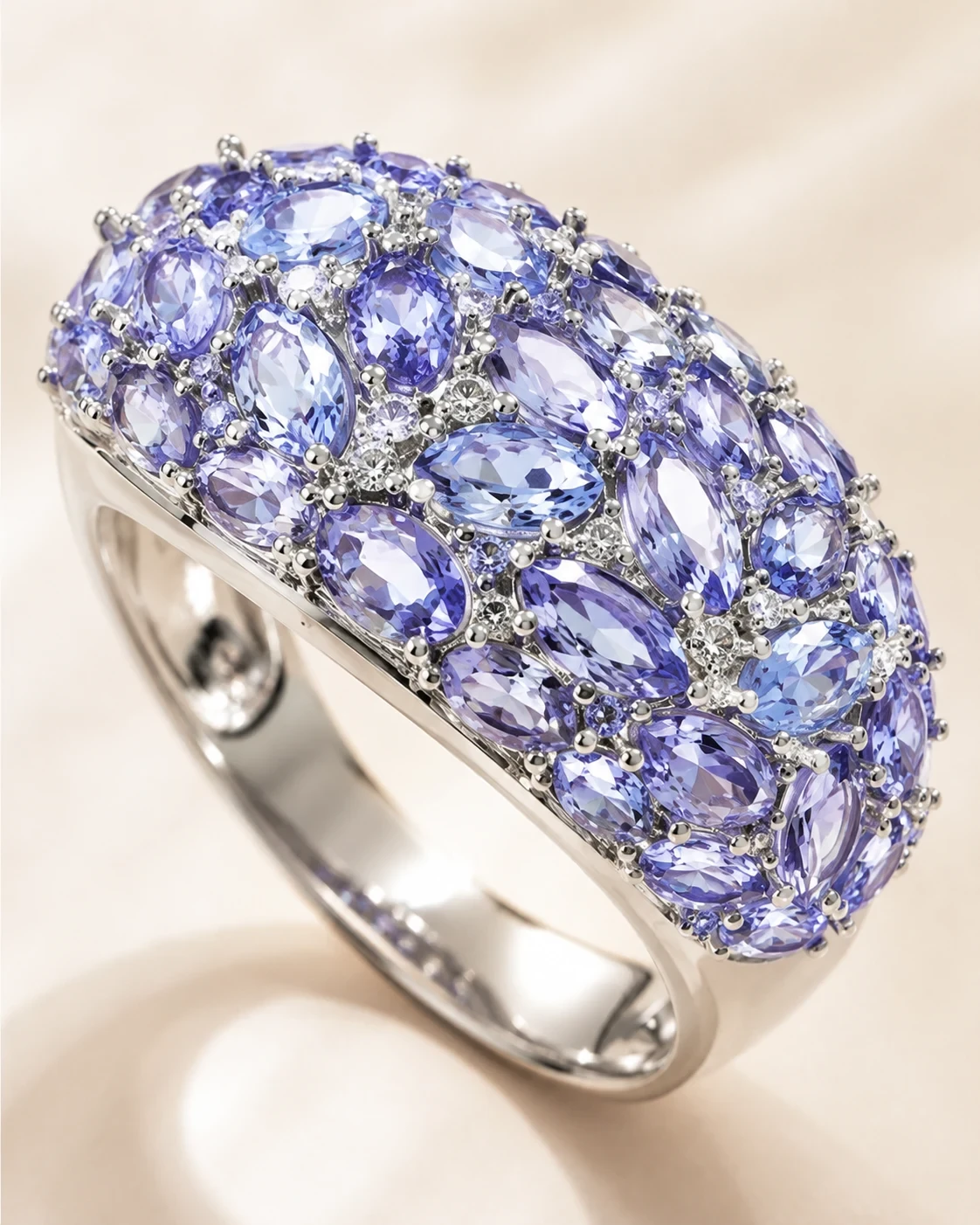
Tanzanite is found in one place because forming it required an improbable sequence of geological events to happen in one order, in one spot, and nowhere else has that sequence been found. The deposit sits in the Merelani Hills of northern Tanzania, in a working area of roughly eight square miles, and it has produced every tanzanite in existence since 1967.
That much is documented and unusually well studied. What is far less documented is the part you will hear most often in a shop: that the supply is about to run out. This page separates the two, because the geology is genuinely remarkable and does not need the sales argument attached to it.
Direct answer: why only Tanzania
Because the stone needs vanadium, and it needs that vanadium to meet a very specific set of pressures, temperatures and structures at a very specific moment in a long metamorphic history.
Zoisite itself is not rare. It occurs in calcareous rocks such as metamorphosed dolomites and calcareous shales subjected to regional metamorphism, which describes a great deal of the Earth’s crust. What is rare is zoisite carrying enough vanadium to be blue, formed and preserved in gem-quality crystals.
The vanadium is the crux. The blue comes from small amounts of vanadium within the zoisite mineral structure, and vanadium has to be concentrated somewhere before it can be incorporated. At Merelani that concentration happened hundreds of millions of years before the gem did, and the rest of the story is about a series of accidents that kept the two together.
Where exactly, and how small it is
Smaller than most people picture.
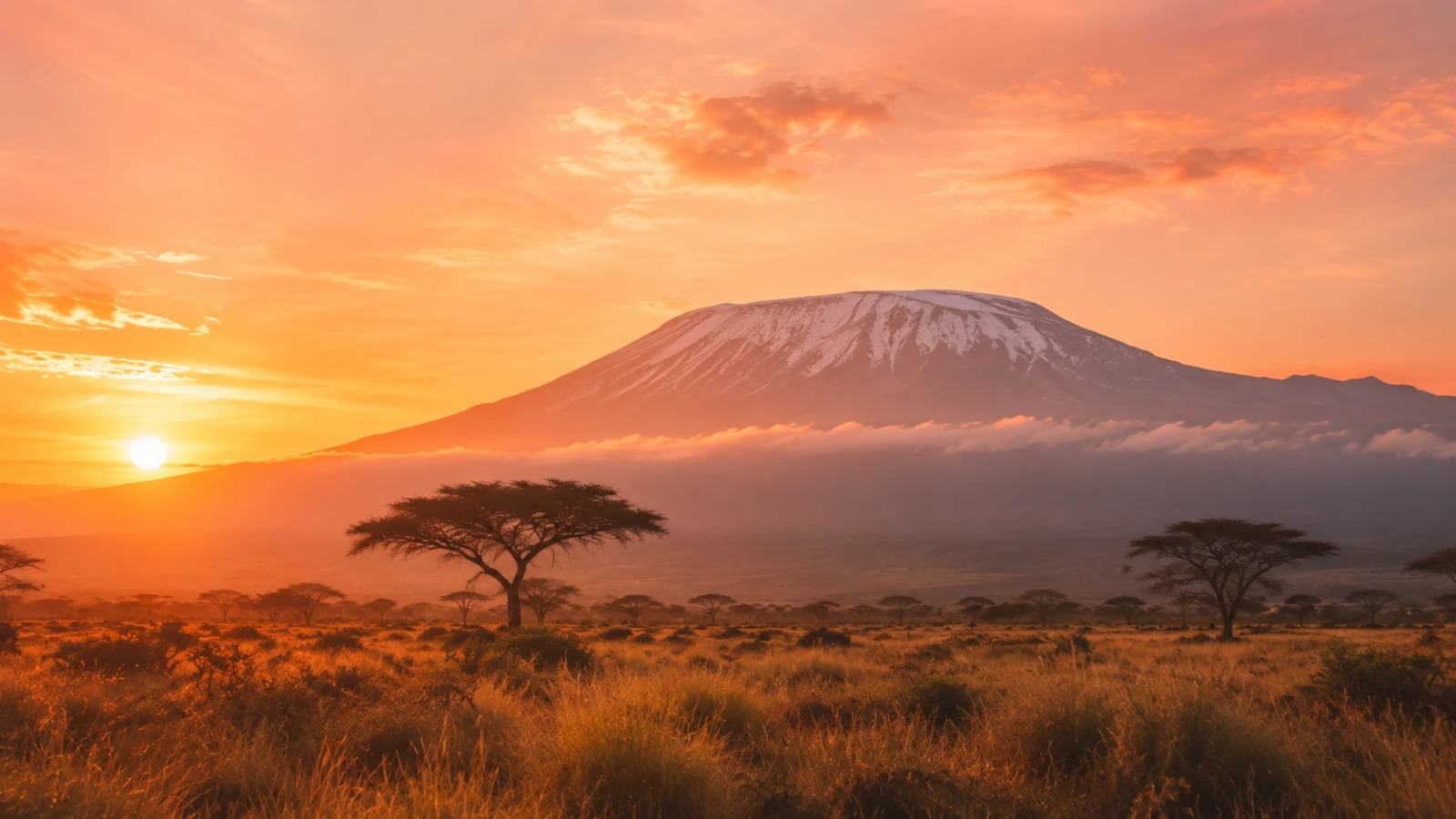
The sole source of tanzanite is the Merelani Hills in the Lelatema Mountains, Tanzania, and the mines are all located in an area of about eight square miles near the base of Mount Kilimanjaro and the city of Arusha. Eight square miles is a small town. Every tanzanite in every window in the world came out of it.
The area is divided into mining blocks. Block C is the largest, accounting for over 50% of the mining area, and is the only mechanised block; the others are worked at smaller scale. That division matters later, because most published production and reserve figures describe Block C rather than the deposit as a whole, and the two get quoted interchangeably.
How it formed, in the order it happened
The detailed work here is a doctoral study of the deposit by Bernard Olivier at the University of Stellenbosch, and it describes a sequence rather than an event.
Read that top to bottom and the improbability becomes concrete. Vanadium had to be gathered by dead organic matter on an ancient sea floor. That rock had to be buried, folded and stretched until competent layers broke into boudins, which are sausage-shaped fragments left when a stiff layer pulls apart between softer ones. Those cavities had to become the sites where vanadium-bearing minerals grew. And then, crucially, the system had to cool.
Tanzanite is a retrograde mineral. It formed on the way down in temperature, not at the peak, which is why it appears after tsavorite rather than alongside it. A deposit that stayed hot, or that cooled differently, produces the garnet and not the gem.
Why the location cannot be repeated
Because the ore body was trapped by an obstacle, and the trapping is part of the recipe.
The association between tanzanite and boudins, and the stacking and multiple duplication of the boudinaged ore-zone through isoclinal folding, resulted in multiple ore-shoots. In plain terms: the same mineralised layer was folded back on itself repeatedly, so a single ore horizon is repeated at intervals underground. That is what makes the deposit worth mining rather than merely interesting.
The wider region was reworked by Pan-African metamorphism, with deformation continuing during the later stages of the Pan-African event between 550 and 500 million years ago. Northern Tanzania has plenty of that. What it has in only one place is that history intersecting a vanadium-enriched carbon-rich horizon and then folding it into repeated, accessible ore-shoots.
This is why prospectors have not found a second Merelani despite sixty years of strong commercial motivation to do so. The individual ingredients are common. The order is not.
What was found, and when
The human half of the story is short enough to tell in a paragraph.
Maasai herders found blue crystals in the Merelani Hills near Arusha in 1967 while tending livestock, and a prospector named Manuel d’Souza registered claims with the government. D’Souza initially believed he was mining sapphire. It was identified as a blue variety of zoisite, a mineral known since the early 1800s, and Tiffany renamed it tanzanite in 1968 rather than try to sell something called blue zoisite.
Sixty years is nothing. The deposit was found within living memory, and the science describing how it formed is more recent still.
What rarity does not mean
Geological rarity and market scarcity are different things, and conflating them is the most common move in tanzanite sales copy.
Tanzanite is geologically rare in the strongest sense available: one deposit, one small area, one improbable formation sequence. That is a real and unusual fact. It is also compatible with tanzanite being widely available and reasonably priced, which it is, because tanzanite is one of the best-selling coloured stones and has been in continuous commercial production for decades.
Both things are true at once. A single-source gem produced in commercial quantity is not a contradiction; it is just what a productive single source looks like.
The scarcity that actually affects what you pay is a different and narrower one. Large clean rough is extremely scarce, and deep colour generally requires size, so the genuinely rare object is a large, vivid, clean stone rather than tanzanite as a category. Being told the stone is rare tells you nothing about the one in front of you. Nearly all of the price difference between two tanzanites is about the individual stone, not about the deposit they share.
Geographic exclusivity also does not translate into retail value on its own. Plenty of gem materials come from a single locality and are worth very little, and diamonds come from dozens of countries and are not cheap. What origin gives tanzanite is a coherent story and a genuine claim to distinctiveness. What it does not give is a floor under any particular price.
Compared with diamond and sapphire
The comparison is worth making because it shows how little single-source status decides on its own.
Diamond is mined across many countries on several continents. Sapphire comes from Sri Lanka, Madagascar, Myanmar, Australia, Montana and more besides. Neither is geographically exclusive in anything like the way tanzanite is, and neither is cheap. If exclusivity set prices, that ordering would be reversed, and it is not.
What multiple sources actually change is resilience and comparability. A gem with many deposits keeps flowing when one country closes a border or a mine floods, and buyers can compare material from different origins, which over time produces the shared vocabulary that becomes a grading standard. Tanzanite has neither. One deposit means the whole supply has a single point of failure, and it means there was never enough diversity of material for a comparative standard to emerge. That is part of why no standard grading scale exists for tanzanite while diamond has one down to fractions of a grade.
So single-source status cuts both ways. It gives tanzanite a genuinely distinctive identity, and it is the reason the stone is harder to price and harder to verify than gems that come from everywhere. A buyer benefits from the first and pays, in uncertainty, for the second.
There is one more asymmetry worth knowing. With diamond and sapphire, origin is often a question, sometimes an expensive one, because where a stone came from can change its value considerably and laboratories are asked to determine it. With tanzanite the question does not arise. If it is tanzanite, it came from Merelani. Origin determination, the service that costs real money for other stones, is free here and tells you nothing you did not already know.
That is quietly one of the better things about the stone. The energy other markets spend arguing about provenance can go into looking at the gem instead.
Supply, with the date attached
Here are the numbers, with their sources and their years, because a figure without those is not evidence.
| Figure | Source and date | What it covers |
|---|---|---|
| 109 million carats total reserves | National Bureau of Statistics of Tanzania, 2018 | The deposit as a whole |
| About 87.1 million carats | High Commission of Tanzania, 2018 | Block C only |
| Enough to support mining into the 2040s | The same 2018 Block C estimate | Block C only, as assessed then |
Three things about that table are worth saying plainly.
First, these are reserve estimates, not production forecasts, and reserves in the ground are not the same as gem-quality faceted stones reaching a market. The gap between the two is large and is not published.
Second, they are from 2018. Any claim about the supply position today should come with a more recent source, and if a seller cannot give you one, they are quoting the same 2018 figures you just read.
Third, some believe the currently known tanzanite resource could be depleted in just a few decades, and the wording there is the wording to keep. It is a belief held by some, about a currently known resource, on a horizon of decades. It is not a date, and we have not found a source that supports a date. This site does not name one, and treats “buy now before it runs out” as a sales argument rather than a fact.
Sourcing, and what we can and cannot tell you
The honest position, which is less than some sites claim.
Maison Tanzanite does not buy rough at the mine, does not operate a cutting works, and cannot trace an individual stone back to a particular block or shaft. Saying otherwise would be easy and would be untrue. Any house that genuinely can trace a stone that far should be able to show you the documentation, and it is worth asking to see it rather than accepting the claim.
What can be said is structural and public. The deposit is formalised into licensed blocks, and Block C is mechanised while the rest of the area is worked at smaller scale, which means tanzanite reaching the market comes from operations of very different sizes and standards. Chain-of-custody claims about coloured stones are difficult everywhere, and tanzanite is not an exception to that difficulty.
If ethical sourcing is a decisive factor for you, the useful question is not whether a seller says the word. It is what document they can produce, who issued it, and what it actually asserts. A certificate that identifies a stone is not a certificate that traces it, and the two are routinely presented as though they were the same object.
It is also worth being clear about what the alternative to a traceability claim is. It is not a worse stone. It is the same stone with less said about it, and a buyer who understands that is in a better position than one who paid extra for a sentence.
What origin means when you are buying
Less than the marketing suggests, and in one specific way more.
It means less because every tanzanite shares the same origin. Proximity to the mine guarantees nothing about a particular stone, a Tanzanian seller is not automatically offering better material, and everything that determines whether a stone is worth its price happened after the rough left the ground: how it was oriented, how it was cut, whether it was heated well.
It means more in one respect. The formation story is why the stone behaves as it does. The vanadium is why heating works at all: heating to 600 °C for about thirty minutes changes vanadium’s oxidation state and produces or enhances the blue, which is why almost every stone you see has been heated and why that is normal rather than suspicious. And the same metamorphic history that grew the crystals gave them a hardness of 6 to 7 and perfect cleavage, which is a wearing consideration rather than a geological curiosity.
For the stone itself, including the trichroism this deposit produced, start with what tanzanite is. For choosing between stones, how to buy tanzanite gives the order to judge in, and what decides the price explains why the deposit is almost never the reason one costs more than another. Before a piece goes onto a hand every day, read the honest care answer.
Whether any of that can actually be proven for a particular stone is a separate question with a short answer: can a tanzanite’s origin be proven. The same hillside produced a second gemstone in the same year, coloured by the same element and never treated: the other gem from Merelani.
When you want to look at pieces, ours are here. They come from the same eight square miles as every other tanzanite, and we would rather tell you that than imply otherwise.
COMMON QUESTIONS
Why is tanzanite only found in Tanzania?
Because forming it required an improbable sequence in one order. Vanadium had to concentrate in organic carbon-rich mudstones, those rocks had to be folded and stretched until stiff layers broke into boudins, mineral-bearing fluids had to fill those cavities, and the system then had to cool, because tanzanite forms on the retrograde path rather than at peak metamorphism. Northern Tanzania has plenty of Pan-African metamorphism. Only Merelani has it intersecting a vanadium-rich horizon folded into repeated ore-shoots.
How big is the tanzanite mining area?
Small. The mines are all located in an area of about eight square miles in the Merelani Hills, near the base of Mount Kilimanjaro and the city of Arusha. The area is divided into blocks, of which Block C is the largest at over 50% of the mining area and the only mechanised one.
How old is tanzanite?
The crystals formed at about 585 million years ago, give or take 28 million, during the retrograde stages of metamorphism, according to doctoral research on the deposit at the University of Stellenbosch. The rocks that hosted it are far older, and the deformation that created the ore structure occurred over a long period, probably between 850 and 600 million years ago.
Is tanzanite really running out?
No source we have found supports a depletion date, so we do not give one. The figures usually quoted come from 2018: Tanzania's National Bureau of Statistics put total reserves at 109 million carats, and a High Commission of Tanzania estimate put Block C at about 87.1 million carats, thought at that time to be enough to support mining into the 2040s. Those are reserve estimates rather than production forecasts, they are now several years old, and reserves in the ground are not the same as gem-quality stones reaching a market.
Does a stone's origin affect what a tanzanite is worth?
Barely, because every tanzanite shares the same origin. Proximity to the mine guarantees nothing about a particular stone, and everything that decides whether one is worth its price happened after the rough left the ground: how it was oriented, how it was cut and how well it was heated. The useful consequence is that origin determination, an expensive service for diamond and sapphire, is unnecessary here.
SOURCES
- The geology and petrology of the Merelani tanzanite deposit, NE Tanzania — Bernard Olivier, University of Stellenbosch Doctoral research on the deposit: deposition of organic carbon-rich mudstones in a back- or fore-arc basin, vanadium accumulation, the D2 deformation event between 850 and 600 Ma, boudinage and stacked ore-shoots, tsavorite during prograde metamorphism, and tanzanite mineralisation at ca. 585 +/- 28 Ma.
- Tanzanite: A blue gemstone found in only one place on Earth — Geology.com The roughly eight square mile mining area near Arusha; Block C as over 50% of the area and the only mechanised block; vanadium as the cause of colour and the 600 degrees C heating; the 2018 reserve figures of 109 million carats total and 87.1 million in Block C with mining into the 2040s; tanzanite as a best-selling coloured stone.
- Tanzanite Value, Price, and Jewelry Information — International Gem Society The Merelani Hills in the Lelatema Mountains as the sole source; zoisite occurring in metamorphosed dolomites and calcareous shales; large clean rough being extremely scarce; hardness 6 to 7 and perfect cleavage.
- History of Tanzanite — American Gem Society The 1967 discovery by Maasai herders near Arusha, Manuel d'Souza's claims and his belief that he had found sapphire, and Tiffany's 1968 renaming.
- Tanzanite Buyer's Guide — GIA The absence of a standard grading scale for tanzanite, used in the comparison with diamond and sapphire.