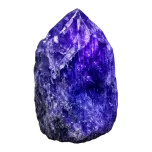
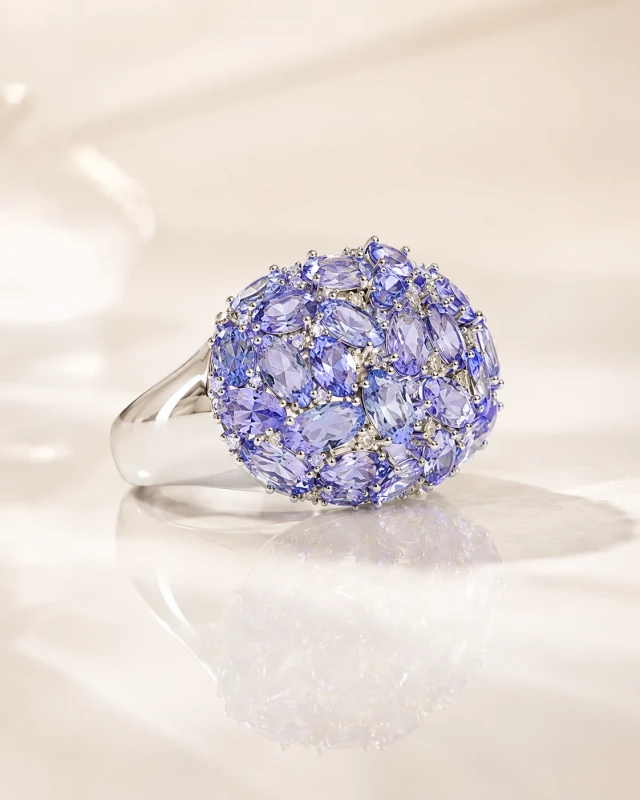
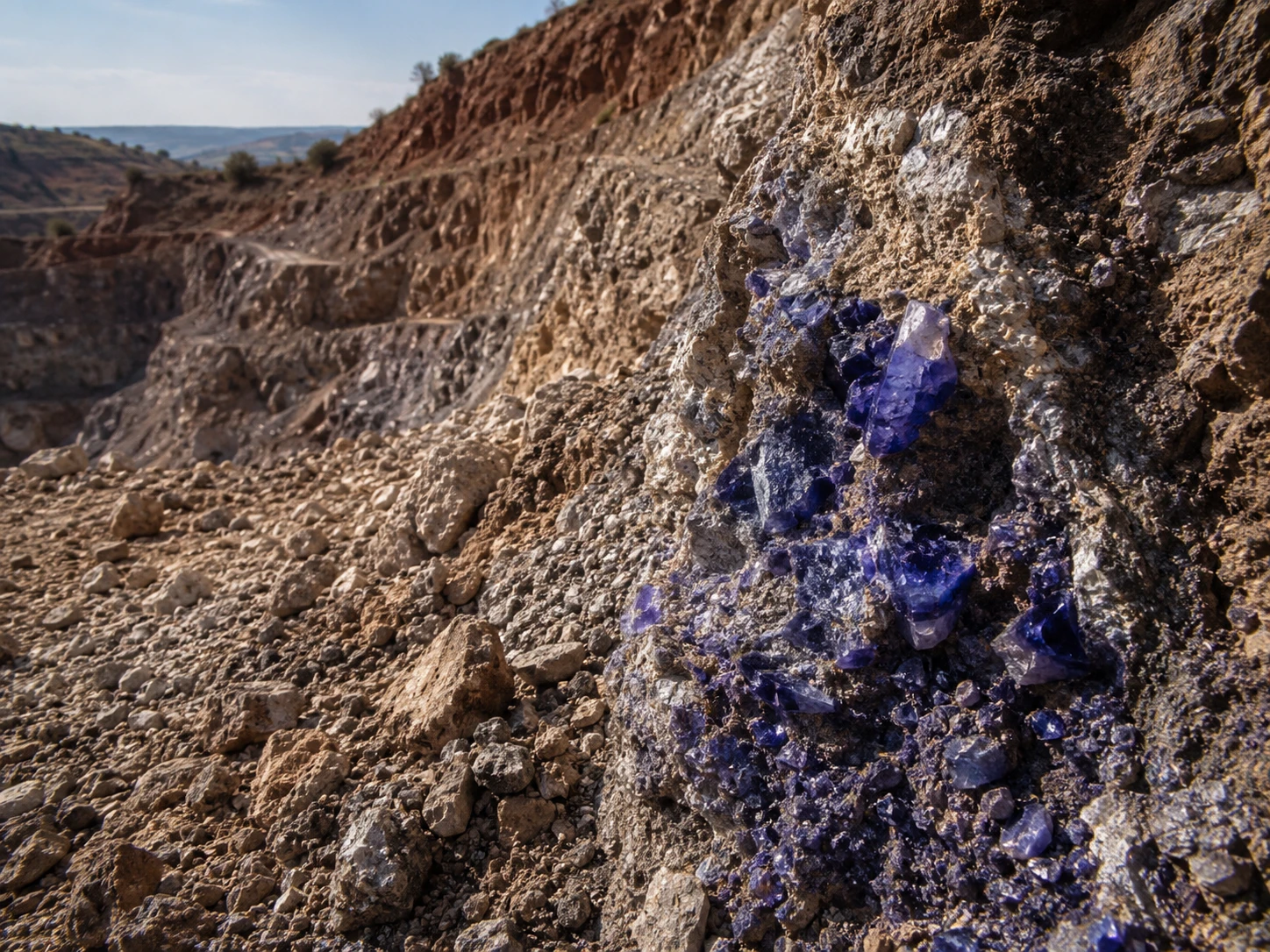


Tanzanite is Ca2Al3(SiO4)3(OH): a calcium aluminium silicate hydroxide, crystallising in the orthorhombic system, coloured blue and violet by trace vanadium. Mineralogically it is not a species at all. It is a variety of zoisite, a mineral described in the early 1800s and unremarkable until one deposit in Tanzania produced it in blue.
That formula explains almost everything a wearer notices: why the stone shows three colours, why it has a plane of weakness, why heating works, and why it sits where it does on the hardness scale. Here is the chemistry, and what each part of it does in the hand.
The formula, decoded
Take it apart and it stops being intimidating.
Ca2 is two calcium atoms. Calcium is why zoisite forms in the rocks it does: it occurs in calcareous rocks such as metamorphosed dolomites and calcareous shales subjected to regional metamorphism. Limestone chemistry, put under pressure and heat.
Al3 is three aluminium atoms, sitting in octahedral sites within the structure. These sites are the important ones for colour, because this is where a foreign atom can substitute without wrecking the crystal.
(SiO4)3 is three silicate groups: silicon at the centre of a tetrahedron of oxygens. Silicates are the great majority of the Earth’s crust, and the way these tetrahedra link determines what kind of silicate you have.
(OH) is a hydroxyl group, one oxygen bonded to one hydrogen. Its presence makes zoisite a hydrous mineral, which is a clue about the conditions it formed in: water had to be involved.
Notice what the formula does not contain: iron, chromium, titanium, or any of the usual suspects behind gemstone colour. Nothing in Ca2Al3(SiO4)3(OH) is coloured at all. Pure zoisite of exactly this composition would be colourless or near it.
Nothing in that formula mentions vanadium, and vanadium is what makes the stone blue. That is the first thing worth understanding about tanzanite, and it is the thing that makes the rest of the chemistry make sense.
Zoisite before it was tanzanite
The mineral is much older than the gem, and the gap between them is the whole story.
Zoisite was described in the early 1800s and spent a century and a half as a mineral of interest to specialists and almost nobody else. It was not rare, it was not usually attractive, and it had no commercial life worth mentioning. Grey, brown and green zoisite occurs in metamorphic rocks in a number of places.
What changed in 1967 was not the discovery of a new mineral but the discovery of a deposit where that ordinary mineral occurred with enough vanadium, in large enough clean crystals, to be cut as a gem. The prospector who registered the first claims initially believed he was mining sapphire, which tells you how unexpected blue zoisite was.
The name followed the market rather than the science. Tiffany renamed the material tanzanite in 1968 rather than attempt to sell something called blue zoisite, and the trade name stuck so completely that most owners have never heard the species name.
None of this is unusual. Ruby and sapphire are both corundum, emerald and aquamarine are both beryl, and amethyst and citrine are both quartz. Variety names are how gemmology talks about appearance, and species names are how mineralogy talks about chemistry. Tanzanite is simply a case where the variety name arrived recently and from a shop.
Where the colour actually comes from
From an impurity measured in fractions of a percent.
The blue and violet come from small amounts of vanadium within the zoisite mineral structure, substituting for aluminium in those octahedral sites. Pure zoisite is not blue. It is typically grey, brown or green, and it was of interest to mineralogists and almost nobody else for a century and a half.
Because the colour is a trace element in a specific oxidation state rather than part of the essential chemistry, it can be changed without changing the mineral. That is exactly what heating does: about 600 degrees Celsius for thirty minutes changes the vanadium’s oxidation state to produce or enhance the blue coloration, and heating can convert naturally brown or green zoisite into blue zoisite.
This is why heat treatment in tanzanite adds nothing and removes nothing. The vanadium was there before and is there after. Only its electronic state differs.
The other consequence is naming. Tanzanite is the blue-to-violet variety of zoisite, and the same mineral occurs in other colours. Zoisite is occasionally found in pink, green and yellow, and although some sellers call those tanzanite, GIA calls them zoisite. Variety names describe appearance; species names describe chemistry.
Three colours down three axes
Tanzanite is trichroic, and the crystal system is the reason.
Orthorhombic crystals have three unequal axes at right angles to each other. Light travelling along each one encounters a different arrangement of atoms, is absorbed differently, and emerges a different colour. Tanzanite’s pleochroism is very strong, which is unusual even among doubly refractive gems.
| Stone type | Colours down the three axes |
|---|---|
| Blue tanzanite | Blue, red-violet, yellow-green |
| Violet tanzanite | Reddish purple, blue, yellowish brown |
All of those colours exist in the stone simultaneously. Which one you see face up was decided by whoever oriented the rough before cutting, and that decision is permanent, which is why how a tanzanite is cut and set matters more here than for most gems.
It also explains something buyers report as a fault. A tanzanite that shifts character as it moves is not defective; it is doing what an orthorhombic trichroic crystal does. A stone that looked identical from every angle would be more suspicious.
The daylight-to-indoor shift has the same origin. Tanzanite reads sapphire blue in natural light and violet under fluorescent light because different light sources emphasise different parts of the absorption behaviour.
What orthorhombic actually means
Crystal systems sound abstract and they determine everything the stone does optically.
A crystal system describes the symmetry of the repeating atomic unit. Orthorhombic means three axes of unequal length, all meeting at right angles: a shoebox rather than a cube. Because the three directions are genuinely different, light behaves differently along each one.
That produces double refraction. A ray entering the stone splits into two rays travelling at slightly different speeds, and the difference between them is the birefringence, 0.009 for tanzanite. It is a modest figure, which is why you do not see obvious doubling of the back facets in a tanzanite the way you do in zircon or peridot.
Double refraction is also what makes pleochroism possible. A singly refractive material such as glass or cubic zirconia has one refractive index in every direction and therefore cannot be pleochroic at all, which is why watching a stone for colour change is a useful screening observation.
Orthorhombic symmetry does one more thing that matters to a cutter. Crystals in this system commonly grow as elongated prisms rather than equant blocks, which is why tanzanite rough tends to be long rather than chunky, and why cushions, ovals and trillions dominate the finished stones. The outline of the gem follows the shape of the crystal, and the shape of the crystal follows the symmetry.
The full property table
| Property | Value |
|---|---|
| Chemical formula | Ca2Al3(SiO4)3(OH) |
| Mineral species | Zoisite. Tanzanite is the blue to violet variety |
| Crystal system | Orthorhombic |
| Mohs hardness | 6 to 7 |
| Cleavage | Perfect, one direction |
| Fracture | Conchoidal to uneven |
| Refractive index | 1.692 to 1.700 |
| Birefringence | 0.009 |
| Dispersion | 0.019 |
| Specific gravity | 3.35 |
| Luster | Vitreous |
| Colouring element | Vanadium |
Two of those numbers do practical work for a buyer. The refractive index and the specific gravity together exclude nearly every simulant, which is how a laboratory identifies the stone in minutes without damaging it.
The dispersion figure explains something else. At 0.019 tanzanite has modest fire compared with diamond, so a tanzanite that throws strong rainbow flashes is worth a second look, because that behaviour is more characteristic of certain simulants than of the real thing.
Hardness 6 to 7 in daily terms
The number is easy to look up and easy to misread.
The Mohs scale is a ranking of scratch resistance, not a measurement of strength, and the intervals are not equal. Something at 7 is not marginally harder than something at 6; the scale compresses enormous differences into single steps, and it says nothing at all about resistance to impact.
What matters practically is what is harder than your stone in ordinary life. Ordinary dust contains quartz at 7, which is why any gem at or below that number gradually dulls if it is handled carelessly, wiped when gritty, or stored loose against other jewellery. That is abrasion rather than catastrophe, and it is why storage matters more for tanzanite than for corundum.
The International Gem Society’s wearability categories put this usefully. Its top rating is reserved for stones safe for any setting or daily use, while lower ones describe gems that can be worn often with some caution or that require special care or protective settings. Tanzanite belongs in the cautious end of that range, and the reason is the cleavage plane at least as much as the hardness.
None of which means the stone is delicate in the hand. It means the properties in the table above translate into habits, and somebody should tell you the habits when you buy rather than after something has happened.
Cleavage, and why the structure produces it
Perfect cleavage means the crystal has a plane along which the atomic bonding is weaker than in other directions, and a sufficient blow in the right orientation will split it cleanly rather than chip it.
The International Gem Society puts it well: cleavage defines how a gemstone breaks when struck, and it relates to how strongly the molecules of a gemstone bind to each other, much like grain in wood. Wood is the right analogy. Splitting along the grain takes far less force than cutting across it, and the grain does not disappear because the plank is thick.
Tanzanite has one direction of perfect cleavage. Combined with a hardness of 6 to 7, that is the whole durability story, and it is why hardness measures scratch resistance, not toughness is the single most useful sentence in gemmology for a tanzanite owner.
How the crystal came to exist
Briefly, because the sequence is remarkable and the detail belongs elsewhere.
Doctoral research on the deposit at the University of Stellenbosch describes a chain of events rather than a single formation. Organic carbon-rich mudstone horizons and limestone beds were deposited in a back-arc or fore-arc spreading basin, and those organic carbon-rich mudstone layers acted as the first phase of vanadium accumulation. Later deformation produced boudinage, and tanzanite mineralisation occurred during the retrograde stages, at about 585 million years ago.
The retrograde detail is the one that matters chemically. Tanzanite formed while the rocks were cooling, not at peak metamorphism, which is why it appears later in the sequence than the vanadium-bearing garnet found alongside it. The full account is in why tanzanite is found in only one place.
What the numbers cannot tell you
A property table identifies a stone. It says nothing about whether a particular stone is any good.
None of the figures above varies between a superb tanzanite and a dull one. Both have the same formula, the same crystal system, the same refractive index and the same specific gravity. Every quality difference lives in things the table does not measure: saturation, hue direction, how the cutter oriented the crystal, whether the pavilion returns light, whether anything is visible inside.
This is also why no standard quality-grading scale exists for tanzanite. The measurable properties are constants of the material, and the variables that decide value are judgements about appearance that the trade has never agreed how to score.
So mineralogy answers “is this tanzanite” completely and “is this a good tanzanite” not at all. Those are separate questions needing separate methods, and confusing them is how a buyer ends up reassured by a certificate that never addressed their actual concern.
Where to start
For the stone as an object rather than a formula, what tanzanite is covers the same ground for a reader who does not want the chemistry. For the geology that produced it, why tanzanite is found in only one place. For what the vanadium oxidation state has to do with the furnace, is all tanzanite heat treated. And for using the refractive index and specific gravity above the way a laboratory does, how to tell if a tanzanite is real.
When you want to look at pieces rather than at property tables, ours are here.
COMMON QUESTIONS
What is the chemical composition of tanzanite?
Ca2Al3(SiO4)3(OH): a calcium aluminium silicate hydroxide. Two calcium atoms, three aluminium in octahedral sites, three silicate tetrahedra and one hydroxyl group. Nothing in that formula is coloured. The blue and violet come from trace vanadium substituting for aluminium, which is why the colour can be changed by heat without changing the mineral.
Is tanzanite a mineral or a variety?
A variety. The mineral species is zoisite, described in the early 1800s, and tanzanite is its blue to violet variety. Zoisite also occurs in pink, green and yellow, and although some sellers call those tanzanite, GIA calls them zoisite. This is the same relationship ruby and sapphire have to corundum, or emerald and aquamarine to beryl.
Why does tanzanite show three different colours?
Because it crystallises in the orthorhombic system, which has three axes of unequal length meeting at right angles. Light travelling along each axis meets a different arrangement of atoms and is absorbed differently. A blue tanzanite shows blue, red-violet and yellow-green down its three axes; a violet one shows reddish purple, blue and yellowish brown. All those colours are in the stone at once, and the cutter decided which faces up.
What are tanzanite's refractive index and specific gravity?
Refractive index 1.692 to 1.700, birefringence 0.009, specific gravity 3.35, dispersion 0.019, and hardness 6 to 7 with perfect cleavage in one direction. The refractive index and specific gravity together exclude nearly every simulant, which is how a laboratory identifies a tanzanite in minutes without damaging it.
Do these properties tell you if a tanzanite is good quality?
No. Every tanzanite has the same formula, crystal system, refractive index and specific gravity, whether it is superb or dull. Quality lives entirely in things the property table does not measure: saturation, hue direction, how the crystal was oriented, whether the pavilion returns light. That is also why no standard grading scale exists for tanzanite.
SOURCES
- Tanzanite Value, Price, and Jewelry Information — International Gem Society The formula Ca2Al3(SiO4)3(OH); orthorhombic crystal system; refractive index 1.692 to 1.700; birefringence 0.009; dispersion 0.019; specific gravity 3.35; hardness 6 to 7; perfect cleavage; conchoidal to uneven fracture; vitreous luster; very strong pleochroism with both colour sets; zoisite occurring in metamorphosed dolomites and calcareous shales.
- Tanzanite: A blue gemstone found in only one place on Earth — Geology.com Vanadium within the zoisite structure as the cause of colour; heating to 600 degrees Celsius for thirty minutes changing its oxidation state; heating converting brown or green zoisite to blue; one direction of perfect cleavage.
- Gemstone Hardness and Wearability — International Gem Society Hardness measuring scratch resistance rather than toughness; cleavage as how a gem breaks when struck, much like grain in wood; the wearability categories from safe for daily use to requiring protective settings.
- The geology and petrology of the Merelani tanzanite deposit, NE Tanzania — Bernard Olivier, University of Stellenbosch Deposition of organic carbon-rich mudstones and limestone in a back- or fore-arc basin; those layers as the first phase of vanadium accumulation; tanzanite mineralisation on the retrograde path at ca. 585 Ma.
- Tanzanite Buyer's Guide — GIA Pink, green and yellow zoisite being called zoisite rather than tanzanite; the absence of a standard quality-grading scale.
- History of Tanzanite — American Gem Society Zoisite known since the early 1800s; the prospector's initial belief that he was mining sapphire; Tiffany's 1968 renaming rather than selling blue zoisite.