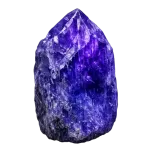
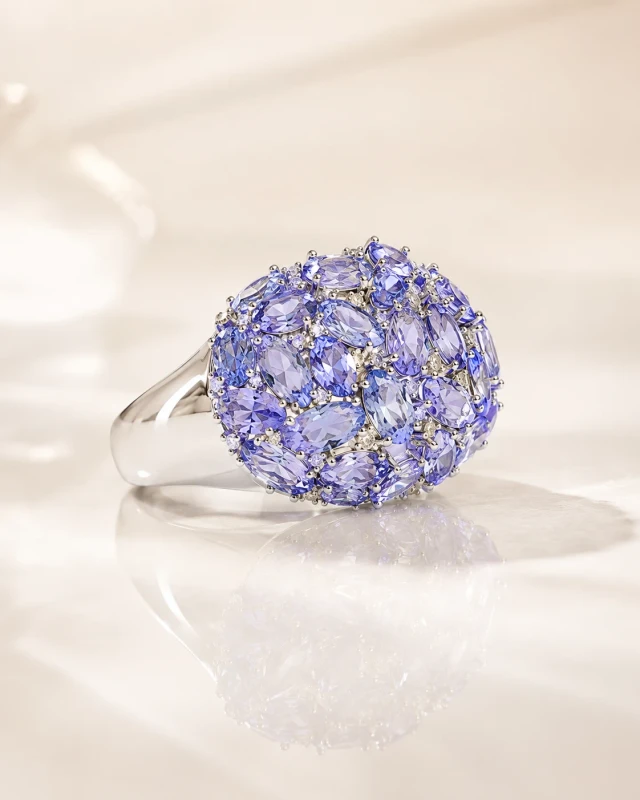
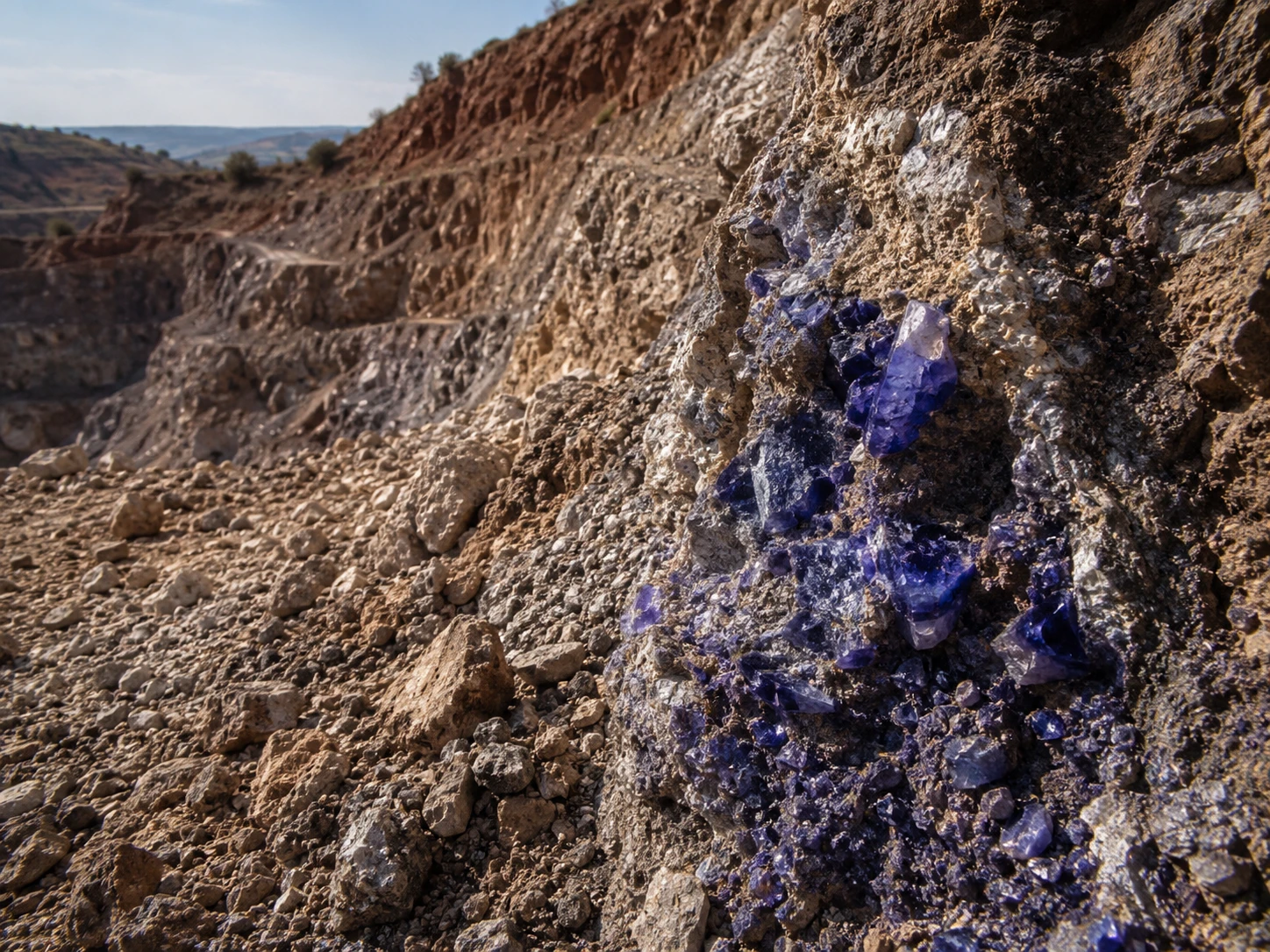



Tanzanite is one variety of a mineral called zoisite, and it has relatives. The mineral itself occurs in many colours, from colourless and grey through yellow, brown, pink and green to blue and violet. Only the transparent blue to violet material is sold as tanzanite. The others go by their own names: thulite for the opaque pink variety, anyolite or “ruby in zoisite” for the green rock studded with ruby crystals, and simply zoisite, sometimes with a colour in front, for transparent stones in greens, yellows and browns. Knowing the family explains why tanzanite behaves as it does, why some sellers stretch the name to cover its cousins, and what you are actually buying when a stone is called “fancy colour tanzanite”.
This entry sets out what zoisite is, the varieties you are likely to meet, how they compare, and where the family resemblance stops being useful.
What zoisite is
Zoisite is a calcium aluminium silicate. Geology.com gives its formula as Ca2Al3(SiO4)(Si2O7)O(OH), crystallising in the orthorhombic system, with a hardness of 6.5, a specific gravity of 3.2 to 3.4 and perfect cleavage in one direction. It forms during regional metamorphism and hydrothermal alteration, and it is found in massive form and as prismatic crystals in veins cutting schists and marbles.
It has a close twin. Clinozoisite has exactly the same chemical composition but crystallises in the monoclinic system. The two have extremely similar physical properties and can be difficult to tell apart in a hand specimen unless well-formed crystals are present; optical tests and X-ray diffraction are the reliable way to separate them. This is a useful reminder that mineral identity depends on structure as well as chemistry, which is exactly what a gemmological laboratory tests.
The colour range of zoisite as a species is wide. The same source lists colourless, grey, yellow, brown, pink, green, blue and violet. Which colour a particular crystal shows depends on trace elements and, for tanzanite, on heating. The chemistry of tanzanite’s own colour is set out in what tanzanite is made of.
| Property | Zoisite (all varieties) | What it means for jewellery |
|---|---|---|
| Composition | Ca2Al3(SiO4)(Si2O7)O(OH) | A silicate, related to epidote group minerals |
| Crystal system | Orthorhombic | Shapes the crystal and how it is oriented for cutting |
| Hardness | Around 6.5 on the Mohs scale | Softer than quartz dust at 7; scratches with daily wear |
| Cleavage | Perfect in one direction | Can split along a plane if struck; settings should protect |
| Specific gravity | 3.2 to 3.4 | Useful in identification, heavier than quartz |
| Colour range | Colourless, grey, yellow, brown, pink, green, blue, violet | Many colours, one of which is sold as tanzanite |
Tanzanite: the blue to violet variety
Tanzanite is the transparent blue to violet zoisite. Geology.com describes it as coloured by vanadium, and notes that some blue zoisite is found naturally, but most is produced by heat-treating brown zoisite, the heat changing the oxidation state of vanadium to produce the blue. The International Gem Society describes tanzanite as naturally reddish brown, achieving a stable blue to violet colour with heat treatment.
That is the key distinction between tanzanite and its cousins: tanzanite is defined by colour and transparency, and the colour is usually the product of heating. The name itself is a trade name rather than a mineral name. GIA notes the stone was only discovered in the late 1960s, and the name attached to a specific colour of a specific variety from a specific place, the Merelani area of northern Tanzania. The heating question is covered fully in is all tanzanite heat treated?, and the stone’s broader introduction in what is tanzanite?.
Vanadium also links tanzanite to another Merelani gem. The green garnet tsavorite owes its colour to the same element and comes from the same ground, a connection described in the other gem from Merelani.
Thulite: the pink zoisite
Thulite is a pink, translucent to opaque variety of zoisite. Geology.com notes it is found in Norway, Namibia, Australia, North Carolina and a few other locations, and that it is rarely seen in commercial jewellery. It is usually cut into cabochons or carved into small sculptures, since its opacity gives it nothing to gain from facets.
The International Gem Society adds that thulite is the national gemstone of Norway, that faceted pieces are rare, and that trade names for it include unionite and rosaline. For a buyer, thulite is a decorative stone, attractive in its soft, sometimes mottled pink, and valued as such. It shares tanzanite’s mineral species but none of its optical character: no transparency, no pleochroic flashes, no blue.
Anyolite: ruby in zoisite
Anyolite is a rock rather than a single crystal. Geology.com describes it as zoisite with red corundum crystals, which is ruby, often accented by black crystals of the hornblende tschermakite. The International Gem Society describes the zoisite in it as chrome-rich and green. The result is a striking green, red and black material, used for cabochons, tumbled stones, carvings and ornamental objects, and sold as specimens.
The ruby crystals in anyolite are genuine corundum, but they are typically opaque and fractured, not the transparent ruby used in fine jewellery. Anyolite is valued for its pattern and contrast as a whole, not for the rubies individually. It is an honest, attractive material at its own price level; it is simply a different thing from a faceted ruby, and a different thing from a tanzanite.
Transparent zoisite in other colours
Between the opaque varieties and tanzanite sits transparent zoisite in other colours: greens, yellows, browns, occasionally pink. The International Gem Society illustrates, for example, a faceted “wine yellow” zoisite from Tanzania, and notes that transparent gem-quality zoisites occur in many colours and can make beautiful gemstones. These stones are uncommon in mainstream jewellery and are mostly sought by collectors.
This is also where the naming problem starts. The same source warns that zoisites of other colours, green, yellow and pink, are sometimes sold as “fancy colour tanzanites”, because the tanzanite name carries more weight with the public and may command a higher price. The stones may be lovely and genuinely rare. The label is the problem, because it borrows a reputation built on blue and violet.
| Variety | Colour and transparency | Typical use | Name you should see |
|---|---|---|---|
| Tanzanite | Blue to violet, transparent | Faceted jewellery | Tanzanite |
| Transparent zoisite, other colours | Green, yellow, brown, pink, transparent | Faceted collector stones | Zoisite, with the colour stated |
| Thulite | Pink, translucent to opaque | Cabochons, carvings | Thulite |
| Anyolite | Green with red ruby and black crystals, opaque | Cabochons, carvings, specimens | Anyolite or ruby in zoisite |
| Clinozoisite | Usually grey, yellow, green or pink | Mostly mineral specimens | Clinozoisite |
When “zoisite” and “tanzanite” should not be used interchangeably
The family resemblance is real, but it has limits, and they matter most when money is involved.
A green or yellow zoisite is not a tanzanite, whatever it is called. Buyers who pay a tanzanite price for a “fancy colour tanzanite” are paying for a name that describes a different colour. If you want one of these stones, buy it as zoisite, with its colour stated plainly, and pay a price that reflects its own market rather than tanzanite’s. The listing vocabulary to watch for is covered in how to buy tanzanite online.
Nor does sharing a species mean sharing durability in every respect. All zoisite varieties share the moderate hardness and the cleavage, but a massive, opaque material such as thulite or anyolite behaves differently from a transparent faceted crystal when knocked, because it is an aggregate rather than a single crystal with one plane of weakness running through it. Care advice written for faceted tanzanite is a reasonable starting point for the others, not a guarantee.
And the family says nothing about origin. Tanzanite as a trade name is tied to Merelani, but zoisite occurs in many places, and thulite, for instance, comes from several countries. Where a zoisite came from is a separate question, and for tanzanite itself, as our entry on whether a tanzanite’s origin can be proven explains, the answer rests on the fact that gem tanzanite comes from one deposit.
Telling the varieties apart, and where the eye stops
Some of the family can be told apart at a glance. Anyolite, with its green body, red crystals and black flecks, looks like nothing else in a jewellery case. Thulite’s opaque pink sets it apart from any transparent stone. A faceted blue to violet stone showing different colours as it turns is the look that defines tanzanite.
Beyond those obvious cases, the eye reaches its limit quickly. A transparent green or yellow zoisite can resemble several other green or yellow gems, and a blue to violet stone can resemble tanzanite without being zoisite at all. Clinozoisite and zoisite, as Geology.com notes, can be difficult to tell apart even for specialists without optical tests or X-ray diffraction. Colour, transparency and pattern narrow the possibilities; they do not settle them.
The practical rule is therefore simple. Use your eye to decide what you like, and use a laboratory to decide what it is. For a decorative carving of thulite or a cabochon of anyolite at a modest price, a reputable seller’s description is usually enough. For a faceted stone sold as tanzanite, or any zoisite at a meaningful price, ask for a report that names the species and variety. A report that says “zoisite” and describes the colour is telling you something a listing that says “fancy tanzanite” may not.
Wearing the relatives
Everything in the family shares the moderate hardness, so none of it enjoys hard wear. The differences come from how each variety is cut and used.
Cabochons, the usual cut for thulite and anyolite, have smooth domed surfaces and no sharp facet junctions, so there are fewer edges to chip. That makes a cabochon pendant or pair of earrings a comfortable way to wear these materials. Rings are more exposed, as with any soft stone, and are best worn with some care or chosen in protective settings. Carvings and specimens are display pieces and should be treated as such, kept away from harder objects on a shelf rather than handled daily.
Cleaning follows the same gentle logic as tanzanite. GIA’s advice for tanzanite is that warm, soapy water is always safe and that ultrasonic and steam cleaners are never recommended. Applied to the rest of the family, that is a sensible default: a soft brush, mild soap, lukewarm water, and a soft cloth to dry. Material with visible fractures deserves even gentler handling, and is better wiped than soaked.
Collecting beyond tanzanite
For anyone drawn to tanzanite as a mineral as well as a jewel, the wider zoisite family is an affordable and interesting field. Thulite and anyolite are generally sold at decorative stone prices, and well-made cabochons, beads and carvings are easy to find. Transparent zoisites in other colours are rarer and more of a collector’s pursuit, and small faceted examples are the usual way in.
A few habits make such a collection more satisfying. Buy pieces labelled with their variety and, where known, their locality, since a thulite from Norway and one from elsewhere are the same mineral with different stories. Keep a note of each piece’s weight, size and source. And treat marketing names cautiously in both directions: a stone called “pink tanzanite” is a zoisite with a borrowed name, while a stone correctly labelled thulite or anyolite is being described honestly, and is often the better buy for it.
Why the family matters to a tanzanite buyer
For most people buying a tanzanite, the zoisite family is background. But three practical points follow from it.
First, it explains the stone’s behaviour. Tanzanite’s moderate hardness and its cleavage are properties of zoisite, not quirks of one stone. Knowing that makes the care advice less arbitrary: a tanzanite is treated gently because the whole species is soft enough to scratch and apt to split.
Second, it explains why identification matters. Tanzanite, other zoisites and clinozoisite share chemistry, and some imitations of tanzanite are entirely different materials. A laboratory report settles identity, variety and, where possible, treatment, in a way that no seller’s description can.
Third, it gives you vocabulary. When a stone is called “fancy colour tanzanite”, “green tanzanite” or “pink tanzanite”, you now know to ask what it is in mineral terms, whether it is transparent zoisite of another colour, and whether the price reflects that. The answer is not a reason to avoid the stone; it is a reason to buy it for what it is.
Where to start
Think of tanzanite as the best known member of a larger family. Zoisite is a calcium aluminium silicate with moderate hardness and one perfect cleavage, found in many colours. Tanzanite is its transparent blue to violet variety, usually heated to that colour. Thulite is the opaque pink variety, anyolite the green rock with ruby, and transparent green, yellow or pink stones are zoisite, whatever a listing calls them. Enjoy the relatives for what they are, and when you are buying a tanzanite, make sure the stone, the name and the price all describe the same thing.
COMMON QUESTIONS
Is tanzanite the same as zoisite?
Tanzanite is a variety of zoisite: the transparent blue to violet material. All tanzanite is zoisite, but most zoisite is not tanzanite, since the mineral also occurs in colourless, grey, yellow, brown, pink and green.
What is thulite?
Thulite is a pink, translucent to opaque variety of zoisite, usually cut as cabochons or carved. The International Gem Society notes it is the national gemstone of Norway; it is also found in Namibia, Australia and North Carolina.
What is anyolite or ruby in zoisite?
Anyolite is a rock of green zoisite containing opaque ruby crystals and often black hornblende. It is used for cabochons, carvings and specimens and is valued for its pattern, not for the rubies individually.
Is green tanzanite real tanzanite?
Stones sold as green, yellow or pink tanzanite are transparent zoisite of other colours. They can be attractive and rare, but the tanzanite name belongs to the blue to violet variety, so buy them as zoisite and at their own market price.
SOURCES
- Zoisite Gems: Tanzanite, Anyolite, Ruby in Zoisite, Thulite — Geology.com Formula, orthorhombic system, Mohs 6.5, SG 3.2 to 3.4, perfect cleavage one direction; colour range; clinozoisite polymorph; thulite localities; anyolite composition; most blue zoisite heated from brown.
- Tanzanite Value, Price, and Jewelry Information — International Gem Society Naturally reddish brown, heated to blue violet; thulite national gemstone of Norway, trade names unionite and rosaline; ruby in zoisite with chrome-rich green zoisite; fancy colour tanzanite naming.
- Tanzanite Quality Factors — GIA Tanzanite only discovered in the late 1960s.
- Tanzanite Care and Cleaning Guide — GIA Hardness and cleavage of zoisite (tanzanite).